
Home / Birds / Ducks, geese and swans / Domestic goose (graylag)
No federal permit to keepDomestic goose (graylag)
Anser anser
Birds › Ducks, geese and swans (Anseriformes) › Anatidae (Ducks, geese and swans)
The greylag goose (Anser anser) is a species of large goose in the waterfowl family Anatidae and the type species of the genus Anser.

Care at a glance
Species-specific values
Values researched for this exact species. Air, surface and water temperatures are listed separately, and each source is kept as published rather than averaged.
| Minimum enclosure | About 6 square feet per goose is the commonly recommended minimum space. Source: cwrescue.org | |
| Diet | Feed high-quality waterfowl or goose pellets, with daily access to safe grazing; offer grit to confined or young geese and calcium to laying females. Source: cwrescue.org | |
| Feeding frequency | Generally provide about 1 to 2 cups of feed per bird per day, especially in winter or when foraging is limited. Source: cwrescue.org | |
| Social housing | Provide social interaction with other geese or gentle human interaction. Source: cwrescue.org |
Understanding the animal
About this animal
About this animal
It has mottled and barred grey and white plumage and an orange beak and pink legs. A large bird, it measures between 74 and 91 centimetres (29 and 36 in) in length, with an average weight of 3.3 kilograms (7 lb 4 oz).
From Wikipedia: Greylag goose, CC BY-SA 4.0 (excerpt)
In the wild
In the wild
Researched for this exact species, not its family. Wild conditions are context, not enclosure settings.1234
| Where it lives | Wild greylag geese breed in Eurasian marshes, fens and islands with protective vegetation. Outside breeding they use pastures and stubble fields alongside freshwater wetlands, salt marshes and estuaries; domestic graylag geese belong to this species. |
| Ground it lives on | Grassy soil, crop stubble and muddy vegetated wetland margins |
| Water it lives in | Freshwater marshes and lakes, with brackish estuaries and saltwater marshes outside breeding. No universal chemistry or water-temperature range is established. |
| Active | Cathemeral; feeding flights occur morning and evening and sometimes midday or night |
| Social life | Family groups and large flocks; pair bonds and family associations structure groups. |
| Wild diet | Grasses, marsh-plant rhizomes and roots, spilled grain and root crops, with some small aquatic animals. |
| Behavior to plan for | It commutes between water and feeding fields, and wild populations may migrate. Ground grazing is a major feeding behavior. |
Native climate (measured)
Native climate (measured)
| Warm-season highs | about 73°F (up to 77°F in the hottest sampled areas) |
| Cool-season lows | about 31°F (down to 26°F in the coldest sampled areas) |
| Average temperature | 47–51°F across sampled records |
| Relative humidity | 77–80% on average (driest month about 70%) |
| Rainfall | about 782 mm a year, spread fairly evenly |
| Winters | Cool to cold winters (lows around 31°F) in much of its native range. Seasonal slowdown may be relevant, but species-specific biology determines whether brumation or hibernation occurs. |
Measured at 131 wild occurrence records sampled against WorldClim 2.1 climate data (1970–2000 averages). Air conditions in the range are ecological context, not enclosure settings: microhabitats such as burrows, leaf litter or basking rocks can be cooler, warmer or more humid.
Profile
Profile
Researched for this exact species. Sources are listed under In the wild above.
History
Greylag geese have a long association with people and are the ancestors of most domestic goose breeds. Domestication occurred at least by 1360 BCE.
Data and studies
The numbers
The numbers
Each bar is what one source reports. Where several sources weigh in, the dashed gold band marks their average.
Maximum recorded lifespan
Longest recorded lifespan reported by each database; typical lifespans are usually shorter. The AnAge record comes from an animal in human care.
Typical adult weight
Average adult body mass in each database (FishBase gives the maximum recorded weight).
Incubation
Female maturity
Veterinary & husbandry research
Veterinary & husbandry research
- Stress assessment in captive greylag geese (Anser anser) Scheiber IB et al., Journal of animal science 2015
- Protective efficacy of a recombinant subunit West Nile virus vaccine in domestic geese (Anser anser) Jarvi SI et al., Vaccine 2008
Peer-reviewed papers that mention this species alongside captivity, zoos, veterinary care or aquaculture. Some cover several species or mention it only in passing, so check the abstract. See all 22 on PubMed → PubMed
Sources for this sheet
- AnAge: The Animal Ageing and Longevity Database (Human Ageing Genomic Resources) (CC BY 3.0) Peer-reviewed researchCurated, referenced longevity and life-history records for thousands of species; maximum lifespans are often from zoo animals.
- Myhrvold et al. (2015). An amniote life-history database. Ecology 96: 3109 Peer-reviewed researchPeer-reviewed compilation of life-history data for over 21,000 birds, mammals and reptiles.
- GBIF Backbone Taxonomy (Global Biodiversity Information Facility) (CC BY 4.0) Peer-reviewed researchInternational scientific taxonomy used here for classification. GBIF Secretariat (2023). GBIF Backbone Taxonomy. Checklist dataset https://doi.org/10.15468/39omei, accessed via GBIF.org.
- Species+ (UNEP-WCMC and the CITES Secretariat) Zoo, university or veterinaryThe official database of species listed under CITES. UNEP (2026). The Species+ Website. Nairobi, Kenya. Compiled by UNEP-WCMC, Cambridge, UK. Available at: www.speciesplus.net. [Accessed 04/10/2026].
- Wikipedia (species article) (CC BY-SA 4.0) Community referenceFree encyclopedia; useful overviews with their own citations. Short excerpts are quoted under CC BY-SA 4.0, each credited with a link to its article.
- PubMed (U.S. National Library of Medicine) Peer-reviewed researchIndex of peer-reviewed veterinary, zoo and husbandry research.
- iNaturalist (captive observations) Community referenceCommunity observation platform run by the California Academy of Sciences and National Geographic; observations marked captive show animals living in homes, zoos and aquariums.
More ducks, geese and swans
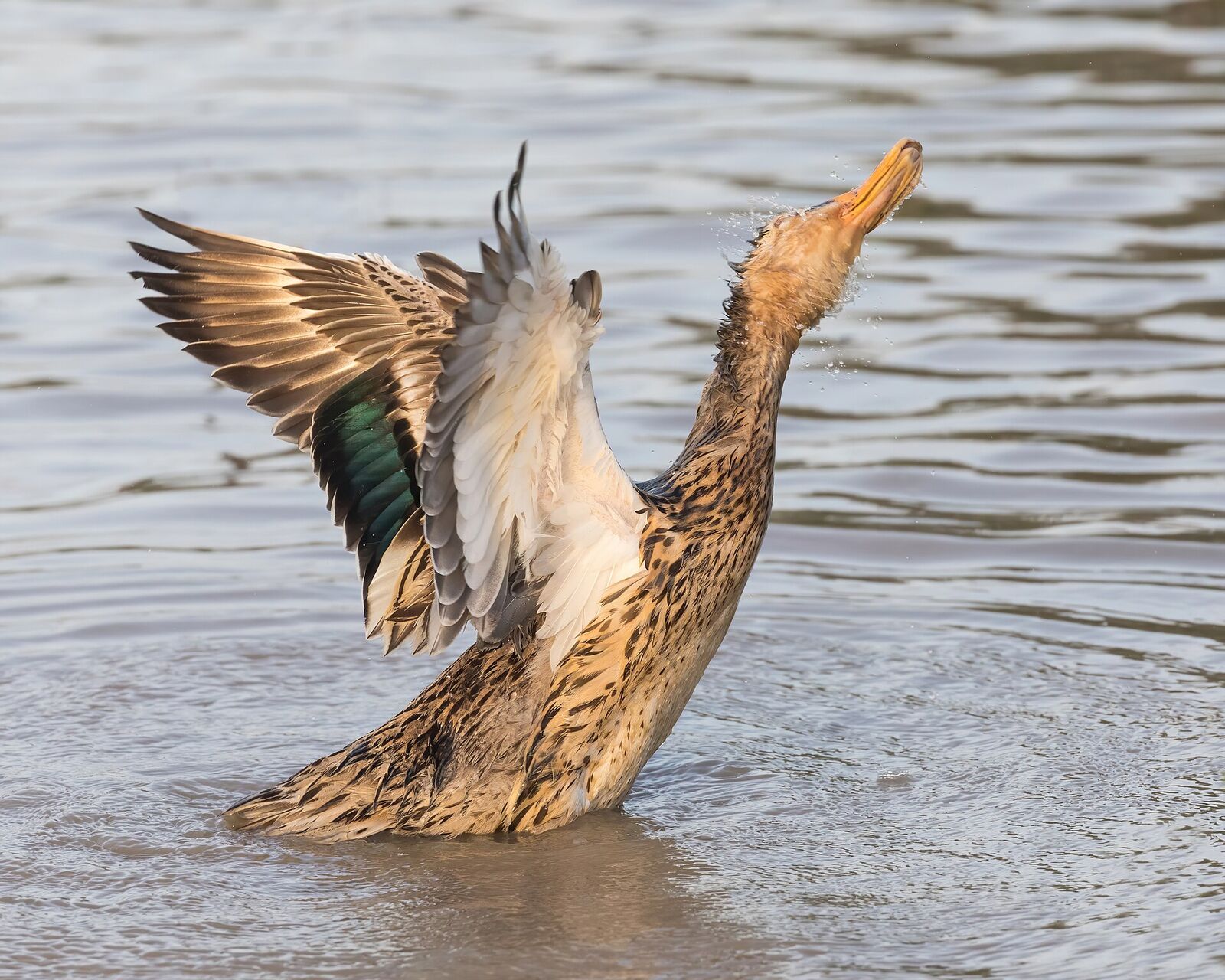
Domestic duck (mallard)
Anas platyrhynchos
Messy, hardy and happiest near water.
Farm & ranch

Baer's pochard
Aythya baeri
Aviary

Bernier's teal
Anas bernieri
Aviary

Black scoter
Melanitta americana
Aviary

Brazilian teal
Amazonetta brasiliensis
Aviary

Comb duck
Sarkidiornis sylvicola
Aviary