
Home / Birds / Ducks, geese and swans / Fulvous whistling duck
Some federal rules applyFulvous whistling duck
Dendrocygna bicolor
Birds › Ducks, geese and swans (Anseriformes) › Anatidae (Ducks, geese and swans)
The fulvous whistling duck or fulvous tree duck (Dendrocygna bicolor) is a species of whistling duck that breeds across the world's tropical regions in much of Mexico and South America, the West Indies, the southern United States, sub-Saharan Africa…

Care at a glance
Species-specific values
Values researched for this exact species. Air, surface and water temperatures are listed separately, and each source is kept as published rather than averaged.
| Minimum enclosure | Keep in a large area so other birds have room to escape; provide a sizeable pond and secluded area. Source: sierwatervogels.nl | |
| Night temperature | Provide frost-free night quarters for winter. Source: sierwatervogels.nl | |
| Bathing water (ducklings) | Ducklings initially need warm water for bathing. Source: sierwatervogels.nl | |
| Diet | Feed wheat, standard pellets, green foods, and bread. Source: sierwatervogels.nl | |
| Social housing | Keep whistling-duck species in separate enclosures to avoid hybridisation. Source: sierwatervogels.nl | |
| Substrate | Provide plenty of ground cover and/or straw to stand on. Source: sierwatervogels.nl |
Understanding the animal
About this animal
About this animal
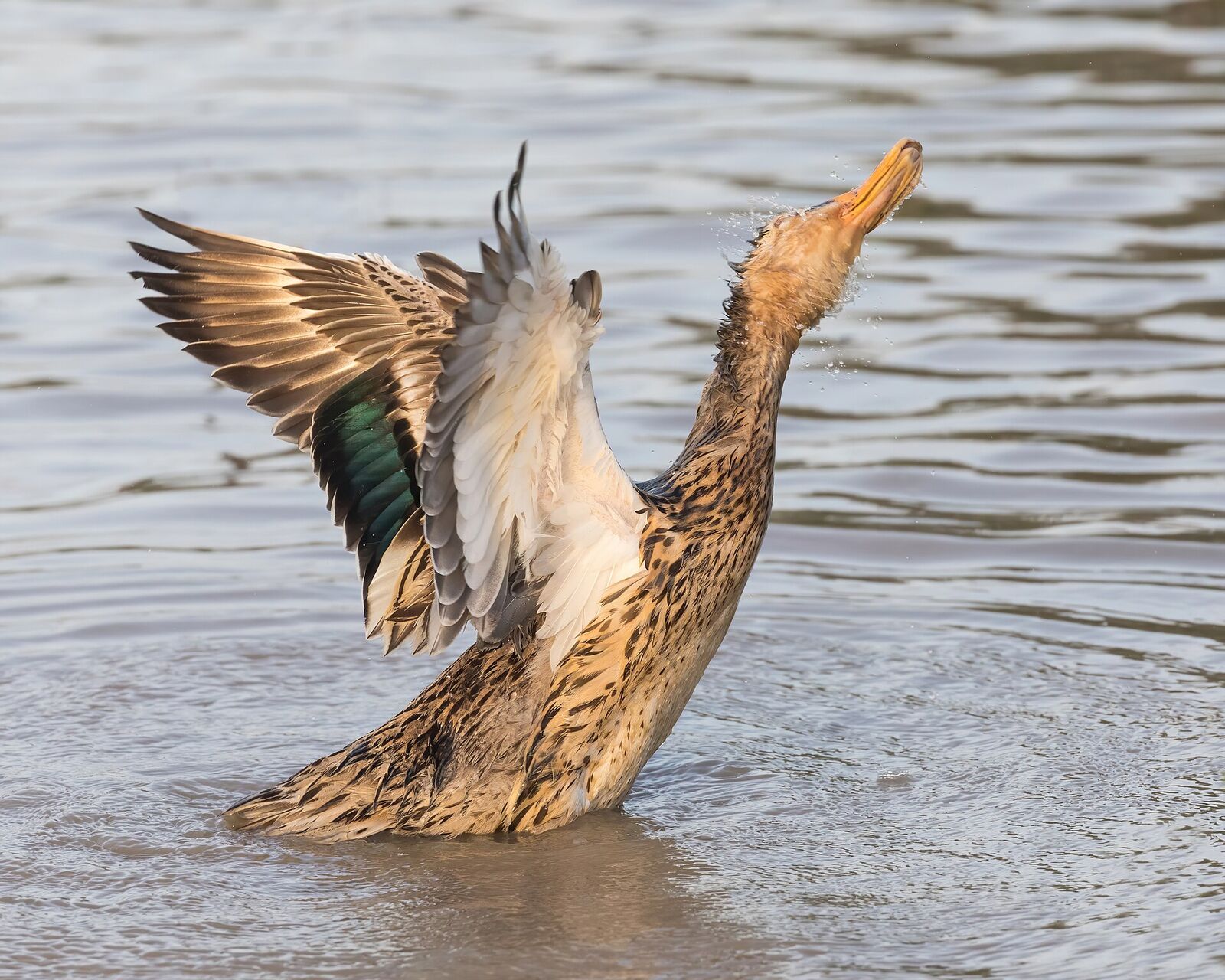
It has plumage that is mainly reddish brown, long legs and a long grey bill, and shows a distinctive white band across its black tail in flight. Like other members of its ancient lineage, it has a whistling call which is given in flight or on the ground.
From Wikipedia: Fulvous whistling duck, CC BY-SA 4.0 (excerpt)
In the wild
In the wild
Researched for this exact species, not its family. Wild conditions are context, not enclosure settings.1
| Where it lives | Vegetated shallow wetlands across parts of the Americas, Africa and southern Asia; the North American population uses flooded rice fields, marshes and slow rivers. Nests among emergent plants or on floating vegetation. |
| Ground it lives on | Wet mud, reed beds and vegetated wetland margins. |
| Social life | Flocks outside nesting; breeding pairs defend nests rather than broad territories, and both parents tend young. |
| Wild diet | Rice and other grass or sedge seeds, aquatic-plant seeds and algae; smaller amounts of worms, aquatic insects, larvae and mollusks. |
| Behavior to plan for | Strains seeds and small prey from fine mud, and also tips up or dives. Flight-feather molt temporarily prevents flight. |
Native climate (measured)
Native climate (measured)
| Warm-season highs | about 88°F (up to 94°F in the hottest sampled areas) |
| Cool-season lows | about 44°F (down to 34°F in the coldest sampled areas) |
| Average temperature | 61–77°F across sampled records |
| Relative humidity | 56–74% on average (driest month about 61%) |
| Rainfall | about 752 mm a year |
Measured at 118 wild occurrence records sampled against WorldClim 2.1 climate data (1970–2000 averages). Air conditions in the range are ecological context, not enclosure settings: microhabitats such as burrows, leaf litter or basking rocks can be cooler, warmer or more humid.
Data and studies
The numbers
The numbers
Each bar is what one source reports. Where several sources weigh in, the dashed gold band marks their average.
Maximum recorded lifespan
Longest recorded lifespan reported by each database; typical lifespans are usually shorter.
Typical adult weight
Average adult body mass in each database (FishBase gives the maximum recorded weight).
Clutch size
Average per litter or clutch.
Incubation
Female maturity
Sources for this sheet
- AnAge: The Animal Ageing and Longevity Database (Human Ageing Genomic Resources) (CC BY 3.0) Peer-reviewed researchCurated, referenced longevity and life-history records for thousands of species; maximum lifespans are often from zoo animals.
- Myhrvold et al. (2015). An amniote life-history database. Ecology 96: 3109 Peer-reviewed researchPeer-reviewed compilation of life-history data for over 21,000 birds, mammals and reptiles.
- Species+ (UNEP-WCMC and the CITES Secretariat) Zoo, university or veterinaryThe official database of species listed under CITES. UNEP (2026). The Species+ Website. Nairobi, Kenya. Compiled by UNEP-WCMC, Cambridge, UK. Available at: www.speciesplus.net. [Accessed 04/10/2026].
- USFWS International Affairs: CITES Zoo, university or veterinaryFederal agency that issues CITES permits.
- 50 CFR 21.48: Permit exceptions for captive-bred migratory waterfowl Zoo, university or veterinaryCurrent federal rule letting people keep marked, captive-bred waterfowl without a permit.
- 50 CFR 10.13: List of migratory birds Zoo, university or veterinaryCurrent federal regulation listing birds protected by the Migratory Bird Treaty Act.
- GBIF Backbone Taxonomy (Global Biodiversity Information Facility) (CC BY 4.0) Peer-reviewed researchInternational scientific taxonomy used here for classification. GBIF Secretariat (2023). GBIF Backbone Taxonomy. Checklist dataset https://doi.org/10.15468/39omei, accessed via GBIF.org.
- Wikipedia (species article) (CC BY-SA 4.0) Community referenceFree encyclopedia; useful overviews with their own citations. Short excerpts are quoted under CC BY-SA 4.0, each credited with a link to its article.
- iNaturalist (captive observations) Community referenceCommunity observation platform run by the California Academy of Sciences and National Geographic; observations marked captive show animals living in homes, zoos and aquariums.
More ducks, geese and swans
Domestic duck (mallard)
Anas platyrhynchos
Messy, hardy and happiest near water.
Farm & ranch

Baer's pochard
Aythya baeri
Aviary

Bernier's teal
Anas bernieri
Aviary

Black scoter
Melanitta americana
Aviary

Brazilian teal
Amazonetta brasiliensis
Aviary

Comb duck
Sarkidiornis sylvicola
Aviary