
Home / Invertebrates / Cockroaches / Dubia (Argentine wood) roach
No federal permit to keepDubia (Argentine wood) roach
Blaptica dubia
Invertebrates › Cockroaches (Blattodea) › Blaberidae (Hissing and feeder roaches)
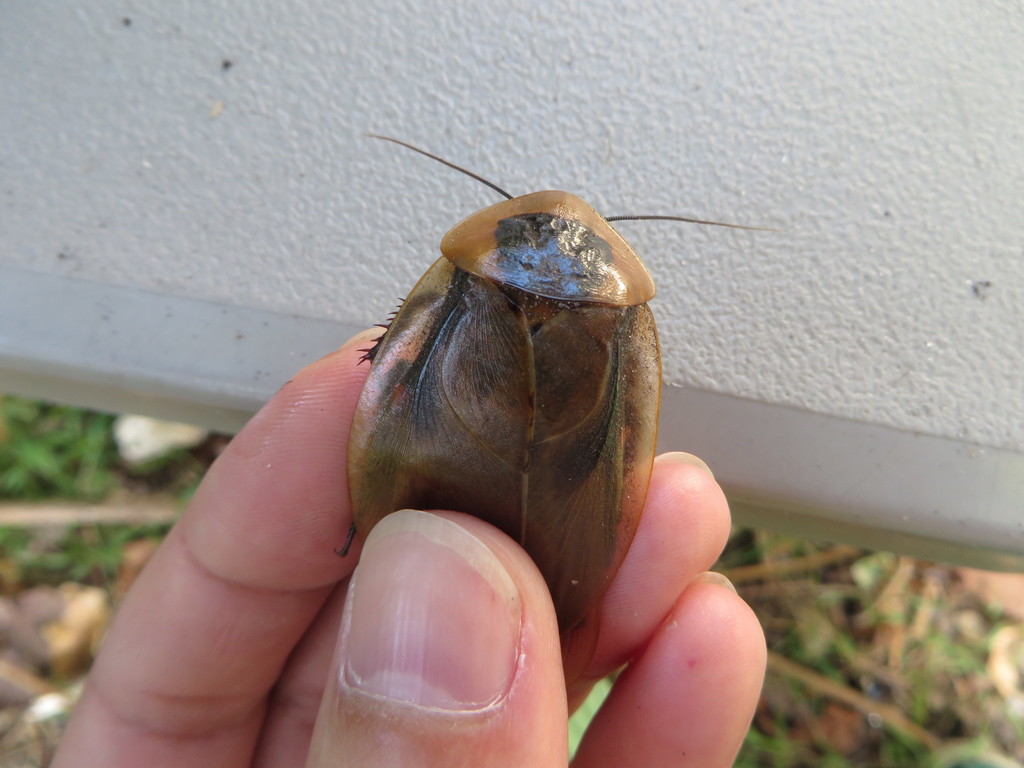
Blaptica dubia, the dubia roach, orange-spotted roach, Guyana spotted roach, or Argentinian wood roach, is a medium-sized species of cockroach which grows to around 40–45 mm (1.6–1.8 in).
From Wikipedia: Blaptica dubia, CC BY-SA 4.0 (excerpt)

Care at a glance
Species-specific values
Values researched for this exact species. Air, surface and water temperatures are listed separately, and each source is kept as published rather than averaged.
| Minimum enclosure | A small starter colony can use a tub around 40–60 l. Source: academy.herpeton.net | |
| Warm side air temperature | 82–90 °F (28–32 °C) Source: academy.herpeton.net | |
| Warm side air temperature | 75–82 °F (24–28 °C) Source: academy.herpeton.net | |
| Cool side air temperature | 72 °F (up to 22 °C) Source: academy.herpeton.net | |
| Diet | Offer dry base foods with fresh plant foods; gut-load before feeding to reptiles or amphibians. Source: academy.herpeton.net | |
| Feeding frequency | Gut-load roaches for 24–48 hours before feeding them to reptiles or amphibians. Source: academy.herpeton.net | |
| Social housing | Start with a male to three to five adult females, adding mixed nymph sizes. Source: academy.herpeton.net | |
| Substrate | Use a dry floor with no loose wet bedding. Source: academy.herpeton.net | |
| Uvb lighting | UVB and bright light are unnecessary; normal room day-night rhythm is enough. Source: academy.herpeton.net |
Understanding the animal
In the wild
In the wild
Researched for this exact species, not its family. Wild conditions are context, not enclosure settings.123
| Where it lives | South America; published ecological background associates this species with tropical rainforest soil communities. Detailed wild microhabitat observations are scarce. |
| Climate | Published background describes warm, humid habitats; numerical wild temperature and relative humidity ranges were not established. |
| Social life | Reported to live in aggregations; wild territorial organization is poorly documented. |
| Wild diet | Vegetative matter is reported; a detailed field-verified list of wild food items was not established. |
Native climate (measured)
Native climate (measured)
| Warm-season highs | about 85°F (up to 89°F in the hottest sampled areas) |
| Cool-season lows | about 42°F (down to 36°F in the coldest sampled areas) |
| Average temperature | 57–64°F across sampled records |
| Relative humidity | 70–76% on average (driest month about 63%) |
| Rainfall | about 969 mm a year, spread fairly evenly |
Measured at 88 wild occurrence records sampled against WorldClim 2.1 climate data (1970–2000 averages). Air conditions in the range are ecological context, not enclosure settings: microhabitats such as burrows, leaf litter or basking rocks can be cooler, warmer or more humid.
Sources for this sheet
- GBIF Backbone Taxonomy (Global Biodiversity Information Facility) (CC BY 4.0) Peer-reviewed researchInternational scientific taxonomy used here for classification. GBIF Secretariat (2023). GBIF Backbone Taxonomy. Checklist dataset https://doi.org/10.15468/39omei, accessed via GBIF.org.
- Wikipedia (species article) (CC BY-SA 4.0) Community referenceFree encyclopedia; useful overviews with their own citations. Short excerpts are quoted under CC BY-SA 4.0, each credited with a link to its article.
- iNaturalist (captive observations) Community referenceCommunity observation platform run by the California Academy of Sciences and National Geographic; observations marked captive show animals living in homes, zoos and aquariums.
More hissing and feeder roaches

Death's head cockroach
Blaberus craniifer
Pet trade
Discoid roach
Blaberus discoidalis
Pet trade
Giant Cave Cockroach
Blaberus giganteus
Pet trade

Giant burrowing cockroach
Macropanesthia rhinoceros
Pet trade

Grandidier's giant Madagascan hissing cockroach
Gromphadorhina grandidieri
Pet trade

Madagascar hissing cockroach
Gromphadorhina portentosa
Pet trade