
Home / Invertebrates / Cockroaches / Madagascar hissing cockroach
No federal permit to keepMadagascar hissing cockroach
Gromphadorhina portentosa
Invertebrates › Cockroaches (Blattodea) › Blaberidae (Hissing and feeder roaches)
The Madagascar hissing cockroach (Gromphadorhina portentosa), also known as the hissing cockroach, Malagasy hissing cockroach or simply hisser, is one of the largest species of cockroach, reaching 5 to 7.5 centimetres (2 to 3 inches) at maturity.

Care at a glance
Species-specific values
Values researched for this exact species. Air, surface and water temperatures are listed separately, and each source is kept as published rather than averaged.
| Diet | Can eat varied fruits and vegetables, or commercially available insect gut load; needs constant access to food and water. Source: thetyedyediguana.com | |
| Substrate | Absorbent peat moss or coconut fiber can help maintain humidity; a bare bottom is another option for easier cleaning. Source: thetyedyediguana.com | |
| Enclosure temperature | 75–90 °F Source: thetyedyediguana.com | |
| Uvb lighting | UVB or other light sources are not needed. Source: thetyedyediguana.com | |
| Humidity | 60–70 % Source: thetyedyediguana.com |
Understanding the animal
About this animal
About this animal
They are native to the island of Madagascar, where they are commonly found in rotting logs. It is one of some 20 known species of large hissing roaches from Madagascar, many of which are kept as pets, and often confused with one another by pet dealers; in particular, G. portentosa is commonly confused with G. oblongonota and G. picea.
From Wikipedia: Madagascar hissing cockroach, CC BY-SA 4.0 (excerpt)
In the wild
In the wild
Researched for this exact species, not its family. Wild conditions are context, not enclosure settings.1
| Where it lives | Tropical lowland forest in Madagascar, where it shelters and feeds in dry litter on the forest floor. |
| Ground it lives on | Dry leaf litter and decaying plant debris. |
| Active | Nocturnal; avoids light. |
| Social life | Females and nymphs are social; adult males defend small territories and contest access using displays. |
| Wild diet | Decaying plant matter and fallen fruit, with smaller insects and animal carrion. |
| Behavior to plan for | Produces hisses by forcing air through abdominal spiracles, including alarm and courtship signals. Males use pronotal humps in contests. |
Native climate (measured)
Native climate (measured)
| Warm-season highs | about 93°F (up to 94°F in the hottest sampled areas) |
| Cool-season lows | about 55°F (down to 51°F in the coldest sampled areas) |
| Average temperature | 72–77°F across sampled records |
| Relative humidity | 69–70% on average (driest month about 66%) |
| Rainfall | about 575 mm a year, with strong wet and dry seasons |
Measured at 58 wild occurrence records sampled against WorldClim 2.1 climate data (1970–2000 averages). Air conditions in the range are ecological context, not enclosure settings: microhabitats such as burrows, leaf litter or basking rocks can be cooler, warmer or more humid.
Data and studies
Researched care notes
Researched care notes
Findings checked against veterinary, zoo, welfare, keeper and peer-reviewed sources. Air, basking-surface and water temperatures are kept separate, and where sources disagree both are shown. “Study” notes report what a paper measured, not a universal rule.
Madagascar Hissing Cockroach
- Use a securely closed, ventilated enclosure; Gromphadorhina portentosa can climb glass and other smooth surfaces.1
- Provide shaded retreats, hiding substrate and structures that increase usable surface area.1
- Air / context: OSU recommends placing the enclosure in a 72–76°F (22.2–24.4°C) location; its discussion of warmer breeding conditions is not a requirement to maximize heat for every pet.1
- Offer suitable dry food with modest fresh-food portions, and remove leftovers before fermentation or decay contaminates the enclosure.1
- Provide drinking access without a drowning hazard for small nymphs; OSU describes a protected reservoir with an absorbent wick.1
- Do not handle a newly molted white cockroach until its exoskeleton hardens.1
- Avoid pulling a firmly gripping cockroach off a surface; its hooked feet can be injured.1
Veterinary & husbandry research
Veterinary & husbandry research
- Allergenicity of the Madagascar hissing cockroach Morgan MS et al., Annals of allergy, asthma & immunology: official publication of the American College of Allergy, Asthma, & Immunology 2007
- Diagnostic imaging in terrestrial invertebrates: Madagascar hissing cockroach (Gromphadorhina portentosa), desert millipede (Orthoporus sp.), emperor scorpion (Pandinus imperator), Chilean rosehair tarantula (Grammostola spatulata), Mexican fireleg tarantula (Brachypelma boehmei), and Mexican redknee tarantula (Brachypelma smithi) Davis MR et al., Zoo biology 2008
- The giant Madagascar hissing-cockroach (Gromphadorhina portentosa) as a source of antagonistic moulds: concerns arising from its use in a public setting Yoder JA et al., Mycoses 2008
Peer-reviewed papers that mention this species alongside captivity, zoos, veterinary care or aquaculture. Some cover several species or mention it only in passing, so check the abstract. See all 10 on PubMed → PubMed
Sources for this sheet
- Clint's Reptiles (YouTube): Giant Hissing Cockroach, The Best Pet Invertebrate? Expert educator & keeperClint Laidlaw, PhD in Biology Education and MS in Evolutionary Ecology; owner of Clint's Reptile Room and a longtime keeper. His "Best Pet?" series reviews each species' care in depth.
- GBIF Backbone Taxonomy (Global Biodiversity Information Facility) (CC BY 4.0) Peer-reviewed researchInternational scientific taxonomy used here for classification. GBIF Secretariat (2023). GBIF Backbone Taxonomy. Checklist dataset https://doi.org/10.15468/39omei, accessed via GBIF.org.
- Wikipedia (species article) (CC BY-SA 4.0) Community referenceFree encyclopedia; useful overviews with their own citations. Short excerpts are quoted under CC BY-SA 4.0, each credited with a link to its article.
- PubMed (U.S. National Library of Medicine) Peer-reviewed researchIndex of peer-reviewed veterinary, zoo and husbandry research.
- iNaturalist (captive observations) Community referenceCommunity observation platform run by the California Academy of Sciences and National Geographic; observations marked captive show animals living in homes, zoos and aquariums.
More hissing and feeder roaches

Death's head cockroach
Blaberus craniifer
Pet trade
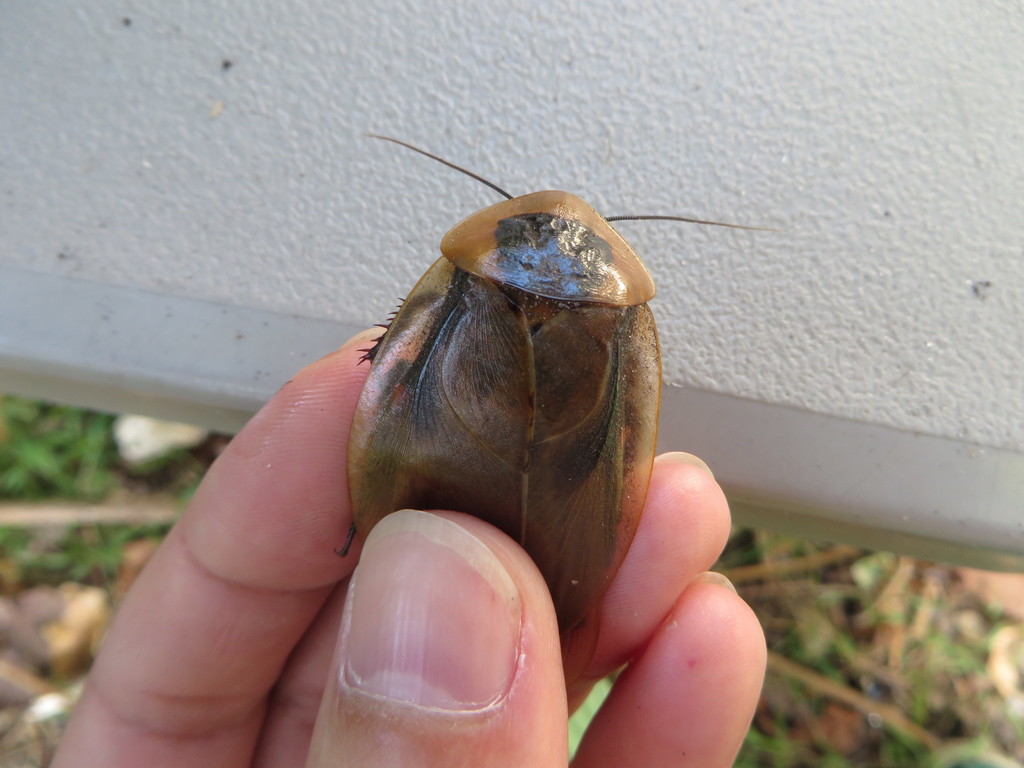
Discoid roach
Blaberus discoidalis
Pet trade

Dubia (Argentine wood) roach
Blaptica dubia
Pet trade
Giant Cave Cockroach
Blaberus giganteus
Pet trade

Giant burrowing cockroach
Macropanesthia rhinoceros
Pet trade

Grandidier's giant Madagascan hissing cockroach
Gromphadorhina grandidieri
Pet trade