
Home / Invertebrates / Cockroaches / Giant burrowing cockroach
No federal permit to keepGiant burrowing cockroach
Macropanesthia rhinoceros
Invertebrates › Cockroaches (Blattodea) › Blaberidae (Hissing and feeder roaches)
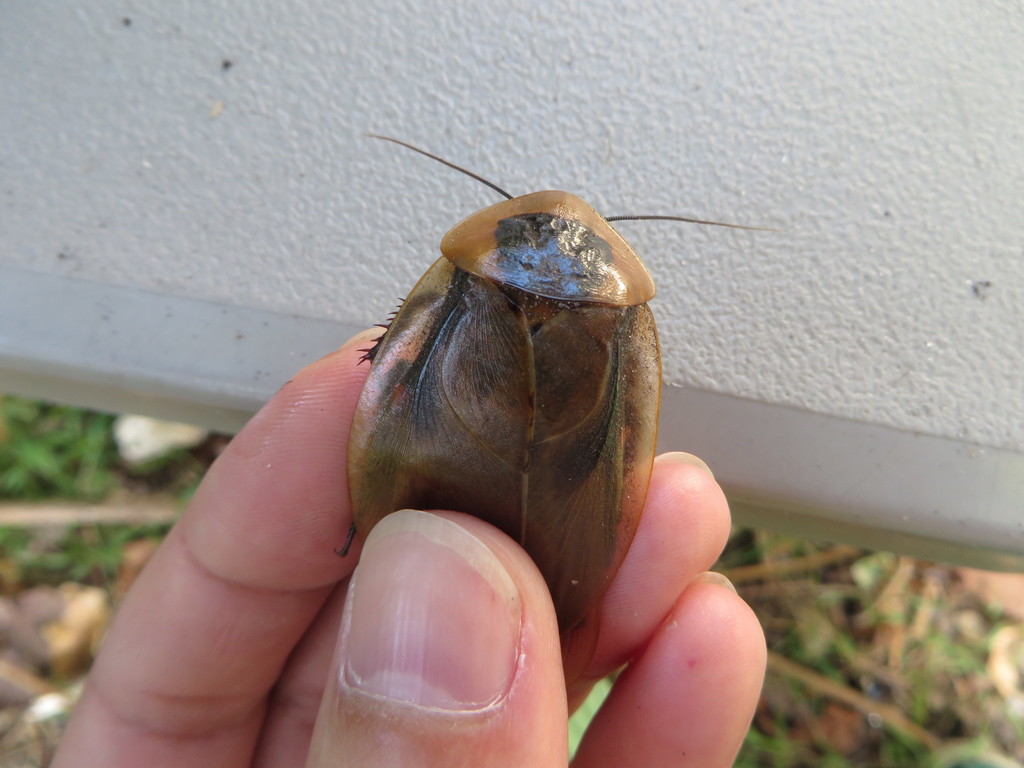
The giant burrowing cockroach (Macropanesthia rhinoceros), also known as the rhinoceros cockroach and Queensland giant cockroach, is a large cockroach native to Australia, found mostly tropical and subtropical parts of Queensland.
From Wikipedia: Giant burrowing cockroach, CC BY-SA 4.0 (excerpt)

Care at a glance
Species-specific values
Values researched for this exact species. Air, surface and water temperatures are listed separately, and each source is kept as published rather than averaged.
| Minimum enclosure | At least 10 x 10 inches of surface area and a few inches high. Source: invertebratedude.com | |
| Humidity | Keep about half the enclosure moist and the rest relatively dry. Source: invertebratedude.com | |
| Diet | Keep decaying hardwood leaves available at all times; offer roach feed, fruits, and vegetables. Source: invertebratedude.com | |
| Feeding frequency | Offer dog, cat, or chick feed, fruits, and vegetables at least weekly, preferably twice weekly. Source: invertebratedude.com | |
| Enclosure temperature | 70–77 °F Source: invertebratedude.com |
Understanding the animal
About this animal
About this animal
They are the world's heaviest species of cockroach and can weigh up to 30-35 grams and measure up to 7.5-8 cm (3.1 in) in length. It is a member of the family Blaberidae, which contains hundreds of species.
From Wikipedia: Giant burrowing cockroach, CC BY-SA 4.0 (excerpt)
In the wild
In the wild
| Overview | The giant burrowing cockroach (Macropanesthia rhinoceros), also known as the rhinoceros cockroach and Queensland giant cockroach, is a large cockroach native to Australia, found mostly tropical and subtropical parts of Queensland. They are the world's heaviest species of cockroach and can weigh up to 30-35 grams and measure up to 7.5-8 cm in length. It is a member of the family Blaberidae, which contains hundreds of species. It is part of the blaberid subfamily Geoscapheinae. — From Wikipedia: Giant burrowing cockroach, CC BY-SA 4.0 (excerpt) |
| Where it lives | The giant burrowing cockroach species are mostly found in Queensland, Australia. It is commonly found along the coastal stretch between Rockhampton and Cooktown. The cockroach can also be located on the islands of the Whitsundays. — From Wikipedia: Giant burrowing cockroach, CC BY-SA 4.0 (excerpt) |
| Social life and communication | The cockroach is generally solitary, yet young nymphs remain with mothers for several months after birth. The cockroach is active after sunrise, and may begin to burrow and dig. Males wander outside of burrows more than females do. — From Wikipedia: Giant burrowing cockroach, CC BY-SA 4.0 (excerpt) |
| Behavior | The cockroach stays underground as it lives permanently in its burrows. The cockroach often surfaces during wet weather, with most activity coinciding with summer rains. During the dry season it remains in its burrows and feed on collected litter. — From Wikipedia: Giant burrowing cockroach, CC BY-SA 4.0 (excerpt) |
| Reproduction | Reproductive behaviour between the cockroaches tends to occur at night time, and is based mostly on scent, taste and touch. The male cockroaches attempt to court the females with motions such as hissing, changing posture, motioning with antennas, grooming the female, and pushing the female with their body in an attempt to lift the female. — From Wikipedia: Giant burrowing cockroach, CC BY-SA 4.0 (excerpt) |
| Appearance and size | The giant burrowing cockroach is identifiable by its large size and weight. An adult can reach over 60 mm and up to 75–80 mm, and can weigh up to 30-35 grams. The pronotum is a prominent plate-like structure that covers the first segment of the thorax, has short tubercles at the sides, and can exceed 15 mm. — From Wikipedia: Giant burrowing cockroach, CC BY-SA 4.0 (excerpt) |
Native climate (measured)
Native climate (measured)
| Warm-season highs | about 87°F (up to 92°F in the hottest sampled areas) |
| Cool-season lows | about 55°F (down to 48°F in the coldest sampled areas) |
| Average temperature | 69–76°F across sampled records |
| Relative humidity | 67–74% on average (driest month about 64%) |
| Rainfall | about 1138 mm a year, with strong wet and dry seasons |
Measured at 76 wild occurrence records sampled against WorldClim 2.1 climate data (1970–2000 averages). Air conditions in the range are ecological context, not enclosure settings: microhabitats such as burrows, leaf litter or basking rocks can be cooler, warmer or more humid.
Sources for this sheet
- GBIF Backbone Taxonomy (Global Biodiversity Information Facility) (CC BY 4.0) Peer-reviewed researchInternational scientific taxonomy used here for classification. GBIF Secretariat (2023). GBIF Backbone Taxonomy. Checklist dataset https://doi.org/10.15468/39omei, accessed via GBIF.org.
- Wikipedia (species article) (CC BY-SA 4.0) Community referenceFree encyclopedia; useful overviews with their own citations. Short excerpts are quoted under CC BY-SA 4.0, each credited with a link to its article.
- iNaturalist (captive observations) Community referenceCommunity observation platform run by the California Academy of Sciences and National Geographic; observations marked captive show animals living in homes, zoos and aquariums.
More hissing and feeder roaches

Death's head cockroach
Blaberus craniifer
Pet trade
Discoid roach
Blaberus discoidalis
Pet trade

Dubia (Argentine wood) roach
Blaptica dubia
Pet trade
Giant Cave Cockroach
Blaberus giganteus
Pet trade

Grandidier's giant Madagascan hissing cockroach
Gromphadorhina grandidieri
Pet trade

Madagascar hissing cockroach
Gromphadorhina portentosa
Pet trade