
Home / Invertebrates / Cockroaches / Wide-horned Hisser
No federal permit to keepWide-horned Hisser
Gromphadorhina oblongonota
Invertebrates › Cockroaches (Blattodea) › Blaberidae (Hissing and feeder roaches)
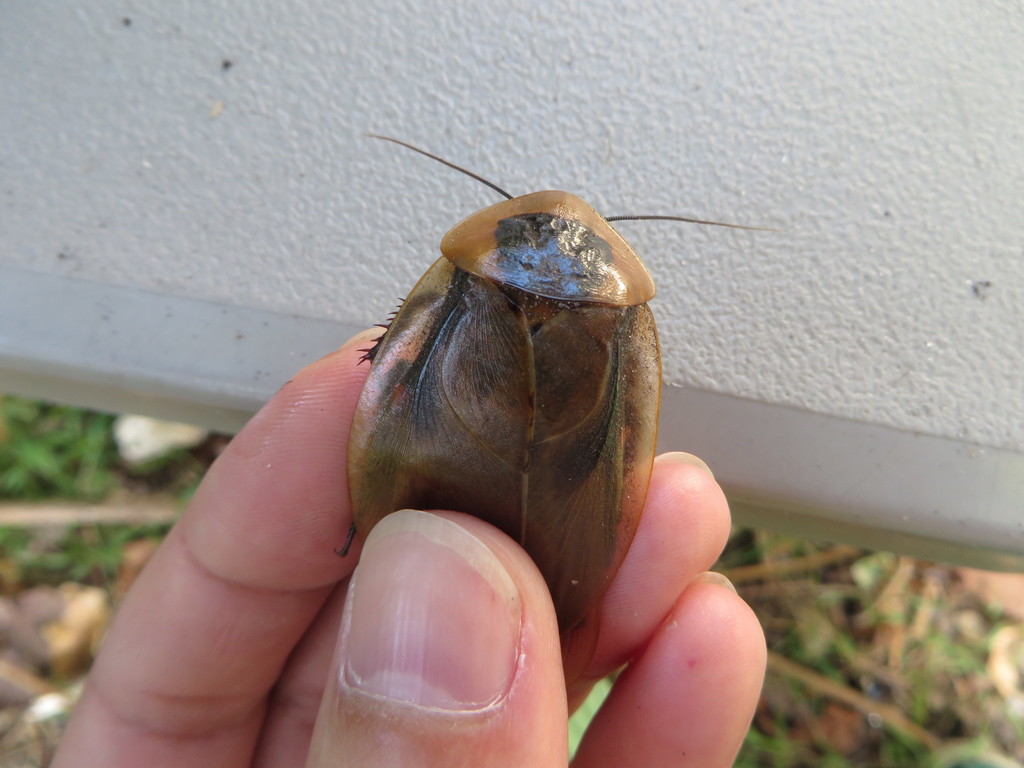
Gromphadorhina oblongonota (often misspelled oblongata or oblongonata), the wide-horned hisser, is a large, flightless species of hissing cockroach from southern Madagascar, and one of four members of the genus Gromphadorhina.
From Wikipedia: Gromphadorhina oblongonota, CC BY-SA 4.0 (excerpt)

Care at a glance
Species-specific values
Values researched for this exact species. Air, surface and water temperatures are listed separately, and each source is kept as published rather than averaged.
| Minimum enclosure | Small colonies should be housed in a small container. Source: limberlostexotics.com | |
| Humidity | Keep the peat and compost mix barely moist, not soggy; misting or adding water to the back half provides humidity. Source: limberlostexotics.com | |
| Diet | Feed organic produce such as bananas, oranges, and zucchini; soaked high-protein puppy food is also preferred. Source: limberlostexotics.com | |
| Social housing | They seem to breed best when kept slightly crowded. Source: limberlostexotics.com | |
| Substrate | Use a barely moist mixture of peat and well-rotted compost. Source: limberlostexotics.com |
Understanding the animal
About this animal
About this animal
This species is common in the pet trade, but it is difficult to distinguish from G. portentosa and is commonly confused with it, although oblongonota tends to be significantly larger and somewhat darker than portentosa.
From Wikipedia: Gromphadorhina oblongonota, CC BY-SA 4.0 (excerpt)
In the wild
In the wild
| Overview | Gromphadorhina oblongonota (often misspelled oblongata or oblongonata), the wide-horned hisser, is a large, flightless species of hissing cockroach from southern Madagascar, and one of four members of the genus Gromphadorhina. This species is common in the pet trade, but it is difficult to distinguish from G. portentosa and is commonly confused with it, although oblongonota tends to be significantly larger and somewhat darker than portentosa. — From Wikipedia: Gromphadorhina oblongonota, CC BY-SA 4.0 (excerpt) |
Sources for this sheet
- GBIF Backbone Taxonomy (Global Biodiversity Information Facility) (CC BY 4.0) Peer-reviewed researchInternational scientific taxonomy used here for classification. GBIF Secretariat (2023). GBIF Backbone Taxonomy. Checklist dataset https://doi.org/10.15468/39omei, accessed via GBIF.org.
- Wikipedia (species article) (CC BY-SA 4.0) Community referenceFree encyclopedia; useful overviews with their own citations. Short excerpts are quoted under CC BY-SA 4.0, each credited with a link to its article.
- iNaturalist (captive observations) Community referenceCommunity observation platform run by the California Academy of Sciences and National Geographic; observations marked captive show animals living in homes, zoos and aquariums.
More hissing and feeder roaches

Death's head cockroach
Blaberus craniifer
Pet trade
Discoid roach
Blaberus discoidalis
Pet trade

Dubia (Argentine wood) roach
Blaptica dubia
Pet trade
Giant Cave Cockroach
Blaberus giganteus
Pet trade

Giant burrowing cockroach
Macropanesthia rhinoceros
Pet trade

Grandidier's giant Madagascan hissing cockroach
Gromphadorhina grandidieri
Pet trade