
Home / Reptiles / Lizards / Scincidae / East Indian brown mabuya
No federal permit to keepEast Indian brown mabuya
Eutropis multifasciata
Reptiles › Lizards (Lacertilia) › Scincidae (Skinks)
Eutropis multifasciata, commonly known as the East Indian brown mabuya, many-lined sun skink, many-striped skink, common sun skink or (ambiguously) as golden skink, is a species of skink that inhabits an extensive range from India and southern China…
From Wikipedia: Eutropis multifasciata, CC BY-SA 4.0 (excerpt)

Care at a glance
Species-specific values
Values researched for this exact species. Air, surface and water temperatures are listed separately, and each source is kept as published rather than averaged.
| Minimum enclosure | At least 36”L x 18”W x 18”H for one skink. Source: reptilesupply.com | |
| Basking surface temperature | 95–105 °F Source: reptilesupply.com | |
| Cool side air temperature | 80–90 °F Source: reptilesupply.com | |
| Humidity | 70–80 % Source: reptilesupply.com | |
| Uvb lighting | Provide UVB; for a mesh top, place the basking area 7–9 inches below the lamp. Source: reptilesupply.com | |
| Diet | Primarily live insects; fruit may be offered as an occasional treat. Source: reptilesupply.com | |
| Feeding frequency | Offer insects the skink will eat in a day; reduce to every other day if it starts looking fat. Source: reptilesupply.com | |
| Social housing | May be kept in female groups or a breeding group of one male and multiple females; never house males together. Source: reptilesupply.com | |
| Substrate | Use recommended soil substrates or a 60% topsoil and 40% coconut fiber mix, at least 3 inches deep. Source: reptilesupply.com |
Understanding the animal
In the wild
In the wild
| Overview | Eutropis multifasciata, commonly known as the East Indian brown mabuya, many-lined sun skink, many-striped skink, common sun skink or (ambiguously) as golden skink, is a species of skink that inhabits an extensive range from India and southern China to southern Indonesia. — From Wikipedia: Eutropis multifasciata, CC BY-SA 4.0 (excerpt) |
| Where it lives | The species is widely present in southern Asia and occurs from India (Assam and the Nicobar islands) and southern China throughout continental Southeast Asia to southern Indonesia, with scattered records from New Guinea. It has been introduced to Australia and the USA. — From Wikipedia: Eutropis multifasciata, CC BY-SA 4.0 (excerpt) |
| Appearance and size | See Snake scales for terminology. Eutropis multifasciata is a species of skink that often shows prominent coloured dorsal bands. They have a number of other distinctive features that allows this species to be distinguished from other species, particularly in the detail of the arrangement of their scales. — From Wikipedia: Eutropis multifasciata, CC BY-SA 4.0 (excerpt) |
Read about this species in the wild at The Reptile Database.
Native climate (measured)
Native climate (measured)
| Warm-season highs | about 88°F (up to 93°F in the hottest sampled areas) |
| Cool-season lows | about 71°F (down to 61°F in the coldest sampled areas) |
| Average temperature | 74–81°F across sampled records |
| Relative humidity | 77–84% on average (driest month about 77%) |
| Rainfall | about 2304 mm a year |
Measured at 131 wild occurrence records sampled against WorldClim 2.1 climate data (1970–2000 averages). Air conditions in the range are ecological context, not enclosure settings: microhabitats such as burrows, leaf litter or basking rocks can be cooler, warmer or more humid.
Profile
Profile
Researched for this exact species. Sources are listed under In the wild above.
Data and studies
The numbers
The numbers
Each bar is what one source reports. Where several sources weigh in, the dashed gold band marks their average.
Typical adult weight
Average adult body mass in each database (FishBase gives the maximum recorded weight).
Adult snout-to-vent length
Body length without the tail.
Sources for this sheet
- Myhrvold et al. (2015). An amniote life-history database. Ecology 96: 3109 Peer-reviewed researchPeer-reviewed compilation of life-history data for over 21,000 birds, mammals and reptiles.
- The Reptile Database Peer-reviewed researchScientist-curated catalog of every reptile species, with taxonomy and literature.
- GBIF Backbone Taxonomy (Global Biodiversity Information Facility) (CC BY 4.0) Peer-reviewed researchInternational scientific taxonomy used here for classification. GBIF Secretariat (2023). GBIF Backbone Taxonomy. Checklist dataset https://doi.org/10.15468/39omei, accessed via GBIF.org.
- Wikipedia (species article) (CC BY-SA 4.0) Community referenceFree encyclopedia; useful overviews with their own citations. Short excerpts are quoted under CC BY-SA 4.0, each credited with a link to its article.
- iNaturalist (captive observations) Community referenceCommunity observation platform run by the California Academy of Sciences and National Geographic; observations marked captive show animals living in homes, zoos and aquariums.
More skinks
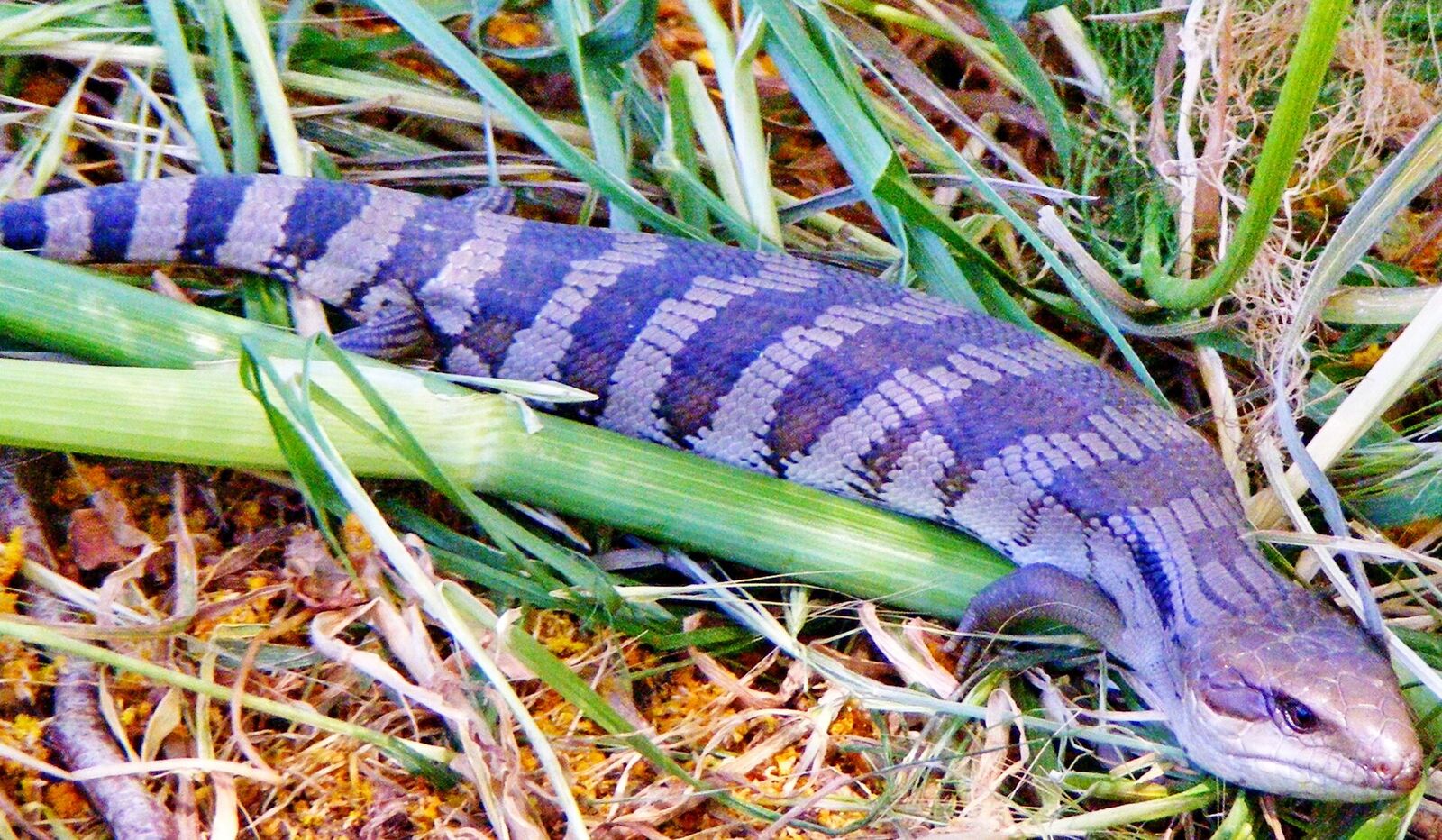
Common blue-tongued skink
Tiliqua scincoides
Docile, chunky and flashes a blue tongue.
Pet trade

Blotched blue-tongued skink
Tiliqua nigrolutea
Pet trade

Centralian blue-tongued skink
Tiliqua multifasciata
Pet trade

Cunningham's skink
Egernia cunninghami
Pet trade

Eastern Pilbara spiny-tailed skink
Egernia epsisolus
Pet trade

Eastern blue-tongued skink
Tiliqua scincoides
Pet trade