
Home / Reptiles / Lizards / Phrynosomatidae / Eastern fence lizard
No federal permit to keepEastern fence lizard
Sceloporus undulatus
+ 4 more names
Mescalero Prairie Lizard, Mescalero Dunes Fence Lizard [tedbrowni], Southern Fence Lizard, Eastern Fence Lizard [undulatus]Reptiles › Lizards (Lacertilia) › Phrynosomatidae (Spiny and horned lizards)
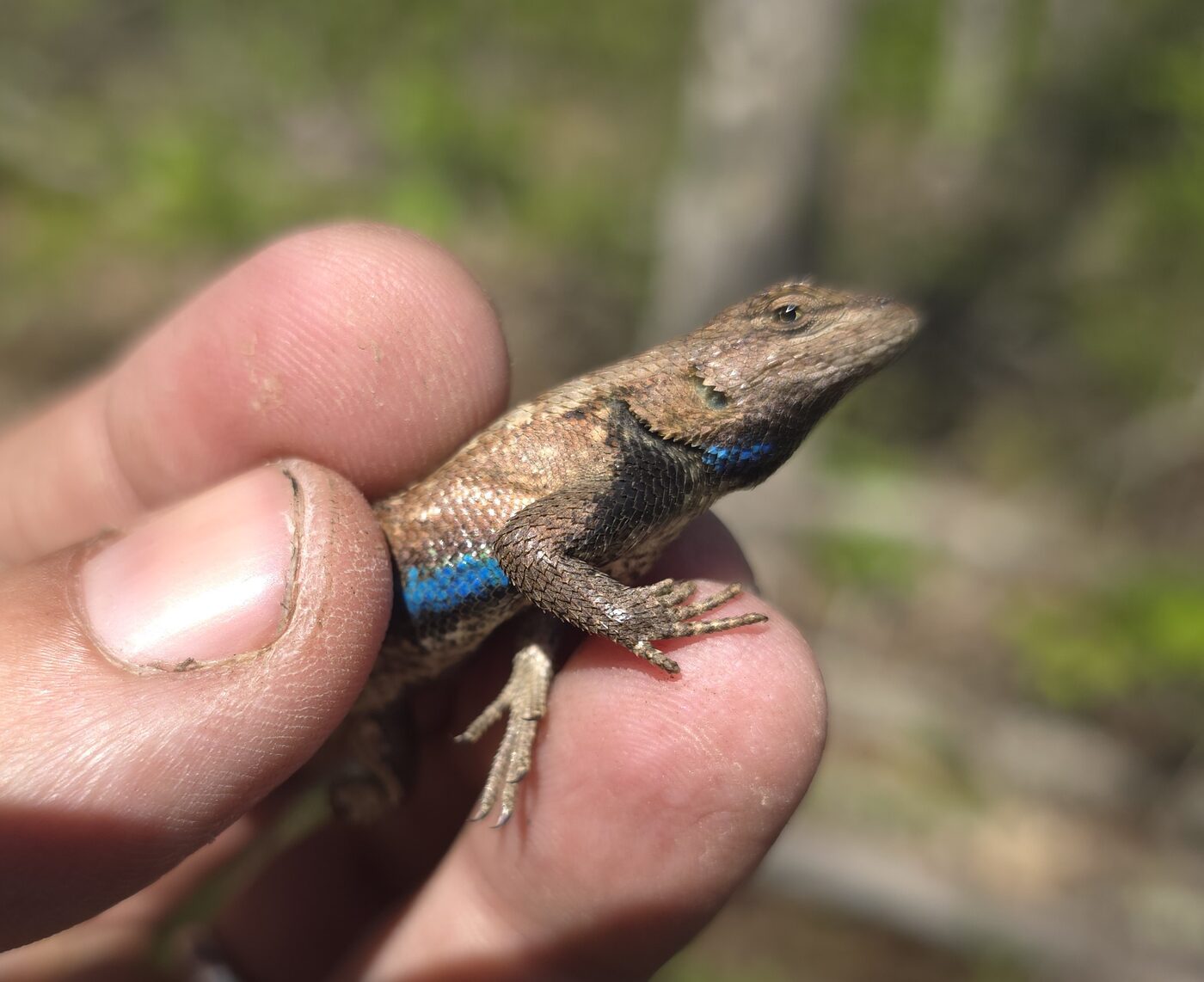
The eastern fence lizard (Sceloporus undulatus) is a medium-sized species of lizard in the family Phrynosomatidae.
From Wikipedia: Eastern fence lizard, CC BY-SA 4.0 (excerpt)
Care at a glance
Species-specific values
Values researched for this exact species. Air, surface and water temperatures are listed separately, and each source is kept as published rather than averaged.
| Minimum enclosure | A young lizard can be kept in a 10-gallon enclosure. Source: reptilescove.com | |
| Basking surface temperature | 95–100 °F Source: reptilescove.com | |
| Warm side air temperature | 85–95 °F Source: reptilescove.com | |
| Night temperature | 75–80 °F Source: reptilescove.com | |
| Uvb lighting | Owners commonly use UVA/UVB lighting for temperature control and vitamin D3. Source: reptilescove.com | |
| Diet | Feed insects such as crickets, fruit flies, small spiders, and small grasshoppers. Source: reptilescove.com | |
| Feeding frequency | Feed every other day, limiting crickets to 3 or 4 per day; the article also says 3–4 times weekly. Source: reptilescove.com | |
| Social housing | Usually house them alone; they can sometimes be kept in pairs. Source: reptilescove.com | |
| Substrate | Use paper or paper towel during isolation; timber mulch is preferred in an equipped vivarium. Source: reptilescove.com |
Understanding the animal
About this animal
About this animal
The species is found along forest edges, rock piles, and rotting logs or stumps in the eastern United States. It is sometimes referred to as the fence swift, gray lizard, gravid lizard, northern fence lizard or pine lizard.
From Wikipedia: Eastern fence lizard, CC BY-SA 4.0 (excerpt)
In the wild
In the wild
| Overview | The eastern fence lizard (Sceloporus undulatus) is a medium-sized species of lizard in the family Phrynosomatidae. The species is found along forest edges, rock piles, and rotting logs or stumps in the eastern United States. It is sometimes referred to as the fence swift, gray lizard, gravid lizard, northern fence lizard or pine lizard. It is also referred to colloquially as the horn-billed lizard. — From Wikipedia: Eastern fence lizard, CC BY-SA 4.0 (excerpt) |
Read about this species in the wild at Animal Diversity Web · The Reptile Database.
Native climate (measured)
Native climate (measured)
| Warm-season highs | about 91°F (up to 92°F in the hottest sampled areas) |
| Cool-season lows | about 39°F (down to 26°F in the coldest sampled areas) |
| Average temperature | 56–69°F across sampled records |
| Relative humidity | 69–72% on average (driest month about 65%) |
| Rainfall | about 1358 mm a year, spread fairly evenly |
| Winters | Cool to cold winters (lows around 39°F) in much of its native range. Seasonal slowdown may be relevant, but species-specific biology determines whether brumation or hibernation occurs. |
Measured at 111 wild occurrence records sampled against WorldClim 2.1 climate data (1970–2000 averages). Air conditions in the range are ecological context, not enclosure settings: microhabitats such as burrows, leaf litter or basking rocks can be cooler, warmer or more humid.
Profile
Profile
Researched for this exact species. Sources are listed under In the wild above.
Data and studies
The numbers
The numbers
Each bar is what one source reports. Where several sources weigh in, the dashed gold band marks their average.
Typical adult weight
Average adult body mass in each database (FishBase gives the maximum recorded weight).
Adult snout-to-vent length
Body length without the tail.
Incubation
Female maturity
Veterinary & husbandry research
Veterinary & husbandry research
- Testosterone Reduces Growth and Hepatic IGF-1 mRNA in a Female-Larger Lizard, Sceloporus undulatus: Evidence of an Evolutionary Reversal in Growth Regulation Duncan CA et al., Integrative organismal biology (Oxford, England) 2020
- Interactive effects of thyroxine and experimental location on running endurance, tissue masses, and enzyme activities in captive versus field-active lizards (Sceloporus undulatus) John-Alder HB et al., General and comparative endocrinology 1991
Peer-reviewed papers that mention this species alongside captivity, zoos, veterinary care or aquaculture. Some cover several species or mention it only in passing, so check the abstract. See all 3 on PubMed → PubMed
Sources for this sheet
- AnAge: The Animal Ageing and Longevity Database (Human Ageing Genomic Resources) (CC BY 3.0) Peer-reviewed researchCurated, referenced longevity and life-history records for thousands of species; maximum lifespans are often from zoo animals.
- Myhrvold et al. (2015). An amniote life-history database. Ecology 96: 3109 Peer-reviewed researchPeer-reviewed compilation of life-history data for over 21,000 birds, mammals and reptiles.
- The Reptile Database Peer-reviewed researchScientist-curated catalog of every reptile species, with taxonomy and literature.
- GBIF Backbone Taxonomy (Global Biodiversity Information Facility) (CC BY 4.0) Peer-reviewed researchInternational scientific taxonomy used here for classification. GBIF Secretariat (2023). GBIF Backbone Taxonomy. Checklist dataset https://doi.org/10.15468/39omei, accessed via GBIF.org.
- Wikipedia (species article) (CC BY-SA 4.0) Community referenceFree encyclopedia; useful overviews with their own citations. Short excerpts are quoted under CC BY-SA 4.0, each credited with a link to its article.
- PubMed (U.S. National Library of Medicine) Peer-reviewed researchIndex of peer-reviewed veterinary, zoo and husbandry research.
- iNaturalist (captive observations) Community referenceCommunity observation platform run by the California Academy of Sciences and National Geographic; observations marked captive show animals living in homes, zoos and aquariums.
More spiny and horned lizards

Baja blue rock lizard
Petrosaurus thalassinus
Pet trade

Blue spiny lizard
Sceloporus cyanogenys
Pet trade

Coast horned lizard
Phrynosoma coronatum
Pet trade

Crevice spiny lizard
Sceloporus poinsettii
Zoos & aquariums

Desert spiny lizard
Sceloporus magister
Pet trade

Emerald swift
Sceloporus malachiticus
Pet trade