
Home / Reptiles / Lizards / Scincidae / Tree-crevice skink
Some federal rules applyTree-crevice skink
Egernia striolata
Reptiles › Lizards (Lacertilia) › Scincidae (Skinks)
The tree-crevice skink or tree skink (Egernia striolata) is a species of skink, a lizard in the family Scincidae.
From Wikipedia: Tree-crevice skink, CC BY-SA 4.0 (excerpt)

Care at a glance
Species-specific values
Values researched for this exact species. Air, surface and water temperatures are listed separately, and each source is kept as published rather than averaged.
| Minimum enclosure | Original group housed in an enclosure 28 × 24 × 24 inches. Source: reptilesmagazine.com | |
| Basking surface temperature | 95 °F Source: reptilesmagazine.com | |
| Warm side air temperature | Stack temperature at the top reached about 105 degrees. Source: reptilesmagazine.com | |
| Cool side air temperature | 80–85 °F Source: reptilesmagazine.com | |
| Night temperature | 65–82 °F Source: reptilesmagazine.com | |
| Uvb lighting | A 24-inch 5-percent UVB fluorescent bulb was on throughout the day. Source: reptilesmagazine.com | |
| Social housing | Raise three or more juveniles together; separate skinks forced out of a group or keep them alone. Source: reptilesmagazine.com | |
| Substrate | A 1-inch layer of cypress mulch. Source: reptilesmagazine.com | |
| Seasonal cooling | At the end of October, lower nighttime temperatures to the mid to low 60s for breeding conditioning. Source: reptilesmagazine.com |
Understanding the animal
About this animal
About this animal
The species is endemic to Australia and is found in the states of Victoria, the Northern Territory, Queensland, New South Wales and South Australia. E. striolata tend to live in crevices and cracks in hollow logs or rocks.
From Wikipedia: Tree-crevice skink, CC BY-SA 4.0 (excerpt)
In the wild
In the wild
| Overview | The tree-crevice skink or tree skink (Egernia striolata) is a species of skink, a lizard in the family Scincidae. The species is endemic to Australia and is found in the states of Victoria, the Northern Territory, Queensland, New South Wales and South Australia. E. striolata tend to live in crevices and cracks in hollow logs or rocks. They greatly prefer heterogeneous and structurally diverse habitats and their behavior changes depending on the habitat they live in. — From Wikipedia: Tree-crevice skink, CC BY-SA 4.0 (excerpt) |
| Where it lives | The tree-crevice skink is a native species from Australia, found from the arid zone of Western Australia from the Pilbara and the Great Sandy Desert south to Carnarvon and the Great Victoria Desert It is not present on the coast and higher altitudes of the Great Dividing Range and on central and eastern Queensland and extra limits in southern Northern Territory and northwestern South Australia. — From Wikipedia: Tree-crevice skink, CC BY-SA 4.0 (excerpt) |
| Wild diet | E. striolata are omnivorous, with their primary food sources consisting of larger, hard-bodied insects such as coleopterans, ants, grasshoppers, and cockroaches. However, plant matter does constitute a significant part of their diet, which is estimated to be at 39.7%. — From Wikipedia: Tree-crevice skink, CC BY-SA 4.0 (excerpt) |
| Behavior | Egernia striolata are well known for their complex social interactions, especially among lizards. One of the reasons they are able to form such complex associations is because they are very good at adapting their behavior and applying existing skills to fit novel situations. This allows them to be flexible with their behavior and react to changes in their environment. — From Wikipedia: Tree-crevice skink, CC BY-SA 4.0 (excerpt) |
| Reproduction | Their mating season occurs in September and October. Egernia striolata are viviparous and have relatively simple type 1 placentas, but not a lot of research has been done on their exact reproductive ecology. They prefer to mate monogamously and keep one mate for at least the entirety of a breeding season. — From Wikipedia: Tree-crevice skink, CC BY-SA 4.0 (excerpt) |
| Appearance and size | The tree-crevice skink is a moderate-to-large, deep-headed species of the genus Egernia. Its coloration ranges from dark black to gray-brown and has a pale dorso-lateral stripe that runs from the head to the base of the tail. Sometimes they present scattered with white spots and flecks on the torso. — From Wikipedia: Tree-crevice skink, CC BY-SA 4.0 (excerpt) |
| History and naming | The genus Egernia is endemic to Australia and has 30 species. These species are diurnal, moderate-to-large lizards with well-developed and pentadactyl limbs that inhabit rocky environments. All members of Egernia are viviparous. — From Wikipedia: Tree-crevice skink, CC BY-SA 4.0 (excerpt) |
Native climate (measured)
Native climate (measured)
| Warm-season highs | about 90°F (up to 95°F in the hottest sampled areas) |
| Cool-season lows | about 39°F (down to 36°F in the coldest sampled areas) |
| Average temperature | 58–69°F across sampled records |
| Relative humidity | 50–62% on average (driest month about 44%) |
| Rainfall | about 556 mm a year, spread fairly evenly |
| Winters | Cool to cold winters (lows around 39°F) in much of its native range. Seasonal slowdown may be relevant, but species-specific biology determines whether brumation or hibernation occurs. |
Measured at 532 wild occurrence records sampled against WorldClim 2.1 climate data (1970–2000 averages). Air conditions in the range are ecological context, not enclosure settings: microhabitats such as burrows, leaf litter or basking rocks can be cooler, warmer or more humid.
Profile
Profile
Researched for this exact species. Sources are listed under In the wild above.
History
The genus Egernia is endemic to Australia and has 30 species. These species are diurnal, moderate-to-large lizards with well-developed and pentadactyl limbs that inhabit rocky environments. All members of Egernia are viviparous.
From Wikipedia: Tree-crevice skink, CC BY-SA 4.0 (excerpt)
Data and studies
The numbers
The numbers
Each bar is what one source reports. Where several sources weigh in, the dashed gold band marks their average.
Maximum recorded lifespan
Longest recorded lifespan reported by each database; typical lifespans are usually shorter.
Typical adult weight
Average adult body mass in each database (FishBase gives the maximum recorded weight).
Adult snout-to-vent length
Body length without the tail.
Basking spot
Species-specific values from keeper care sheets. Basking figures are often surface readings taken with an infrared thermometer, which run hotter than air.
Sources for this sheet
- Myhrvold et al. (2015). An amniote life-history database. Ecology 96: 3109 Peer-reviewed researchPeer-reviewed compilation of life-history data for over 21,000 birds, mammals and reptiles.
- Reptiles Magazine (care articles) Experienced keeper or breederEstablished reptile and amphibian hobby magazine; care articles are written by breeders, keepers and veterinarians.
- Species+ (UNEP-WCMC and the CITES Secretariat) Zoo, university or veterinaryThe official database of species listed under CITES. UNEP (2026). The Species+ Website. Nairobi, Kenya. Compiled by UNEP-WCMC, Cambridge, UK. Available at: www.speciesplus.net. [Accessed 04/10/2026].
- USFWS International Affairs: CITES Zoo, university or veterinaryFederal agency that issues CITES permits.
- The Reptile Database Peer-reviewed researchScientist-curated catalog of every reptile species, with taxonomy and literature.
- GBIF Backbone Taxonomy (Global Biodiversity Information Facility) (CC BY 4.0) Peer-reviewed researchInternational scientific taxonomy used here for classification. GBIF Secretariat (2023). GBIF Backbone Taxonomy. Checklist dataset https://doi.org/10.15468/39omei, accessed via GBIF.org.
- Wikipedia (species article) (CC BY-SA 4.0) Community referenceFree encyclopedia; useful overviews with their own citations. Short excerpts are quoted under CC BY-SA 4.0, each credited with a link to its article.
- iNaturalist (captive observations) Community referenceCommunity observation platform run by the California Academy of Sciences and National Geographic; observations marked captive show animals living in homes, zoos and aquariums.
More skinks
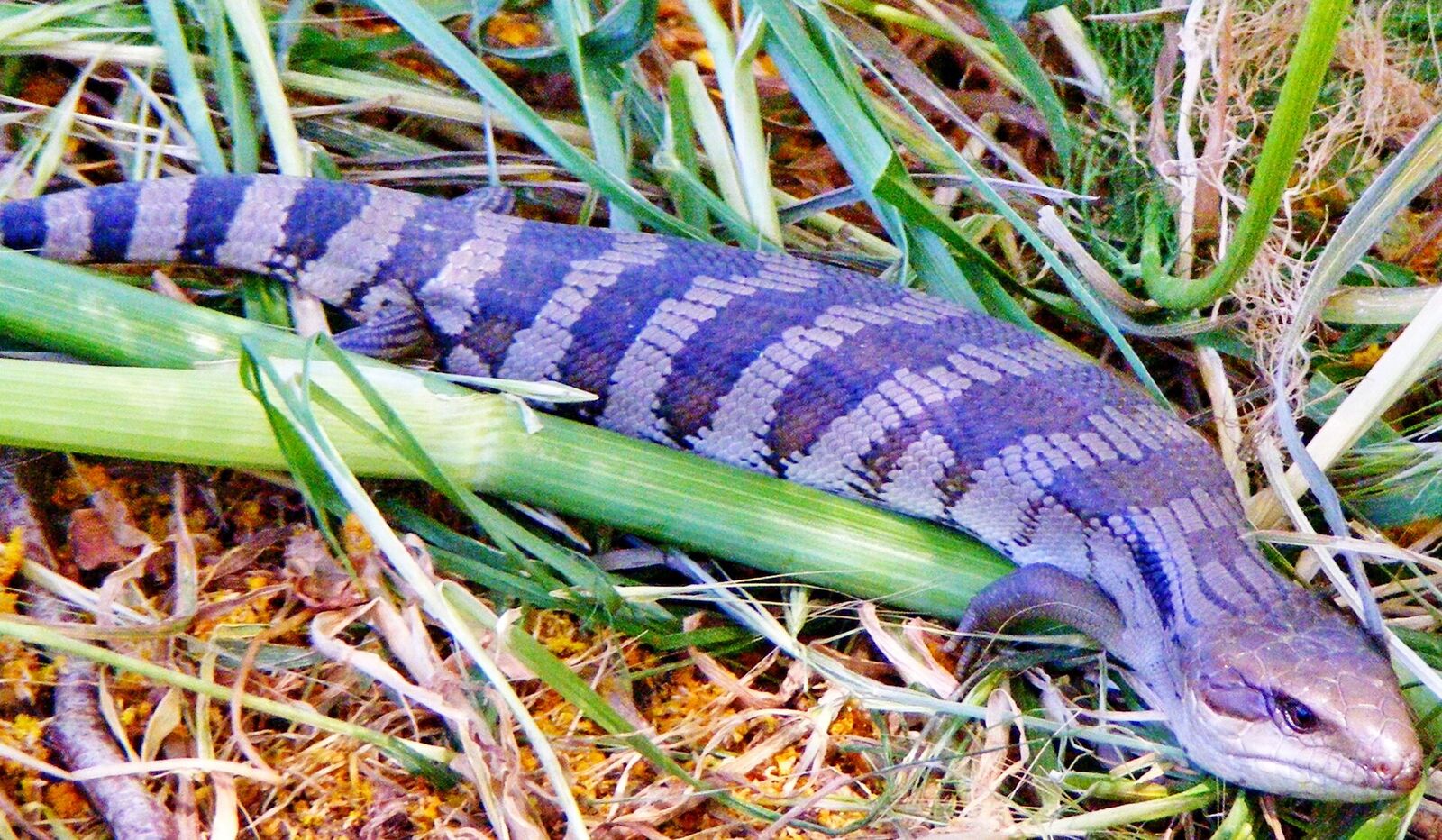
Common blue-tongued skink
Tiliqua scincoides
Docile, chunky and flashes a blue tongue.
Pet trade

Blotched blue-tongued skink
Tiliqua nigrolutea
Pet trade

Centralian blue-tongued skink
Tiliqua multifasciata
Pet trade

Cunningham's skink
Egernia cunninghami
Pet trade

East Indian brown mabuya
Eutropis multifasciata
Pet trade

Eastern Pilbara spiny-tailed skink
Egernia epsisolus
Pet trade