Home / Reptiles / Lizards / Fire skink
No federal permit to keepFire skink
Lepidothyris fernandi
Reptiles › Lizards (Lacertilia) › Scincidae (Skinks)
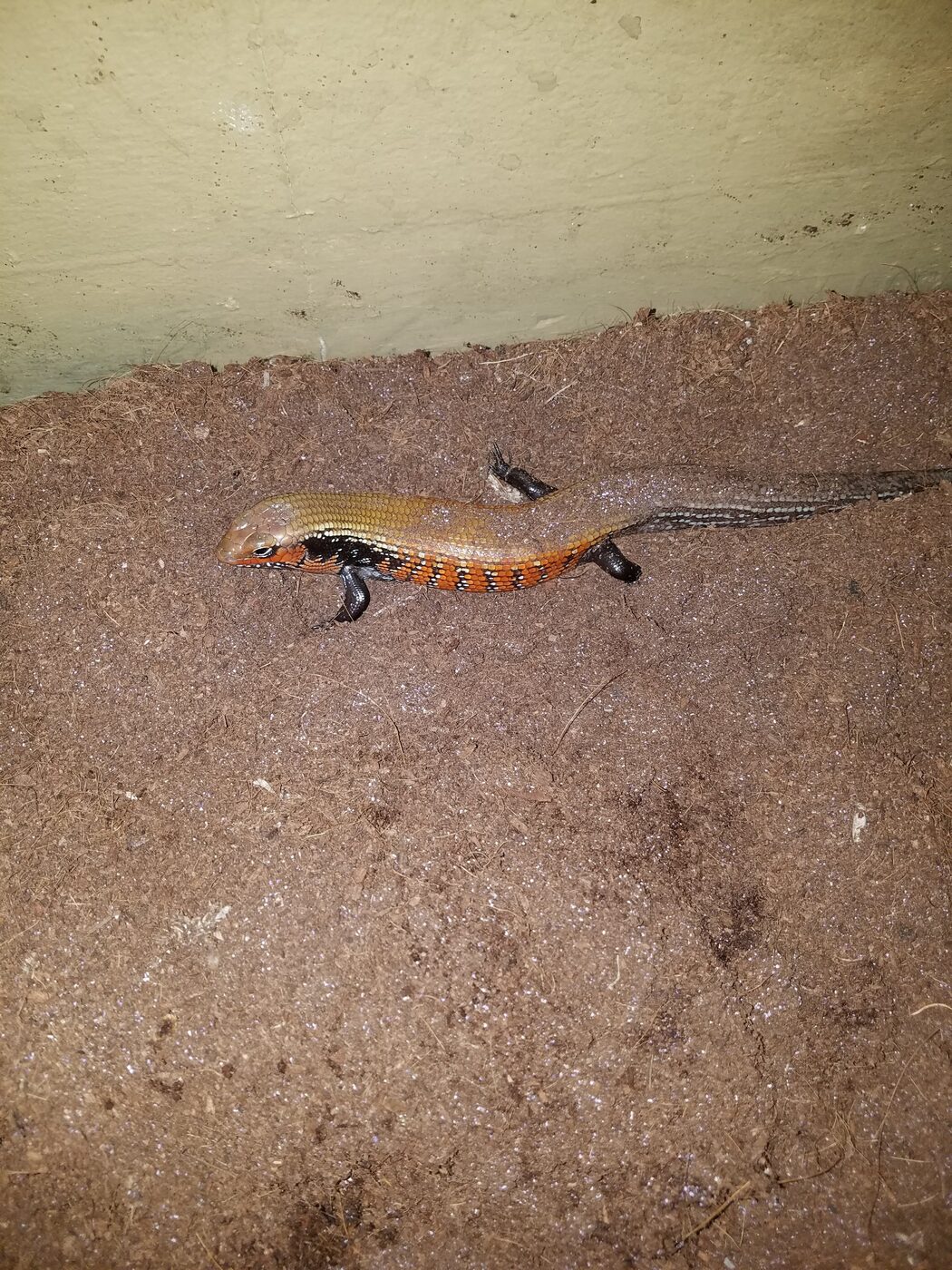
The fire skink (Lepidothyris fernandi), also known commonly as Fernand's skink, the Togo fire skink, and the true fire skink, is a fairly large skink, a species of lizard in the family Scincidae.
Care at a glance
Species-specific values
Values researched for this exact species. Where they differ from the group guide below, follow these. Air, surface and water temperatures are listed separately, and each source is kept as published rather than averaged.
| Minimum enclosure dimensions | length: 36 in; width: 18 in; height: 18 in One adult. | 225 |
| Basking surface temperature | 92–96 °F Probe on basking surface. | 225 |
| Cool zone temperature | 75–85 °F Cool-end probe; type not expressly stated. | 225 |
| Night temperature | 70–75 °F Measurement type not expressly stated. | 225 |
| Relative humidity | 60–70 % Average; ventilation and moisture gradients. | 225 |
| Adult total length | 12–15 in | 225 |
| Diet | Varied invertebrate prey, predominantly insects. | 225 |
| Social needs | Can live alone; never combine males. | 225 |
Care guide
Small and mid-sized skinks
Applies to most species in this group. Habitat: Forest floor, grassland and sand. Individual species can differ, so compare with the species numbers above and the linked sources.
Housing & setup
- Deep, moisture-holding substrate for fire skinks and crocodile skinks; loose sand for sandfish.
- Hides and leaf litter; most are shy.
Climate & lighting
Starting point only: Fire skinks and desert sandfish need very different heat and moisture regimes. Check the species-specific values for this animal where shown.
| Basking spot | 90–95°F |
| Warm side / daytime | 80–85°F |
| Cool side | 70–75°F |
| Humidity | 60–80% |
- UVB: Recommended.
Diet
- Insects and worms; some take fruit.
Health watch
- Crocodile skinks are fragile and humidity-dependent; fire skinks are hardy if kept humid.
Understanding the animal
About this animal
About this animal
The species is known for its bright and vivid coloration. Native to tropical forests in West and Central Africa, the fire skink lives 15 to 20 years.
Quoted from the Wikipedia article “Fire skink” (CC BY-SA 4.0) 174
In the wild
In the wild
Researched for this exact species, not its family. Good care copies these conditions.12345
| Where it lives | A terrestrial forest skink of western and central tropical Africa. Niger Delta field research found it in dryland and swamp forest, using excavable ground burrows. |
| Ground it lives on | forest litter over soil with burrows |
| Climate | Southern Nigerian study sites have wet seasons in April–October and drier seasons in November–March, with relatively small monthly temperature changes; numerical wild temperature and relative-humidity ranges were not provided. |
| Active | Diurnal. |
| Wild diet | Mostly arthropods: isopods and beetles dominated Nigerian samples; ants and many other invertebrates were eaten, with occasional lizards in swamp-forest wet-season samples. |
| Behavior to plan for | Burrows through soil and litter, remaining concealed much of the time and emerging to hunt at the surface. |
What this means for care
- Provide deep diggable soil and a leaf-litter layer.
- Keep protected moist retreats with drainage and surface variation.
- Offer varied invertebrates rather than a narrow cricket-only diet.
Native climate (measured)
Native climate (measured)
| Warm-season highs | about 89°F (up to 93°F in the hottest sampled areas) |
| Cool-season lows | about 69°F (down to 60°F in the coldest sampled areas) |
| Average temperature | 72–81°F across sampled records |
| Relative humidity | 77–82% on average (driest month about 74%) |
| Rainfall | about 1600 mm a year |
Measured at 26 wild occurrence records sampled against WorldClim 2.1 climate data (1970–2000 averages). Air conditions in the range are ecological context, not enclosure settings: microhabitats such as burrows, leaf litter or basking rocks can be cooler, warmer or more humid.
Profile
Profile
Researched for this exact species. Sources are listed under In the wild above.
History
The specific name fernandi refers to the island formerly called Fernando Po, now Bioko. The species has historically been placed in several genera, and the supplied sources use both Lepidothyris fernandi and Mochlus fernandi; ReptiFiles treats it as Mochlus fernandi.
Behaviors reported
- Burrows and hides frequently.
- May become tame in captivity.
- Can be active despite its reputation for shyness when housed properly.
Remarkable facts
- It is also called Fernand's skink, the Togo fire skink, and the true fire skink.
- The species is noted for bright, vivid coloration.
- It can live 15 to 20 years.
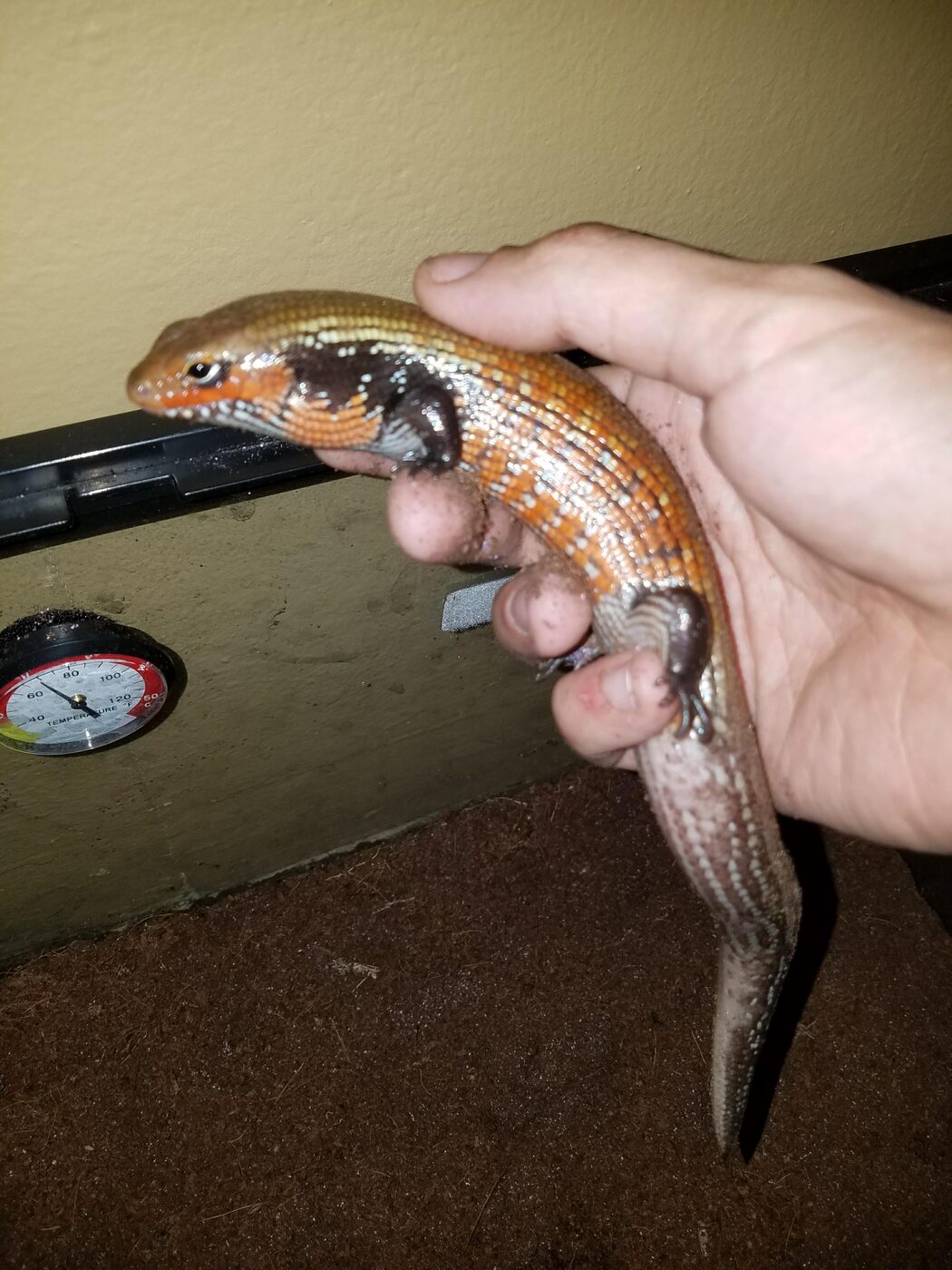
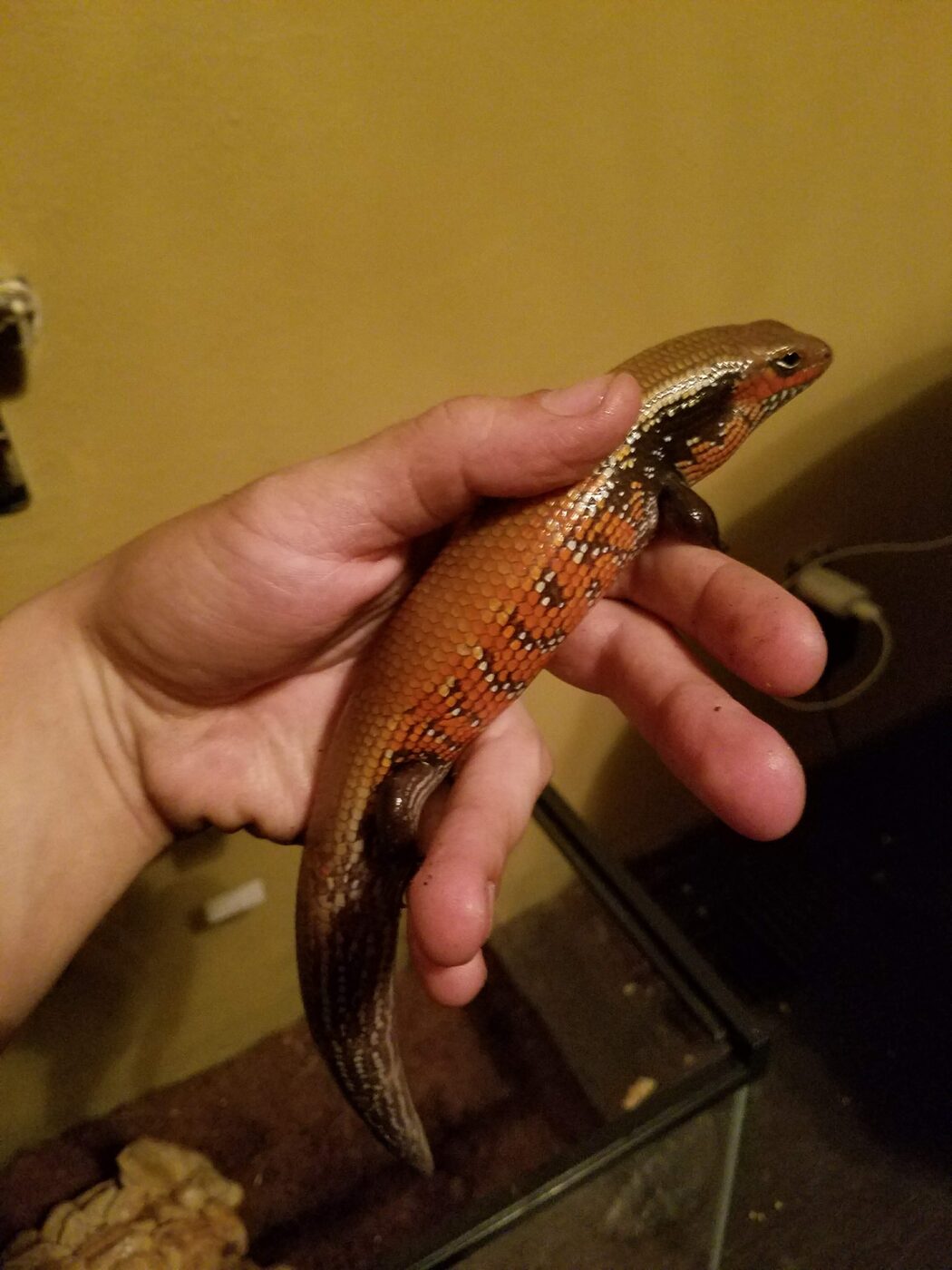
- Reptiles Magazine describes bright red sides marked with black and white bars, with a bronze-to-golden back.
From the sources
From the sources
Quoted from the matching sections of reputable sources for this exact species. Specialist databases are used first; Wikipedia (community-edited, CC BY-SA 4.0) only fills gaps. Other sources are short credited quotes.
| Overview | The fire skink (Lepidothyris fernandi), also known commonly as Fernand's skink, the Togo fire skink, and the true fire skink, is a fairly large skink, a species of lizard in the family Scincidae. The species is known for its bright and vivid coloration. Native to tropical forests in West and Central Africa, the fire skink lives 15 to 20 years. This species is a diurnal lizard that burrows and hides. — Wikipedia (community-edited) |
| Where it lives | Mochlus fernandi occurs in the humid forest zone of southern West and Central Africa, from Guinea and Sierra Leone to Gabon and the Democratic Republic of the Congo. — Wikipedia (community-edited) |
| Wild diet | M. fernandi has a large appetite, and it is mainly insectivorous. Insects such as crickets, and larvae such as mealworms, are used for feeding captive specimens. — Wikipedia (community-edited) |
| Reproduction | The fire skink is oviparous. An adult female will generally lay a clutch of five to nine eggs after mating. Fire skink eggs take forty to fifty days to hatch when incubated at a temperature of 85 F. — Wikipedia (community-edited) |
| Appearance and size | The fire skink is a fairly large species of skink, reaching up to 37 cm in total length (including tail). The most notable aspect of the fire skink's appearance is its vivid, bright colors. Smooth, gold scales adorn the fire skink's back, while red and black bars set against a silver background line its sides. — Wikipedia (community-edited) |
| History and naming | Historically, the fire skink has been placed in several different genera and was until recently placed in Riopa together with several skinks from southeast Asia. While these are superficially similar to the African fire skink, they are closer to some other Asian skinks, resulting in their move to Mochlus. — Wikipedia (community-edited) |
More photos
Data and studies
The numbers
The numbers
Each bar is what one source reports. Where several sources weigh in, the dashed gold band marks their average.
Incubation
Basking spot
Species-specific values from keeper care sheets. Basking figures are often surface readings taken with an infrared thermometer, which run hotter than air.
Night temperature
Species-specific values from keeper care sheets. Basking figures are often surface readings taken with an infrared thermometer, which run hotter than air.
Humidity
Species-specific values from keeper care sheets. Basking figures are often surface readings taken with an infrared thermometer, which run hotter than air.
Daytime air temperature
Species-specific values from keeper care sheets. Basking figures are often surface readings taken with an infrared thermometer, which run hotter than air.
Care articles for this species
Care articles for this species
- Fire Skink Care Sheet (ReptiFiles)
- African Fire Skink Care Sheet (Reptiles Magazine)
Sources for this sheet
- Myhrvold et al. (2015). An amniote life-history database. Ecology 96: 3109 Peer-reviewed researchPeer-reviewed compilation of life-history data for over 21,000 birds, mammals and reptiles.
- ReptiFiles (care guides) Experienced keeper or breederWell-researched reptile care guides that cite herpetological literature and experienced keepers.
- Reptiles Magazine (care articles) Experienced keeper or breederEstablished reptile and amphibian hobby magazine; care articles are written by breeders, keepers and veterinarians.
- Merck Veterinary Manual: Management and husbandry of reptiles Zoo, university or veterinaryThe Merck Veterinary Manual: a standard veterinary reference written and reviewed by veterinary specialists.
- Merck Veterinary Manual: Nutritional, metabolic and endocrine diseases of reptiles Zoo, university or veterinaryThe Merck Veterinary Manual: a standard veterinary reference written and reviewed by veterinary specialists.
- ReptiFiles: Fire skink care sheet Zoo, university or veterinaryAdded in the 2026 source-checked care-guide review.
- ReptiFiles: Sandfish temperature, UVB and humidity Zoo, university or veterinaryAdded in the 2026 source-checked care-guide review.
- Clint's Reptiles (YouTube): Fire Skink, The Best Pet Lizard? Expert educator & keeperClint Laidlaw, PhD in Biology Education and MS in Evolutionary Ecology; owner of Clint's Reptile Room and a longtime keeper. His "Best Pet?" series reviews each species' care in depth.
- The Reptile Database Peer-reviewed researchScientist-curated catalog of every reptile species, with taxonomy and literature.
- GBIF Backbone Taxonomy (Global Biodiversity Information Facility) Peer-reviewed researchInternational scientific taxonomy used here for classification.
- Wikipedia (species article) Community referenceFree encyclopedia; useful overviews with their own citations. Intro text is quoted under CC BY-SA 4.0.
More skinks
 In-depth
Common blue-tongued skink
Tiliqua scincoides
Docile, chunky and flashes a blue tongue.
Pet trade

Blotched blue-tongued skink
Tiliqua nigrolutea
Pet trade

Centralian blue-tongued skink
Tiliqua multifasciata
Pet trade

Indonesian blue-tongued skink
Tiliqua gigas
Pet trade

Sandfish skink
Scincus scincus
Pet trade

Shingleback skink
Tiliqua rugosa
Pet trade