
Home / Invertebrates / Scorpions / Heterometrus longimanus
No federal permit to keepHeterometrus longimanus
Heterometrus longimanus
Invertebrates › Scorpions (Scorpiones) › Scorpionidae (Emperor and forest scorpions)
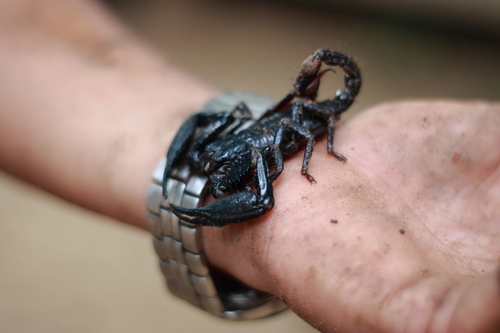
Heterometrus longimanus, the Asian forest scorpion, is a species of scorpions belonging to the family Scorpionidae.
From Wikipedia: Heterometrus longimanus, CC BY-SA 4.0 (excerpt)
Care at a glance
Species-specific values
Values researched for this exact species. Air, surface and water temperatures are listed separately, and each source is kept as published rather than averaged.
| Humidity | 78–82 % Source: reptilesbymack.com | |
| Diet | Crickets or mealworms; babies eat pinhead crickets or other small insects. Source: reptilesbymack.com | |
| Social housing | Recommended to house alone due to aggressive nature. Source: reptilesbymack.com | |
| Substrate | Use peat moss, potting soil or Eco-earth, 3–4 inches deep. Source: reptilesbymack.com |
Understanding the animal
In the wild
In the wild
| Overview | Heterometrus longimanus, the Asian forest scorpion, is a species of scorpions belonging to the family Scorpionidae. — From Wikipedia: Heterometrus longimanus, CC BY-SA 4.0 (excerpt) |
| Where it lives | This species is native to Southeast Asia (Malaysia, Indonesia, the Philippines, and Singapore), where it inhabits the humid tropical rainforests. — From Wikipedia: Heterometrus longimanus, CC BY-SA 4.0 (excerpt) |
| Appearance and size | Heterometrus longimanus can reach a length of 10–12 cm. Body color is uniformly black. These scorpions are viviparous. — From Wikipedia: Heterometrus longimanus, CC BY-SA 4.0 (excerpt) |
Native climate (measured)
Native climate (measured)
| Warm-season highs | about 88°F (up to 90°F in the hottest sampled areas) |
| Cool-season lows | about 72°F (down to 66°F in the coldest sampled areas) |
| Average temperature | 74–81°F across sampled records |
| Relative humidity | 81–85% on average (driest month about 80%) |
| Rainfall | about 2597 mm a year, spread fairly evenly |
Measured at 111 wild occurrence records sampled against WorldClim 2.1 climate data (1970–2000 averages). Air conditions in the range are ecological context, not enclosure settings: microhabitats such as burrows, leaf litter or basking rocks can be cooler, warmer or more humid.
Sources for this sheet
- GBIF Backbone Taxonomy (Global Biodiversity Information Facility) (CC BY 4.0) Peer-reviewed researchInternational scientific taxonomy used here for classification. GBIF Secretariat (2023). GBIF Backbone Taxonomy. Checklist dataset https://doi.org/10.15468/39omei, accessed via GBIF.org.
- Wikipedia (species article) (CC BY-SA 4.0) Community referenceFree encyclopedia; useful overviews with their own citations. Short excerpts are quoted under CC BY-SA 4.0, each credited with a link to its article.
- iNaturalist (captive observations) Community referenceCommunity observation platform run by the California Academy of Sciences and National Geographic; observations marked captive show animals living in homes, zoos and aquariums.
More emperor and forest scorpions
Emperor scorpion
Pandinus imperator
A big, shy scorpion with a mild sting.
Pet trade

Asian forest scorpion
Heterometrus spinifer
Pet trade

Asian giant forest scorpion
Heterometrus laoticus
Pet trade

Heterometrus silenus
Heterometrus silenus
Pet trade

Tanzanian red-clawed scorpion
Pandinus cavimanus
Pet trade
Scorpion
Pandinus dictator
Pet trade