
Home / Amphibians / Salamanders and newts / Hong Kong warty newt
Some federal rules applyHong Kong warty newt
Paramesotriton hongkongensis
Amphibians › Salamanders and newts (Caudata) › Salamandridae (Newts and fire salamanders)
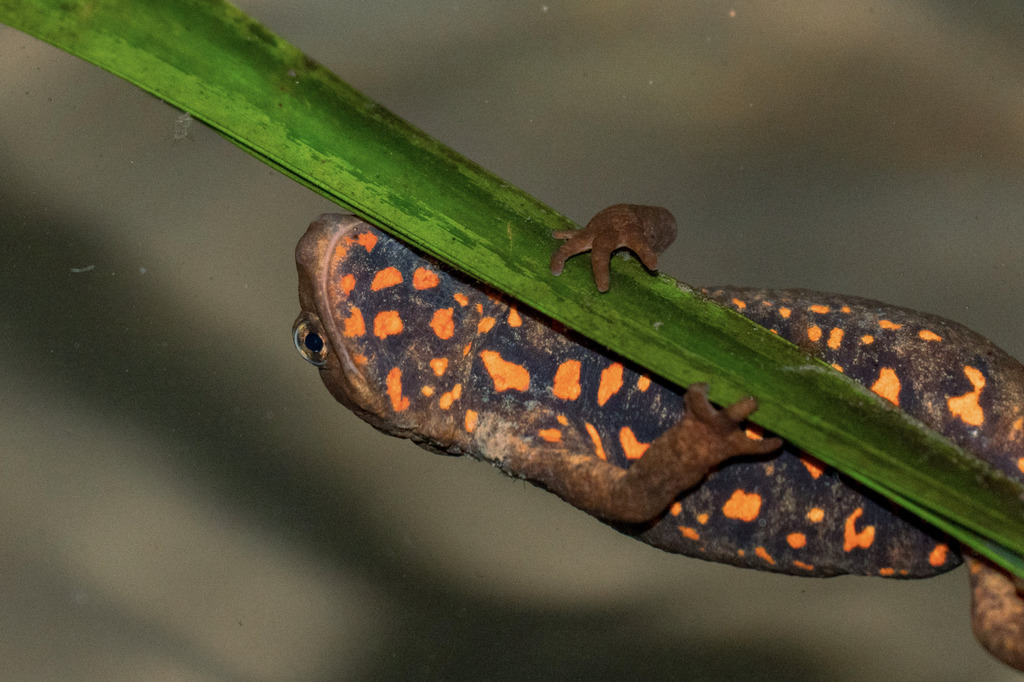
The Hong Kong warty newt or Hong Kong newt is a species of salamander (newt) found in Hong Kong.
Care at a glance
Setup
One answer per setting. Where sources differ, the smaller figure is the minimum and the larger is what we recommend.
| Adult enclosure | 15 gallon aquarium for an adult pair, with at least a floating cork island | caudata.org |
| Warm side | At least 64°F Preferably 72°F Richly planted aquatic setup | caudata.org |
| Water | Dechlorinated or spring water about 20 cm (8 in) deep | caudata.org |
| Food | Every 2-3 days: earthworms, slugs, wax worms, maggots and tubifex worms | caudata.org |
| Brumation | At least 8°C Preferably 10°C Optional winter cooling for a few weeks to encourage breeding | caudata.org |
Understanding the animal
About this animal
About this animal
Once thought to be endemic to the territory, the species has also been found in the coastal parts of Guangdong Province. It is the only Urodela living in Hong Kong.
From Wikipedia: Hong Kong warty newt, CC BY-SA 4.0 (excerpt)
In the wild
In the wild
Researched for this exact species, not its family. Wild conditions are context, not enclosure settings.1
Profile
Profile
Researched for this exact species. Sources are listed under In the wild above.
Remarkable facts
- Adults normally 14-16 cm.
Data and studies
Veterinary & husbandry research
Veterinary & husbandry research
- OCCURRENCE OF PATHOGENIC CHYTRID FUNGI BATRACHOCHYTRIUM SALAMANDRIVORANS AND BATRACHOCHYTRIUM DENDROBATIDIS IN THE HONG KONG NEWT (PARAMESOTRITON HONGKONGENSIS) AND OTHER WILD AND IMPORTED AMPHIBIANS IN A SUBTROPICAL ASIAN REGION. et al., Journal of wildlife diseases 2023
- Genetic Diversity and Interpopulation Variability of the Hong Kong Newt (Paramesotriton hongkongensis) in an Urbanized and Deforested Landscape. et al., Ecology and evolution 2025
- Environmental factors and host sex influence the skin microbiota structure of Hong Kong newt (Paramesotriton hongkongensis) in a coldspot of chytridiomycosis in subtropical East Asia. et al., Integrative zoology 2025
- A new species of the genus Paramesotriton (Caudata: Salamandridae) from Fujian, southeastern China. et al., Zootaxa 2016
Peer-reviewed papers that mention this species alongside captivity, zoos, veterinary care or aquaculture. Some cover several species or mention it only in passing, so check the abstract. PubMed
Sources for this sheet
- 50 CFR Part 16: Injurious wildlife (Lacey Act) Zoo, university or veterinaryCurrent federal regulation, read from eCFR.
- U.S. Association of Reptile Keepers v. Zinke (D.C. Cir. 2017) Zoo, university or veterinaryAppeals ruling that the Lacey Act's shipping ban does not cover moves between the continental states.
- Species+ (UNEP-WCMC and the CITES Secretariat) Zoo, university or veterinaryThe official database of species listed under CITES. UNEP (2026). The Species+ Website. Nairobi, Kenya. Compiled by UNEP-WCMC, Cambridge, UK. Available at: www.speciesplus.net. [Accessed 04/10/2026].
- USFWS International Affairs: CITES Zoo, university or veterinaryFederal agency that issues CITES permits.
- Paramesotriton hongkongensis caresheet (caudata.org) Community referenceWeb page.
- Wikipedia: Paramesotriton hongkongensis (CC BY-SA 4.0) Community referenceEncyclopedia article.
- The Reptile Database: Paramesotriton hongkongensis Zoo, university or veterinaryTaxonomy, distribution and literature for every reptile species.
- AmphibiaWeb (University of California, Berkeley) (CC BY-NC) Peer-reviewed researchUniversity-hosted database of amphibian biology and conservation.
- GBIF Backbone Taxonomy (Global Biodiversity Information Facility) (CC BY 4.0) Peer-reviewed researchInternational scientific taxonomy used here for classification. GBIF Secretariat (2023). GBIF Backbone Taxonomy. Checklist dataset https://doi.org/10.15468/39omei, accessed via GBIF.org.
- Wikipedia (species article) (CC BY-SA 4.0) Community referenceFree encyclopedia; useful overviews with their own citations. Short excerpts are quoted under CC BY-SA 4.0, each credited with a link to its article.
- PubMed (U.S. National Library of Medicine) Peer-reviewed researchIndex of peer-reviewed veterinary, zoo and husbandry research.
More newts and fire salamanders

Algerian newt
Pleurodeles poireti
Zoos & aquariums

Algerian ribbed newt
Pleurodeles nebulosus
Pet trade

Alpine newt
Ichthyosaura alpestris
Pet trade

California newt
Taricha torosa
Pet trade

Chinese fire-bellied newt
Hypselotriton orientalis
Pet trade

Chinese warty newt
Paramesotriton chinensis
Zoos & aquariums