
Home / Reptiles / Snakes / Boidae / Javelin sand boa
Some federal rules applyJavelin sand boa
Eryx jaculus
Reptiles › Snakes (Serpentes) › Boidae (Boas)
Eryx jaculus, known commonly as the javelin sand boa, is a species of snake in the Boidae family.
From Wikipedia: Eryx jaculus, CC BY-SA 4.0 (excerpt)

Care at a glance
Species-specific values
Values researched for this exact species. Air, surface and water temperatures are listed separately, and each source is kept as published rather than averaged.
| Basking surface temperature | 86–91 °F (30–33 °C) Source: repticare.ch | |
| Cool side air temperature | 68–75 °F (20–24 °C) Source: repticare.ch | |
| Humidity | 35–55 % Source: repticare.ch | |
| Uvb lighting | Daylight is recommended; UVB is advisable. Source: repticare.ch | |
| Diet | Feed thawed rodents. Source: repticare.ch | |
| Social housing | Keep singly. Source: repticare.ch | |
| Substrate | Use deep, diggable soil and sand mix. Source: repticare.ch | |
| Seasonal cooling | 54–61 °F (12–16 °C) Source: repticare.ch |
Understanding the animal
About this animal
About this animal
It is the type species of the genus Eryx.
From Wikipedia: Eryx jaculus, CC BY-SA 4.0 (excerpt)
In the wild
In the wild
| Overview | Eryx jaculus, known commonly as the javelin sand boa, is a species of snake in the Boidae family. It is the type species of the genus Eryx. — From Wikipedia: Eryx jaculus, CC BY-SA 4.0 (excerpt) |
| Where it lives | Eryx jaculus is found in Eastern Europe and Balkans, the Caucasus, the Middle East, and North-Africa. In September 2014 the snake was rediscovered in Romania near the Danube after being extinct in the country since 1937, when the last specimen was seen near Cochirleni. In late 2015 the snake was rediscovered near Licata on the south coast of Sicily after not having been officially recorded in Italy for eighty years. — From Wikipedia: Eryx jaculus, CC BY-SA 4.0 (excerpt) |
| Behavior | The javelin sand boa exhibits a broader defensive repertoire than previously recognized. In addition to passive defenses such as remaining immobile, balling the body to conceal the head, retreating, and defecation, individuals may display active defensive behaviors when threatened. These include mock biting, full-body dorsolateral flattening, and, rarely, actual biting. — From Wikipedia: Eryx jaculus, CC BY-SA 4.0 (excerpt) |
Read about this species in the wild at The Reptile Database.
Native climate (measured)
Native climate (measured)
| Warm-season highs | about 85°F (up to 89°F in the hottest sampled areas) |
| Cool-season lows | about 44°F (down to 26°F in the coldest sampled areas) |
| Average temperature | 53–68°F across sampled records |
| Relative humidity | 64–67% on average (driest month about 58%) |
| Rainfall | about 504 mm a year, with strong wet and dry seasons |
Measured at 106 wild occurrence records sampled against WorldClim 2.1 climate data (1970–2000 averages). Air conditions in the range are ecological context, not enclosure settings: microhabitats such as burrows, leaf litter or basking rocks can be cooler, warmer or more humid.
Profile
Profile
Researched for this exact species. Sources are listed under In the wild above.
Data and studies
The numbers
The numbers
Each bar is what one source reports. Where several sources weigh in, the dashed gold band marks their average.
Maximum recorded lifespan
Longest recorded lifespan reported by each database; typical lifespans are usually shorter. The AnAge record comes from an animal in human care.
Typical adult weight
Average adult body mass in each database (FishBase gives the maximum recorded weight).
Sources for this sheet
- AnAge: The Animal Ageing and Longevity Database (Human Ageing Genomic Resources) (CC BY 3.0) Peer-reviewed researchCurated, referenced longevity and life-history records for thousands of species; maximum lifespans are often from zoo animals.
- Myhrvold et al. (2015). An amniote life-history database. Ecology 96: 3109 Peer-reviewed researchPeer-reviewed compilation of life-history data for over 21,000 birds, mammals and reptiles.
- Species+ (UNEP-WCMC and the CITES Secretariat) Zoo, university or veterinaryThe official database of species listed under CITES. UNEP (2026). The Species+ Website. Nairobi, Kenya. Compiled by UNEP-WCMC, Cambridge, UK. Available at: www.speciesplus.net. [Accessed 04/10/2026].
- USFWS International Affairs: CITES Zoo, university or veterinaryFederal agency that issues CITES permits.
- The Reptile Database Peer-reviewed researchScientist-curated catalog of every reptile species, with taxonomy and literature.
- GBIF Backbone Taxonomy (Global Biodiversity Information Facility) (CC BY 4.0) Peer-reviewed researchInternational scientific taxonomy used here for classification. GBIF Secretariat (2023). GBIF Backbone Taxonomy. Checklist dataset https://doi.org/10.15468/39omei, accessed via GBIF.org.
- Wikipedia (species article) (CC BY-SA 4.0) Community referenceFree encyclopedia; useful overviews with their own citations. Short excerpts are quoted under CC BY-SA 4.0, each credited with a link to its article.
- iNaturalist (captive observations) Community referenceCommunity observation platform run by the California Academy of Sciences and National Geographic; observations marked captive show animals living in homes, zoos and aquariums.
More boas
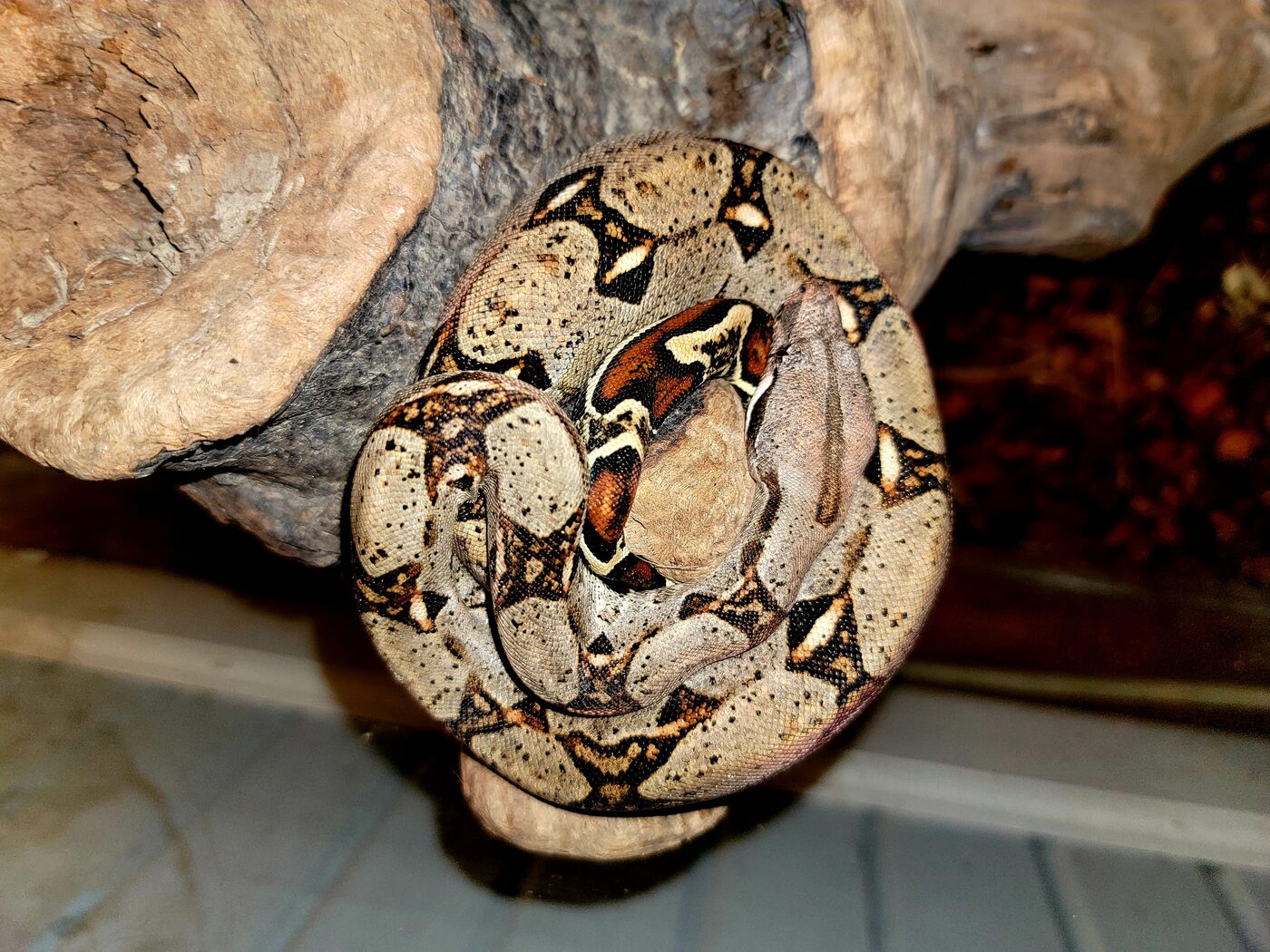
Common boa constrictor (red-tailed boa)
Boa constrictor
A powerful but famously steady big snake.
Pet trade
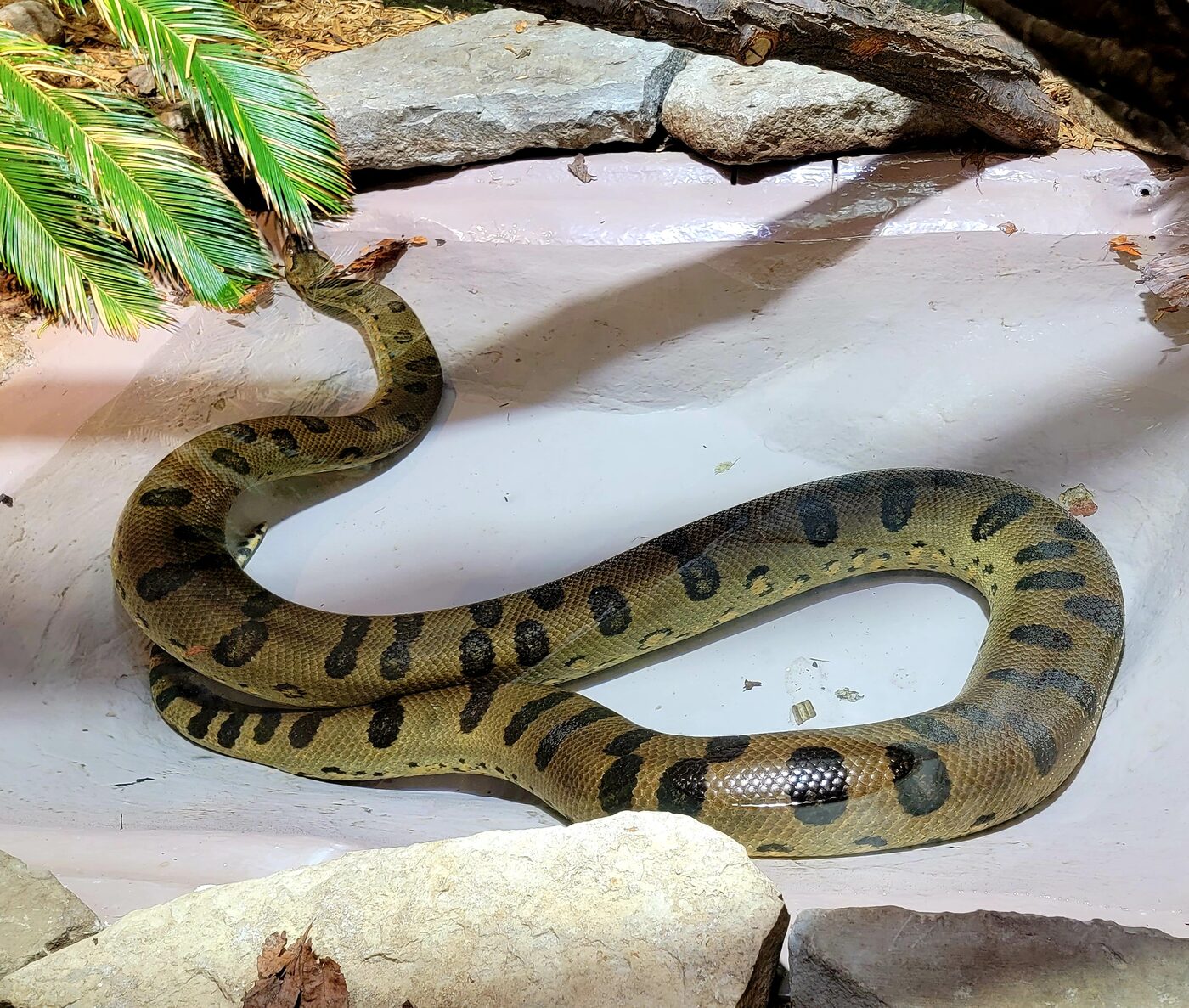
Green anaconda
Eunectes murinus
The heaviest snake on Earth, at home in the water.
Pet trade

Amazon basin emerald tree boa
Corallus batesii
Pet trade
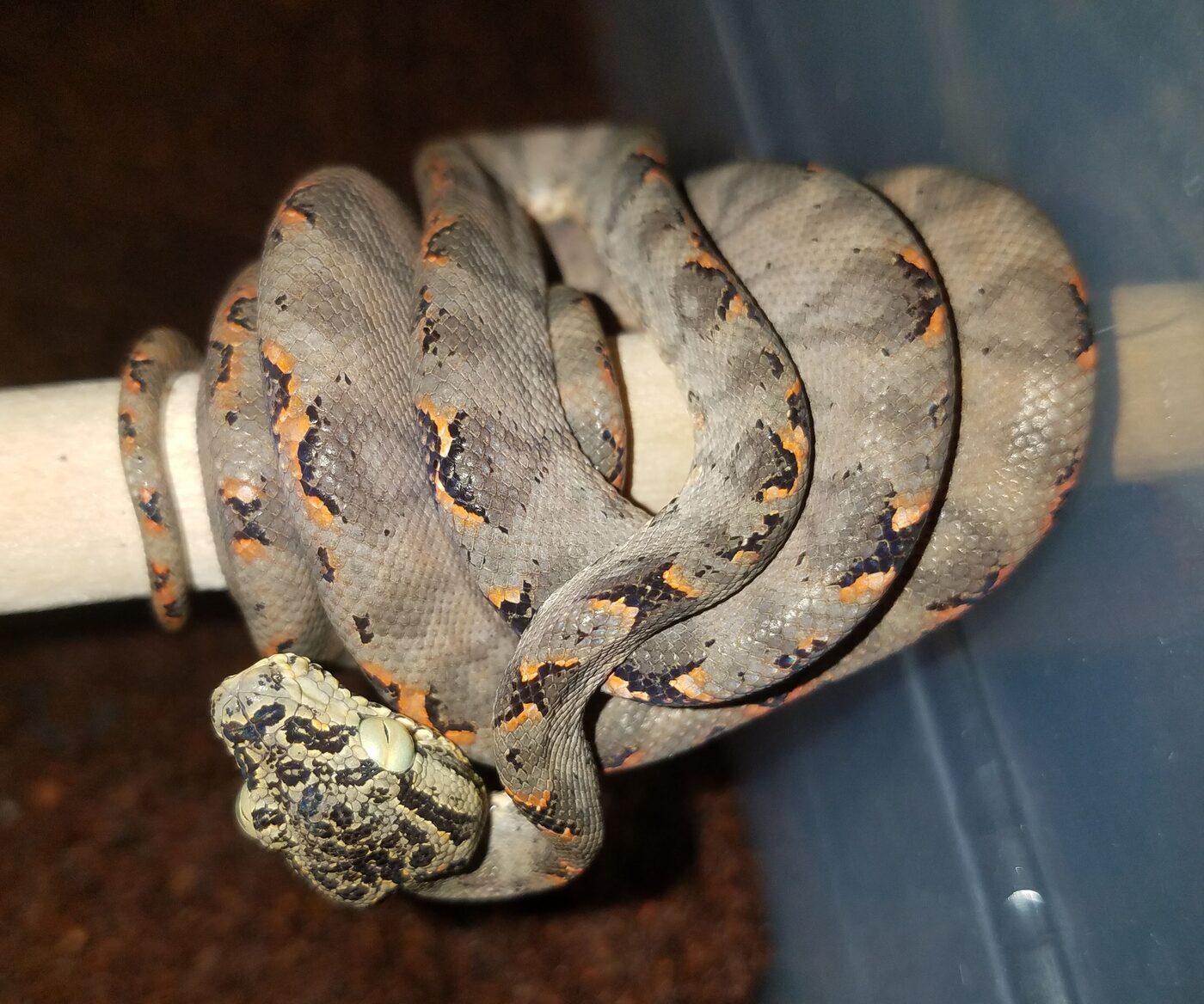
Amazon tree boa
Corallus hortulana
Pet trade

Annulated tree boa
Corallus annulatus
Pet trade

Arabian sand boa
Eryx jayakari
Pet trade