
Home / Birds / Parrots / Jenday conure
Some federal rules applyJenday conure
Aratinga jandaya
Birds › Parrots (Psittaciformes) › Psittacidae (New World and African parrots)
The jandaya parakeet (Aratinga jandaya), or jenday conure, is a small Neotropical parrot with green wings and tail, reddish-orange body, yellow head and neck, orange cheeks, and black bill, native to wooded habitats in northeastern Brazil.
From Wikipedia: Jandaya parakeet, CC BY-SA 4.0 (excerpt)

Care at a glance
Species-specific values
Values researched for this exact species. Air, surface and water temperatures are listed separately, and each source is kept as published rather than averaged.
| Minimum enclosure | At least 36 inches long, 24 inches wide, and 24 inches high. Source: lafeber.com | |
| Diet | Offer seeds, pellets, and a wide variety of fruits and vegetables daily. Source: lafeber.com | |
| Social housing | Paired Jendays can retain their pet quality with daily attention; compatible conures may be companions, without breeding. Source: lafeber.com | |
| Minimum enclosure | Minimum single-bird cage is 91 x 61 x 61 cm (36 x 24 x 24 in). Source: royalveterinarycenter.com | |
| Substrate | Line the tray with plain paper or newspaper; avoid scented, clumping, cedar, or pine shavings. Source: royalveterinarycenter.com | |
| Diet | Pellets should make up roughly 60 to 70 percent of daily intake, supplemented with vegetables, greens, and smaller amounts of fruit. Source: royalveterinarycenter.com | |
| Warm side air temperature | 64–84 °F (18–29 °C) Source: royalveterinarycenter.com | |
| Night temperature | 61–64 °F (16–18 °C) Source: royalveterinarycenter.com | |
| Humidity | 40–60 % Source: royalveterinarycenter.com | |
| Uvb lighting | Full-spectrum or UVB avian lighting is beneficial if the bird lacks unfiltered natural sunlight. Source: royalveterinarycenter.com | |
| Social housing | They can be kept as a bonded pair or small group; a single bird needs several hours of daily interaction. Source: royalveterinarycenter.com |
Understanding the animal
About this animal
About this animal
It is a member of the Aratinga solstitialis complex of parakeets very closely related to, and possibly subspecies of the sun conure. The bird has a wide range, but is locally rare in the wild; they are common in aviculture, where they are known as "jenday conures".
From Wikipedia: Jandaya parakeet, CC BY-SA 4.0 (excerpt)
In the wild
In the wild
| Overview | The jandaya parakeet (Aratinga jandaya), or jenday conure, is a small Neotropical parrot with green wings and tail, reddish-orange body, yellow head and neck, orange cheeks, and black bill, native to wooded habitats in northeastern Brazil. It is a member of the Aratinga solstitialis complex of parakeets very closely related to, and possibly subspecies of the sun conure. The bird has a wide range, but is locally rare in the wild; they are common in aviculture, where they are known as "jenday conures". — From Wikipedia: Jandaya parakeet, CC BY-SA 4.0 (excerpt) |
| Where it lives | It has an extremely large range in northeastern Brazil in the states of Piauí, Maranhão, Tocantins, and Ceará, and portions of Goiás and Pará. It is found in lowland deciduous woodland and palm groves. — From Wikipedia: Jandaya parakeet, CC BY-SA 4.0 (excerpt) |
| Wild diet | In the wild, it has a predilection for various fruits including mango and cashew apples, as well as palm nuts, and an unfortunate attraction to plants cultivated by humans (rice, maize, members of the family Annonaceae, etc.). Things that are toxic to jandaya parakeets include chocolate, caffeine, and a chemical often found in avocados. — From Wikipedia: Jandaya parakeet, CC BY-SA 4.0 (excerpt) |
| Reproduction | Jandaya parakeets nest in tree hollows, typically choosing a location at least 15 m (50 feet) from the ground. In captivity, the hen lays three to six eggs, which she then incubates for roughly 26 days. The young are fed by both parents, and fledge after two months. — From Wikipedia: Jandaya parakeet, CC BY-SA 4.0 (excerpt) |
| Appearance and size | The jandaya parakeet is a small, long-tailed parakeet with the reddish-orange body, green wings, vent and tail, yellow head, neck, and shoulders, orange cheeks, black bill, whitish orbital ring, and dark eyes. The ends of the tail feathers are tinged in blue. It measures 30 cm (12 in) in length and weighs 125–140 gm. — From Wikipedia: Jandaya parakeet, CC BY-SA 4.0 (excerpt) |
| History and naming | The first description of a bird called "jendaya" was by the German naturalist, Georg Marcgrave, who saw the bird during his 1638 expedition through Dutch Brazil. Based on Marcgrave's description, the jandaya parakeet was included in the works of Francis Willughby in 1678, John Ray in 1713, Mathurin Jacques Brisson in 1760, the Comte de Buffon in 1779, and John Latham in 1781. — From Wikipedia: Jandaya parakeet, CC BY-SA 4.0 (excerpt) |
| Conservation | The species is listed as least concern by IUCN. It is listed on CITES Appendix II. It is protected under Brazil Wildlife Protection Act (1967), export and trade forbidden. — From Wikipedia: Jandaya parakeet, CC BY-SA 4.0 (excerpt) |
Native climate (measured)
Native climate (measured)
| Warm-season highs | about 88°F (up to 92°F in the hottest sampled areas) |
| Cool-season lows | about 68°F (down to 64°F in the coldest sampled areas) |
| Average temperature | 76–80°F across sampled records |
| Relative humidity | 77–82% on average (driest month about 76%) |
| Rainfall | about 1743 mm a year |
Measured at 87 wild occurrence records sampled against WorldClim 2.1 climate data (1970–2000 averages). Air conditions in the range are ecological context, not enclosure settings: microhabitats such as burrows, leaf litter or basking rocks can be cooler, warmer or more humid.
Profile
Profile
Researched for this exact species. Sources are listed under In the wild above.
History
The first description of a bird called "jendaya" was by the German naturalist, Georg Marcgrave, who saw the bird during his 1638 expedition through Dutch Brazil. Based on Marcgrave's description, the jandaya parakeet was included in the works of Francis Willughby in 1678, John Ray in 1713, Mathurin Jacques Brisson in 1760, the Comte de Buffon in 1779, and John Latham in 1781.
From Wikipedia: Jandaya parakeet, CC BY-SA 4.0 (excerpt)
Data and studies
The numbers
The numbers
Each bar is what one source reports. Where several sources weigh in, the dashed gold band marks their average.
Typical adult weight
Average adult body mass in each database (FishBase gives the maximum recorded weight).
Veterinary & husbandry research
Veterinary & husbandry research
- Food selection and digestibility in yellow-headed conure (Aratinga jandaya) and golden-caped conure (Aratinga auricapilla) in captivity Carciofi AC et al., The Journal of nutrition 2006
Peer-reviewed papers that mention this species alongside captivity, zoos, veterinary care or aquaculture. Some cover several species or mention it only in passing, so check the abstract. PubMed
Sources for this sheet
- Myhrvold et al. (2015). An amniote life-history database. Ecology 96: 3109 Peer-reviewed researchPeer-reviewed compilation of life-history data for over 21,000 birds, mammals and reptiles.
- Species+ (UNEP-WCMC and the CITES Secretariat) Zoo, university or veterinaryThe official database of species listed under CITES. UNEP (2026). The Species+ Website. Nairobi, Kenya. Compiled by UNEP-WCMC, Cambridge, UK. Available at: www.speciesplus.net. [Accessed 04/10/2026].
- USFWS International Affairs: CITES Zoo, university or veterinaryFederal agency that issues CITES permits.
- 9 CFR 2.1: Animal Welfare Act licensing (USDA) Zoo, university or veterinaryWho needs a USDA license to breed, sell or exhibit animals.
- GBIF Backbone Taxonomy (Global Biodiversity Information Facility) (CC BY 4.0) Peer-reviewed researchInternational scientific taxonomy used here for classification. GBIF Secretariat (2023). GBIF Backbone Taxonomy. Checklist dataset https://doi.org/10.15468/39omei, accessed via GBIF.org.
- Wikipedia (species article) (CC BY-SA 4.0) Community referenceFree encyclopedia; useful overviews with their own citations. Short excerpts are quoted under CC BY-SA 4.0, each credited with a link to its article.
- PubMed (U.S. National Library of Medicine) Peer-reviewed researchIndex of peer-reviewed veterinary, zoo and husbandry research.
- iNaturalist (captive observations) Community referenceCommunity observation platform run by the California Academy of Sciences and National Geographic; observations marked captive show animals living in homes, zoos and aquariums.
More new world and african parrots
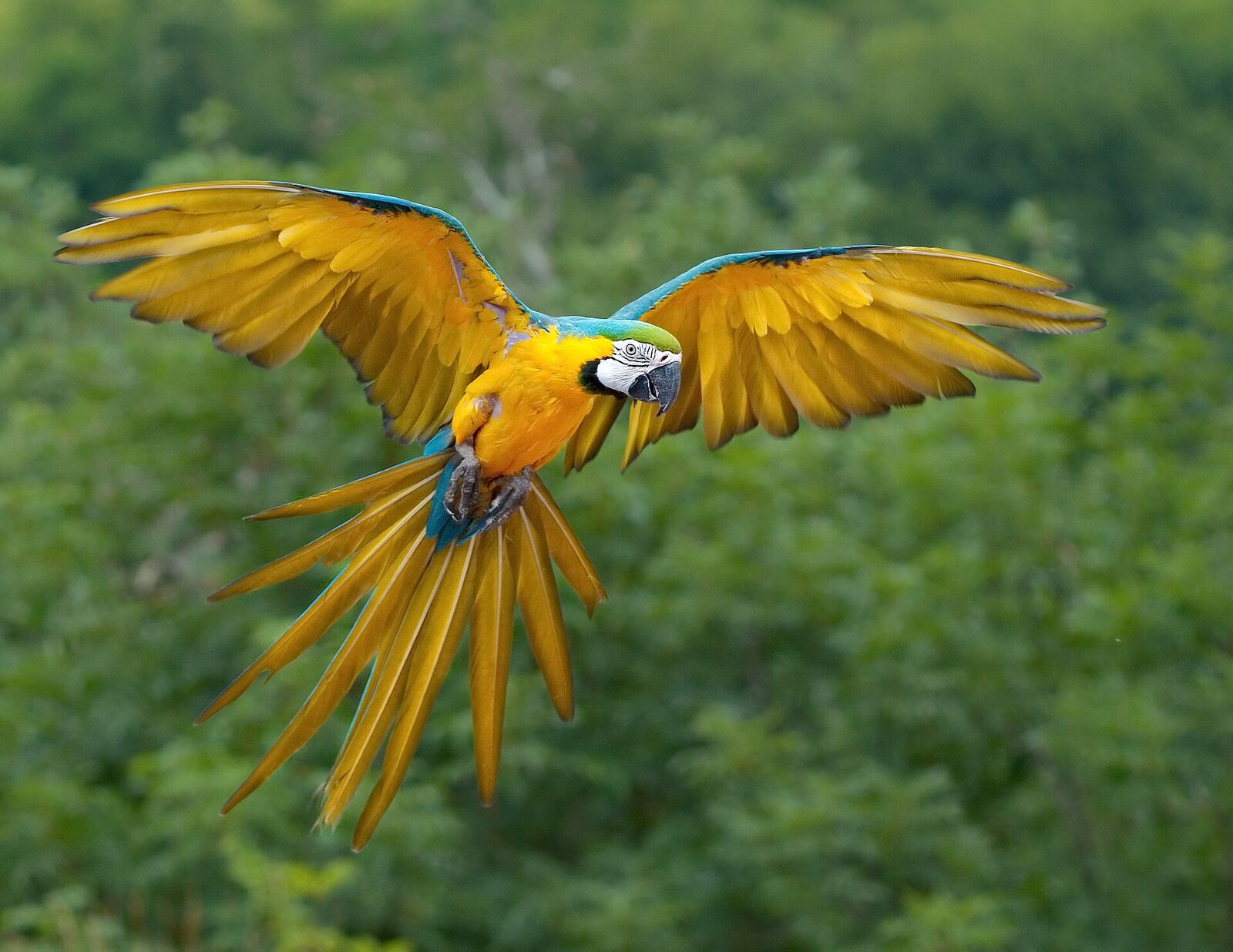
Blue-and-yellow macaw
Ara ararauna
A loud, brilliant, lifelong commitment.
Pet trade
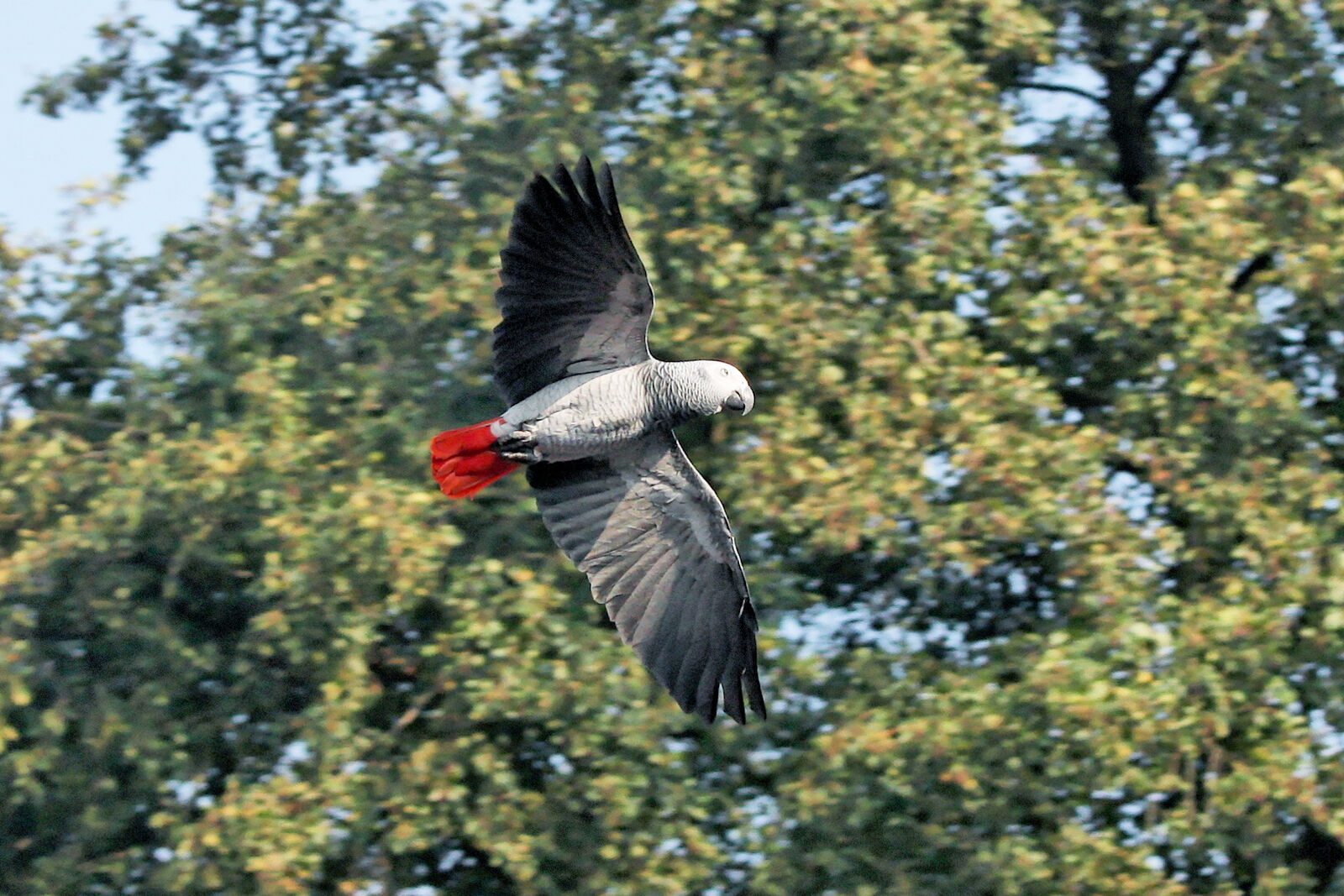
Gray parrot (Congo African grey)
Psittacus erithacus
One of the most intelligent birds on Earth.
Pet trade

Black-headed caique
Pionites melanocephalus
Pet trade

Blue-headed macaw
Primolius couloni
Aviary

Blue-throated macaw
Ara glaucogularis
Pet trade

Blue-winged (Illiger's) macaw
Primolius maracana
Pet trade