
Home / Amphibians / Frogs and toads / New Granada cross-banded tree frog
No federal permit to keepNew Granada cross-banded tree frog
Smilisca phaeota
Amphibians › Frogs and toads (Anura) › Hylidae (Tree frogs)
The New Granada cross-banded tree frog (Smilisca phaeota), also known as the masked tree frog, is a species of frog in the family Hylidae found in Colombia, Costa Rica, Ecuador, Honduras, Nicaragua, and Panama.
From Wikipedia: New Granada cross-banded tree frog, CC BY-SA 4.0 (excerpt)

Care at a glance
Species-specific values
Values researched for this exact species. Air, surface and water temperatures are listed separately, and each source is kept as published rather than averaged.
| Minimum enclosure | 18x18x24 enclosure for multiple frogs Source: joshsfrogs.com | |
| Minimum enclosure | 20 gallon high for a single adult Source: joshsfrogs.com | |
| Humidity | 50–70 % Source: joshsfrogs.com | |
| Humidity | up to 80 % Source: joshsfrogs.com | |
| Feeding frequency | Frogs consume three to four 1/4 inch crickets (gutloaded) three times every week. Source: joshsfrogs.com | |
| Social housing | Solitary by nature; they mainly seek each other out to breed. Source: joshsfrogs.com | |
| Substrate | Coco fiber or peat moss with leaf litter, or Tropical BioBedding with leaf litter; the latter is preferred by many. Source: joshsfrogs.com |
Warnings
Understanding the animal
About this animal
About this animal
Its natural habitats are subtropical or tropical dry forest, subtropical or tropical moist lowland forest, rivers, freshwater marshes, intermittent freshwater marshes, plantations, rural gardens, urban areas, heavily degraded former forests, ponds, and canals and ditches. Their nickname of masked tree frog comes from the black or dark colored markings that start at their nose and go back along the face toward their ear, covering their eye.
From Wikipedia: New Granada cross-banded tree frog, CC BY-SA 4.0 (excerpt)
In the wild
In the wild
| Overview | The New Granada cross-banded tree frog (Smilisca phaeota), also known as the masked tree frog, is a species of frog in the family Hylidae found in Colombia, Costa Rica, Ecuador, Honduras, Nicaragua, and Panama. Its natural habitats are subtropical or tropical dry forest, subtropical or tropical moist lowland forest, rivers, freshwater marshes, intermittent freshwater marshes, plantations, rural gardens, urban areas, heavily degraded former forests, ponds, and canals and ditches. — From Wikipedia: New Granada cross-banded tree frog, CC BY-SA 4.0 (excerpt) |
Native climate (measured)
Native climate (measured)
| Warm-season highs | about 86°F (up to 91°F in the hottest sampled areas) |
| Cool-season lows | about 67°F (down to 57°F in the coldest sampled areas) |
| Average temperature | 68–80°F across sampled records |
| Relative humidity | 80–85% on average (driest month about 78%) |
| Rainfall | about 2520 mm a year |
Measured at 238 wild occurrence records sampled against WorldClim 2.1 climate data (1970–2000 averages). Air conditions in the range are ecological context, not enclosure settings: microhabitats such as burrows, leaf litter or basking rocks can be cooler, warmer or more humid.
Data and studies
The numbers
The numbers
Each bar is what one source reports. Where several sources weigh in, the dashed gold band marks their average.
Maximum recorded lifespan
Longest recorded lifespan reported by each database; typical lifespans are usually shorter. The AnAge record comes from an animal in human care.
Sources for this sheet
- AnAge: The Animal Ageing and Longevity Database (Human Ageing Genomic Resources) (CC BY 3.0) Peer-reviewed researchCurated, referenced longevity and life-history records for thousands of species; maximum lifespans are often from zoo animals.
- AmphibiaWeb (University of California, Berkeley) (CC BY-NC) Peer-reviewed researchUniversity-hosted database of amphibian biology and conservation.
- Wikipedia (species article) (CC BY-SA 4.0) Community referenceFree encyclopedia; useful overviews with their own citations. Short excerpts are quoted under CC BY-SA 4.0, each credited with a link to its article.
- iNaturalist (captive observations) Community referenceCommunity observation platform run by the California Academy of Sciences and National Geographic; observations marked captive show animals living in homes, zoos and aquariums.
More tree frogs

Amazon milk frog
Trachycephalus resinifictrix
Pet trade

American green tree frog
Dryophytes cinereus
Pet trade
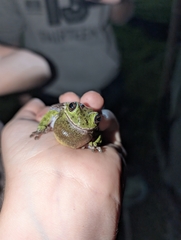
Barking tree frog
Dryophytes gratiosus
Pet trade
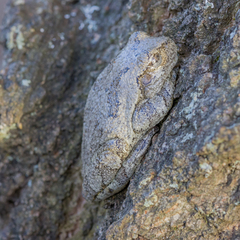
Cope's gray tree frog
Dryophytes chrysoscelis
Pet trade

Cuban tree frog
Osteopilus septentrionalis
Pet trade

European tree frog
Hyla arborea
Zoos & aquariums