
Home / Amphibians / Salamanders and newts / Kurdistan newt
Federal restrictions applyKurdistan newt
Neurergus derjugini
Amphibians › Salamanders and newts (Caudata) › Salamandridae (Newts and fire salamanders)
Neurergus derjugini, the Kurdistan newt, Kurdistan newt, Derjugin's (Kurdistan) mountain newt, or yellow-spotted mountain newt, is a species of salamander in the family Salamandridae.
From Wikipedia: Kurdistan newt, CC BY-SA 4.0 (excerpt)
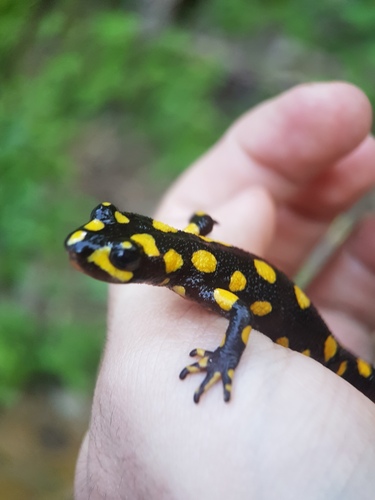
Care at a glance
Species-specific values
Values researched for this exact species. Air, surface and water temperatures are listed separately, and each source is kept as published rather than averaged.
| Minimum enclosure | At least 45 L. Source: atlarium.bio | |
| Night temperature | 46–54 °F (8–12 °C) Source: atlarium.bio | |
| Humidity | 50–80 % Source: atlarium.bio | |
| Water temperature | 57–64 °F (14–18 °C) Source: atlarium.bio | |
| Seasonal cooling | 39–46 °F (4–8 °C) Source: atlarium.bio | |
| Uvb lighting | Provide low-output 5% UVB lighting. Source: atlarium.bio | |
| Diet | Offer daphnia, blackworms, bloodworms, small snails, and chopped earthworms. Source: atlarium.bio | |
| Social housing | Generally peaceful and social in small groups of their own species; avoid housing with other species. Source: atlarium.bio |
Warnings
Understanding the animal
About this animal
About this animal
It is found in Kurdistan in western Iran and in northeastern Iraq. There are two subspecies, Neurergus derjugini and Neurergus derjugini microspilotus, the latter is sometimes known as the Avroman Dagh newt.
From Wikipedia: Kurdistan newt, CC BY-SA 4.0 (excerpt)
In the wild
In the wild
| Overview | Neurergus derjugini, the Kurdistan newt, Kurdistan newt, Derjugin's (Kurdistan) mountain newt, or yellow-spotted mountain newt, is a species of salamander in the family Salamandridae. It is found in Kurdistan in western Iran and in northeastern Iraq. There are two subspecies, Neurergus derjugini and Neurergus derjugini microspilotus, the latter is sometimes known as the Avroman Dagh newt. — From Wikipedia: Kurdistan newt, CC BY-SA 4.0 (excerpt) |
| Where it lives | Neurergus derjugini occurs in small streams at elevations of 1300–1865 m above sea level. It is threatened by droughts, water extraction, pollution, and collection for pet trade. It is known from a small number of populations, most of them very small. — From Wikipedia: Kurdistan newt, CC BY-SA 4.0 (excerpt) |
| Reproduction | Breeding takes place from April to June. Females lay eggs about 6 mm long (including the capsule), either singly or in small groups on vegetation and rocks in the stream. A female may lay around 100 eggs. — From Wikipedia: Kurdistan newt, CC BY-SA 4.0 (excerpt) |
| History and naming | The species was first described by Pyotr Nesterov in 1916 based on a population in the Surkev Mountains. He described a second population from the Avroman region as a subspecies microspilotus which varied in the number of yellow spots and the spots being more circular. — From Wikipedia: Kurdistan newt, CC BY-SA 4.0 (excerpt) |
Native climate (measured)
Native climate (measured)
| Warm-season highs | about 96°F (up to 106°F in the hottest sampled areas) |
| Cool-season lows | about 25°F (down to 19°F in the coldest sampled areas) |
| Average temperature | 51–68°F across sampled records |
| Relative humidity | 42–46% on average (driest month about 21%) |
| Rainfall | about 700 mm a year, with strong wet and dry seasons |
| Winters | Cool to cold winters (lows around 25°F) in much of its native range. Seasonal slowdown may be relevant, but species-specific biology determines whether brumation or hibernation occurs. |
Measured at 16 wild occurrence records sampled against WorldClim 2.1 climate data (1970–2000 averages). Air conditions in the range are ecological context, not enclosure settings: microhabitats such as burrows, leaf litter or basking rocks can be cooler, warmer or more humid.
Profile
Profile
Researched for this exact species. Sources are listed under In the wild above.
History
The species was first described by Pyotr Nesterov in 1916 based on a population in the Surkev Mountains. He described a second population from the Avroman region as a subspecies microspilotus which varied in the number of yellow spots and the spots being more circular.
From Wikipedia: Kurdistan newt, CC BY-SA 4.0 (excerpt)
Sources for this sheet
- 50 CFR Part 16: Injurious wildlife (Lacey Act) Zoo, university or veterinaryCurrent federal regulation, read from eCFR.
- U.S. Association of Reptile Keepers v. Zinke (D.C. Cir. 2017) Zoo, university or veterinaryAppeals ruling that the Lacey Act's shipping ban does not cover moves between the continental states.
- AmphibiaWeb (University of California, Berkeley) (CC BY-NC) Peer-reviewed researchUniversity-hosted database of amphibian biology and conservation.
- GBIF Backbone Taxonomy (Global Biodiversity Information Facility) (CC BY 4.0) Peer-reviewed researchInternational scientific taxonomy used here for classification. GBIF Secretariat (2023). GBIF Backbone Taxonomy. Checklist dataset https://doi.org/10.15468/39omei, accessed via GBIF.org.
- Wikipedia (species article) (CC BY-SA 4.0) Community referenceFree encyclopedia; useful overviews with their own citations. Short excerpts are quoted under CC BY-SA 4.0, each credited with a link to its article.
More newts and fire salamanders

Algerian newt
Pleurodeles poireti
Zoos & aquariums

Algerian ribbed newt
Pleurodeles nebulosus
Pet trade

Alpine newt
Ichthyosaura alpestris
Pet trade

California newt
Taricha torosa
Pet trade

Chinese fire-bellied newt
Hypselotriton orientalis
Pet trade

Chinese warty newt
Paramesotriton chinensis
Zoos & aquariums