
Home / Invertebrates / Scorpions / Scorpion
Some federal rules applyScorpion
Pandinus dictator
Invertebrates › Scorpions (Scorpiones) › Scorpionidae (Emperor and forest scorpions)
Care at a glance
Species-specific values
Values researched for this exact species. Air, surface and water temperatures are listed separately, and each source is kept as published rather than averaged.
| Minimum enclosure | Roughly 10–20+ gallon-equivalent floor space is commonly practical for large adults. Source: habitatcraft.com | |
| Warm side air temperature | 75–85 °F Source: habitatcraft.com | |
| Humidity | 70–80 % Source: habitatcraft.com | |
| Substrate | Use deep, burrowable, moisture-retentive substrate; 5–7+ inches is a practical target for large adults. Source: habitatcraft.com | |
| Diet | Feed appropriately sized live or pre-killed insects, such as large crickets, dubia roaches, or locusts. Source: habitatcraft.com | |
| Feeding frequency | Feed juveniles every 5–7 days and adults every 1–2 weeks. Source: habitatcraft.com | |
| Social housing | Communal keeping is possible under specific conditions but is not recommended for new keepers and carries cannibalism risk. Source: habitatcraft.com | |
| Water temperature | Provide a shallow water dish at all times. Source: habitatcraft.com | |
| Minimum enclosure | House one or two in a 10-gallon horizontal glass tank; use a slightly larger tank for more than two. Source: backwaterreptilesblog.com | |
| Warm side air temperature | Keep temperatures in the mid-80s throughout the day. Source: backwaterreptilesblog.com | |
| Night temperature | A slight temperature drop at night is fine. Source: backwaterreptilesblog.com | |
| Diet | They eat insects; listed foods include gut-loaded crickets, roaches, mealworms, and occasional wax worms. Source: backwaterreptilesblog.com | |
| Feeding frequency | A few insects per animal every other day is an acceptable amount. Source: backwaterreptilesblog.com | |
| Social housing | Several same-size scorpions can usually share an enclosure if space is sufficient; do not house multiple males together. Source: backwaterreptilesblog.com | |
| Substrate | Provide substrate suitable for burrowing. Source: backwaterreptilesblog.com |
Understanding the animal
Native climate (measured)
Native climate (measured)
| Warm-season highs | about 85°F (up to 89°F in the hottest sampled areas) |
| Cool-season lows | about 67°F (down to 66°F in the coldest sampled areas) |
| Average temperature | 74–79°F across sampled records |
| Relative humidity | 83–85% on average (driest month about 81%) |
| Rainfall | about 2084 mm a year |
Measured at 10 wild occurrence records sampled against WorldClim 2.1 climate data (1970–2000 averages). Air conditions in the range are ecological context, not enclosure settings: microhabitats such as burrows, leaf litter or basking rocks can be cooler, warmer or more humid.
Sources for this sheet
- Species+ (UNEP-WCMC and the CITES Secretariat) Zoo, university or veterinaryThe official database of species listed under CITES. UNEP (2026). The Species+ Website. Nairobi, Kenya. Compiled by UNEP-WCMC, Cambridge, UK. Available at: www.speciesplus.net. [Accessed 04/10/2026].
- USFWS International Affairs: CITES Zoo, university or veterinaryFederal agency that issues CITES permits.
- GBIF Backbone Taxonomy (Global Biodiversity Information Facility) (CC BY 4.0) Peer-reviewed researchInternational scientific taxonomy used here for classification. GBIF Secretariat (2023). GBIF Backbone Taxonomy. Checklist dataset https://doi.org/10.15468/39omei, accessed via GBIF.org.
More emperor and forest scorpions
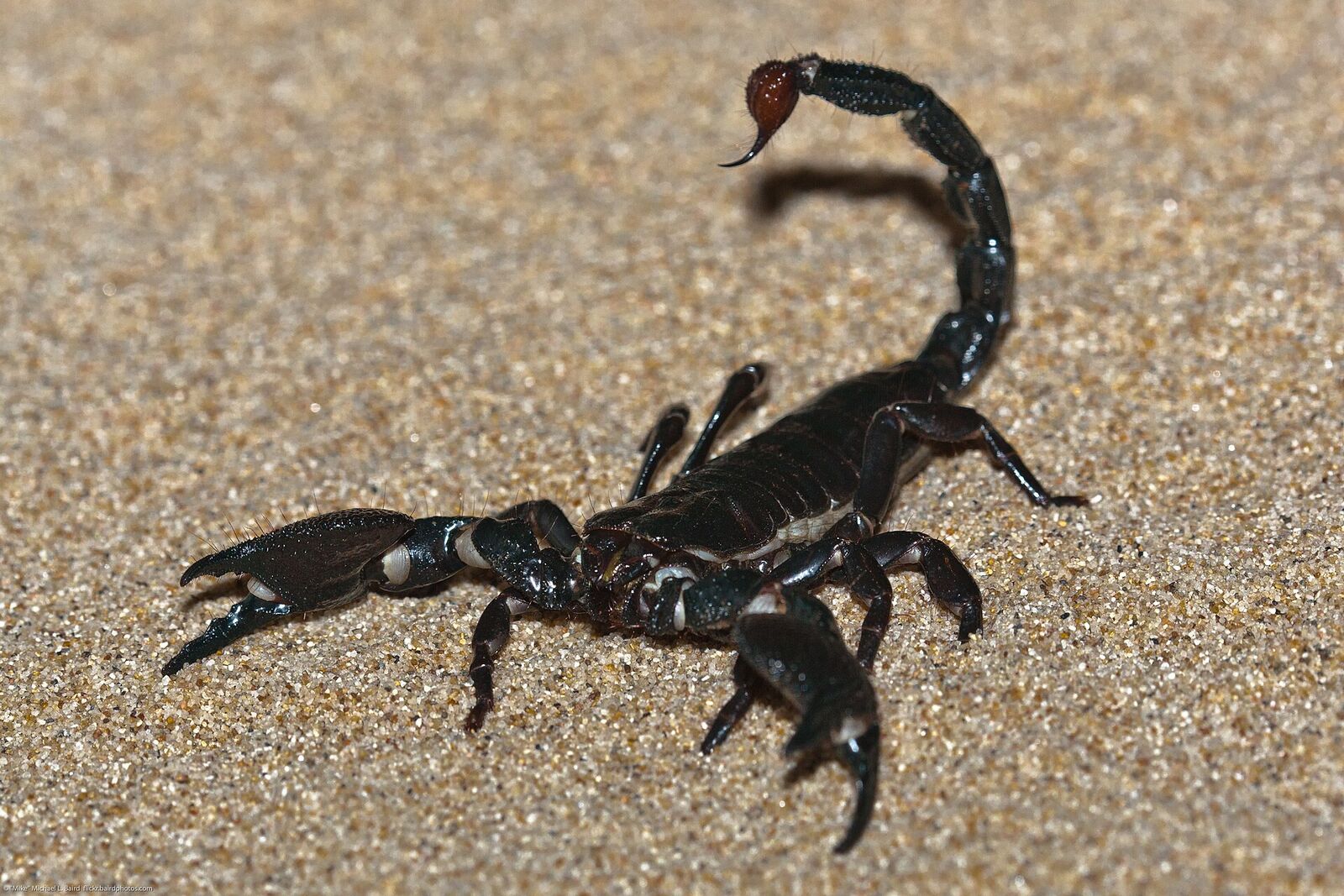
Emperor scorpion
Pandinus imperator
A big, shy scorpion with a mild sting.
Pet trade

Asian forest scorpion
Heterometrus spinifer
Pet trade

Asian giant forest scorpion
Heterometrus laoticus
Pet trade
Heterometrus longimanus
Heterometrus longimanus
Pet trade

Heterometrus silenus
Heterometrus silenus
Pet trade

Tanzanian red-clawed scorpion
Pandinus cavimanus
Pet trade