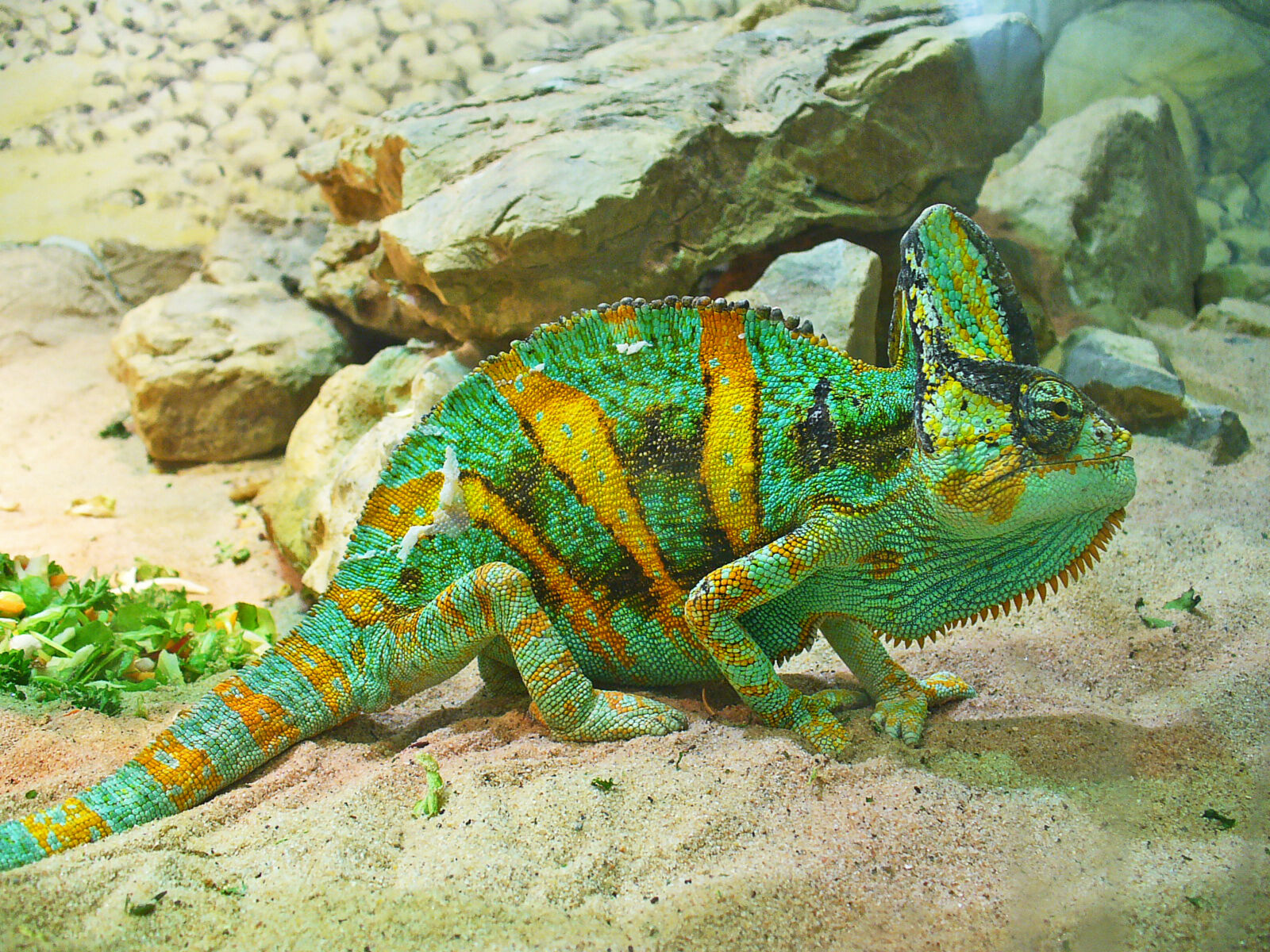
Home / Reptiles / Lizards / Panther chameleon
Some federal rules apply In-depth sheetPanther chameleon
Furcifer pardalis
Reptiles › Lizards (Lacertilia) › Chamaeleonidae (Chameleons)
Panther chameleons are stunningly colored, solitary chameleons from Madagascar with care similar to veileds.
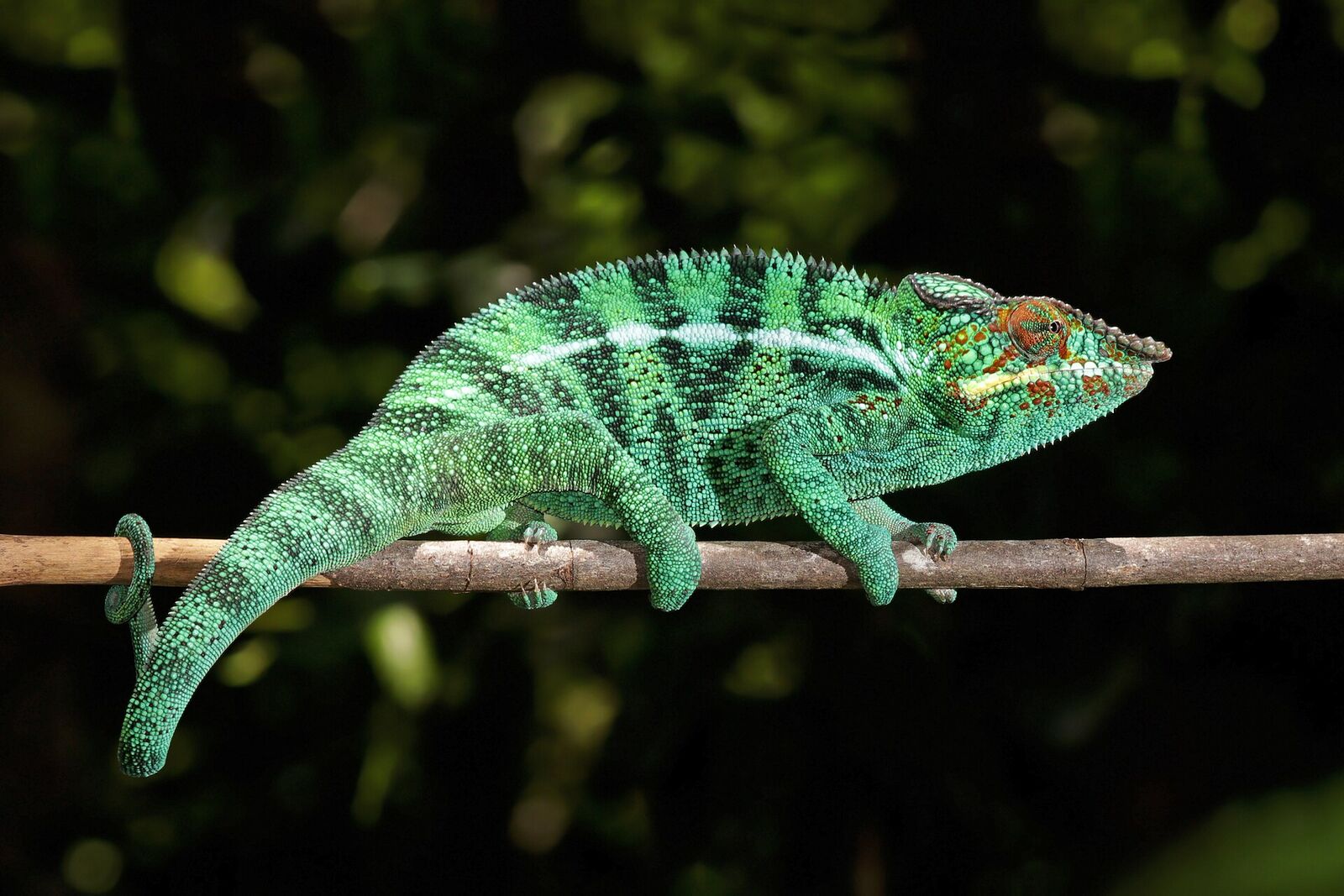
Care at a glance
Species-specific values
Values researched for this exact species. Where they differ from the group guide below, follow these. Air, surface and water temperatures are listed separately, and each source is kept as published rather than averaged.
| Minimum enclosure dimensions | length: 24 in; width: 24 in; height: 48 in One animal; larger preferred. | 221 |
| Basking surface temperature | 85–90 °F Source measures using a probe on the basking surface. | 221 |
| General enclosure temperature | 72–77 °F Source recommends IR measurement here; measurement type ambiguous, do not silently label as air. | 221 |
| Night temperature | 60–70 °F Source does not expressly identify measurement type. | 221 |
| Day relative humidity | 50–60 % | 221 |
| Night relative humidity | 75–100 % | 221 |
| Diet | Varied insects; adjust intake to age and body condition. | 221 |
| Basking uv index | 3 UVI Approximate target at the animal, with shaded retreats. | 221 |
Care guide
Enclosure
- Minimum 24×24×48 in; cool end about 77°F; strong UVB.
Sources 50
Show the group care guide for chameleons
Chameleons
Applies to most species in this group. Habitat: Tropical and montane forests. Individual species can differ, so compare with the species numbers above and the linked sources.
Housing & setup
- Screen or hybrid enclosures with lots of live plants and branches; good airflow.
- Daily misting or a dripper; chameleons rarely drink from bowls.
- Montane species (Jackson's, Meller's) need cooler temperatures than veiled or panther chameleons.
Climate & lighting
Starting point only: Jackson and panther day/night regimes differ; VCA and RF also disagree and must remain separate. Check the species-specific values for this animal where shown.
| Basking spot | 85–95°F |
| Warm side / daytime | 75–85°F |
| Cool side | 65–75°F |
| Humidity | 50–80% |
- UVB: Required.
Diet
- Gut-loaded insects dusted with calcium and multivitamins on a schedule.
Social life
- Solitary; even seeing another chameleon can stress them.
Handling
- Minimal handling; they're display animals.
Health watch
- Dehydration, MBD, eye problems and stress from handling or seeing other chameleons.
- House singly.
Understanding the animal
In the wild
In the wild
Researched for this exact species, not its family. Good care copies these conditions.1234
| Where it lives | Lowland vegetation of northern and eastern coastal Madagascar. It often uses shrubs and trees at forest edges, roadsides and river margins, favoring relatively open sunny vegetation. |
| Ground it lives on | Arboreal; females descend to soil to bury eggs. |
| Active | Diurnal. |
| Social life | Solitary and territorial; males defend resident shrubs or trees and may pursue and injure rivals. |
| Wild diet | Primarily terrestrial invertebrates captured from vegetation with the projectile tongue; plant material is rare. |
| Behavior to plan for | Grasps branches with specialized feet and tail, and visually tracks passing prey. Color and posture displays signal territorial or reproductive interactions. |
What this means for care
- Provide many narrow graspable branches and foliage, plus access to light and shade.
- House individually with visual barriers from rivals.
- Provide suitable digging soil for egg-laying females.
- Offer insect prey in positions reachable from stable perches.
Native climate (measured)
Native climate (measured)
| Warm-season highs | about 86°F (up to 90°F in the hottest sampled areas) |
| Cool-season lows | about 62°F (down to 50°F in the coldest sampled areas) |
| Average temperature | 66–79°F across sampled records |
| Relative humidity | 73–81% on average (driest month about 72%) |
| Rainfall | about 1711 mm a year |
Measured at 71 wild occurrence records sampled against WorldClim 2.1 climate data (1970–2000 averages). Air conditions in the range are ecological context, not enclosure settings: microhabitats such as burrows, leaf litter or basking rocks can be cooler, warmer or more humid.
Profile
Profile
Researched for this exact species. Sources are listed under In the wild above.
History
The panther chameleon was first described by French naturalist Georges Cuvier in 1829. Although currently treated as one widespread and highly variable species, genetic and captive-breeding evidence cited by Wikipedia suggests it may eventually be divided into several species.
Keeper tips
- Provide a tall enclosure suited to an animal that spends almost all of its time in trees.
- Use live nontoxic plants together with multiple sticks or vines for climbing.
- ReptiFiles recommends a 24 x 24 x 48 inch mesh enclosure or larger.
- Reptiles Magazine states that young animals can initially be housed in smaller cages to make prey easier to locate.
- Expect specialized equipment and comparatively demanding husbandry.
Behaviors reported
- Very rarely descends from trees to the ground.
- Uses open areas for basking.
- Males use visual signals during courtship.
- Males establish territories.
Unique adaptations
- Wide, splayed zygodactylous feet.
- Bulging independently moving eyes.
- A curled tail.
- Strong geographic variation in coloration and pattern.
Remarkable facts
- Panther chameleons are among the largest types of chameleon.
- Wikipedia and ReptiFiles give an adult length of about 16-20 inches.
- Males are generally larger and much more colorful than females.
- Regional color forms are commonly called locales.
- The species has been introduced to Réunion, Mauritius and Florida.
- ReptiFiles gives lifespans of up to about 6 years for males and 3 years for females, while Reptiles Magazine states approximately 5-7 years under good conditions.
From the sources
From the sources
Quoted from the matching sections of reputable sources for this exact species. Specialist databases are used first; Wikipedia (community-edited, CC BY-SA 4.0) only fills gaps. Other sources are short credited quotes.
| Overview | The panther chameleon (Furcifer pardalis) is a species of chameleon found in the eastern and northern parts of Madagascar in a tropical forest biome. Additionally, it has been introduced to Réunion and Mauritius, as well as the state of Florida within the United States. — Wikipedia (community-edited) |
| Where it lives | Furcifer pardalis mainly inhabits lowland, dry deciduous forests close to thin belts of trees bordering rivers and roads. — Animal Diversity Web |
| Behavior | The panther chameleon is very territorial; aside from mating, it spends the majority of its life in isolation. When two males come into contact, they will change color and inflate their bodies, attempting to assert their dominance. Often these battles end at this stage, with the loser retreating, turning drab and dark colors. — Wikipedia (community-edited) |
| Reproduction | Courtship often begins with displays by males. — Animal Diversity Web |
| Lifespan | While males can exceed five years of age in captivity, most wild panther chameleons survive only one or two years after maturity. — Animal Diversity Web |
| Appearance and size | The most fascinating feature of Furcifer pardalis is their extraordinarily vibrant coloration. — Animal Diversity Web |
| History and naming | Named after Latin pardalis, panther, denoting the black colouration of the type specimen (Charles Klaver, pers. comm., 11 Jan 2023). — The Reptile Database |
Data and studies
The numbers
The numbers
Each bar is what one source reports. Where several sources weigh in, the dashed gold band marks their average.
Basking
Humidity
Maximum recorded lifespan
Longest recorded lifespan reported by each database; typical lifespans are usually shorter. The AnAge record comes from an animal in human care.
Incubation
Night temperature
Species-specific values from keeper care sheets. Basking figures are often surface readings taken with an infrared thermometer, which run hotter than air.
Care articles for this species
Care articles for this species
- Panther Chameleon Care Sheet (ReptiFiles)
- Panther Chameleon Care Sheet (Reptiles Magazine)
- Panther Chameleon Care Information (Reptiles Magazine)
- Breeding Panther Chameleons (Reptiles Magazine)
- Natural History, Breeding and Care for Panther Chameleons (Reptiles Magazine)
Veterinary & husbandry research
Veterinary & husbandry research
- Ultrasonographic appearance of the coelomic cavity organs in healthy veiled chameleons (Chamaeleo calyptratus) and panther chameleons (Furcifer pardalis) Melero A et al., Veterinary radiology & ultrasound: the official journal of the American College of Veterinary Radiology and the International Veterinary Radiology Association 2020
- Is the natural UV zone important for successful captive propagation of the Panther Chameleon (Furcifer pardalis); are different UVB irradiance exposures that generate a similar dose equally successful? Ferguson GW et al., Zoo biology 2021
- Computed tomography of the coelomic cavity in healthy veiled chameleons (Chamaeleo calyptratus) and panther chameleons (Furcifer pardalis) Melero A et al., Open veterinary journal 2023
- Female heterogamety in Madagascar chameleons (Squamata: Chamaeleonidae: Furcifer): differentiation of sex and neo-sex chromosomes Rovatsos M et al., Scientific reports 2015
Peer-reviewed papers that mention this species alongside captivity, zoos, veterinary care or aquaculture. Some cover several species or mention it only in passing, so check the abstract. See all 13 on PubMed → 170
Sources for this sheet
- Royal Veterinary College Exotics Service: Panther chameleon care Zoo, university or veterinaryVet-school exotics hospital factsheet, reviewed 2021–2024.
- AnAge: The Animal Ageing and Longevity Database (Human Ageing Genomic Resources) Peer-reviewed researchCurated, referenced longevity and life-history records for thousands of species; maximum lifespans are often from zoo animals.
- Myhrvold et al. (2015). An amniote life-history database. Ecology 96: 3109 Peer-reviewed researchPeer-reviewed compilation of life-history data for over 21,000 birds, mammals and reptiles.
- ReptiFiles (care guides) Experienced keeper or breederWell-researched reptile care guides that cite herpetological literature and experienced keepers.
- Species+ (UNEP-WCMC and the CITES Secretariat) Zoo, university or veterinaryThe official database of species listed under CITES.
- USFWS International Affairs: CITES Zoo, university or veterinaryFederal agency that issues CITES permits.
- Merck Veterinary Manual: Management and husbandry of reptiles Zoo, university or veterinaryThe Merck Veterinary Manual: a standard veterinary reference written and reviewed by veterinary specialists.
- Merck Veterinary Manual: Nutritional, metabolic and endocrine diseases of reptiles Zoo, university or veterinaryThe Merck Veterinary Manual: a standard veterinary reference written and reviewed by veterinary specialists.
- Royal Veterinary College Exotics Service: Veiled chameleon care Zoo, university or veterinaryVet-school exotics hospital factsheet, reviewed 2021–2024.
- ReptiFiles: Jackson's chameleon lighting and temperatures Zoo, university or veterinaryAdded in the 2026 source-checked care-guide review.
- ReptiFiles: Jackson's chameleon humidity and water Zoo, university or veterinaryAdded in the 2026 source-checked care-guide review.
- ReptiFiles: Panther chameleon care sheet Zoo, university or veterinaryAdded in the 2026 source-checked care-guide review.
- VCA Animal Hospitals: Care and Housing for Chameleons Zoo, university or veterinaryAdded in the 2026 source-checked care-guide review.
- Clint's Reptiles (YouTube): Panther Chameleon, The Best Pet Lizard? Expert educator & keeperClint Laidlaw, PhD in Biology Education and MS in Evolutionary Ecology; owner of Clint's Reptile Room and a longtime keeper. His "Best Pet?" series reviews each species' care in depth.
- The Reptile Database Peer-reviewed researchScientist-curated catalog of every reptile species, with taxonomy and literature.
- GBIF Backbone Taxonomy (Global Biodiversity Information Facility) Peer-reviewed researchInternational scientific taxonomy used here for classification.
- Wikipedia (species article) Community referenceFree encyclopedia; useful overviews with their own citations. Intro text is quoted under CC BY-SA 4.0.
- PubMed (U.S. National Library of Medicine) Peer-reviewed researchIndex of peer-reviewed veterinary, zoo and husbandry research.
- iNaturalist (captive observations) Community referenceCommunity observation platform run by the California Academy of Sciences and National Geographic; observations marked captive show animals living in homes, zoos and aquariums.
- Reptiles Magazine (care articles) Experienced keeper or breederEstablished reptile and amphibian hobby magazine; care articles are written by breeders, keepers and veterinarians.