
Home / Reptiles / Lizards / Chamaeleonidae / Veiled chameleon
Some federal rules applyVeiled chameleon
Chamaeleo calyptratus
Reptiles › Lizards (Lacertilia) › Chamaeleonidae (Chameleons)
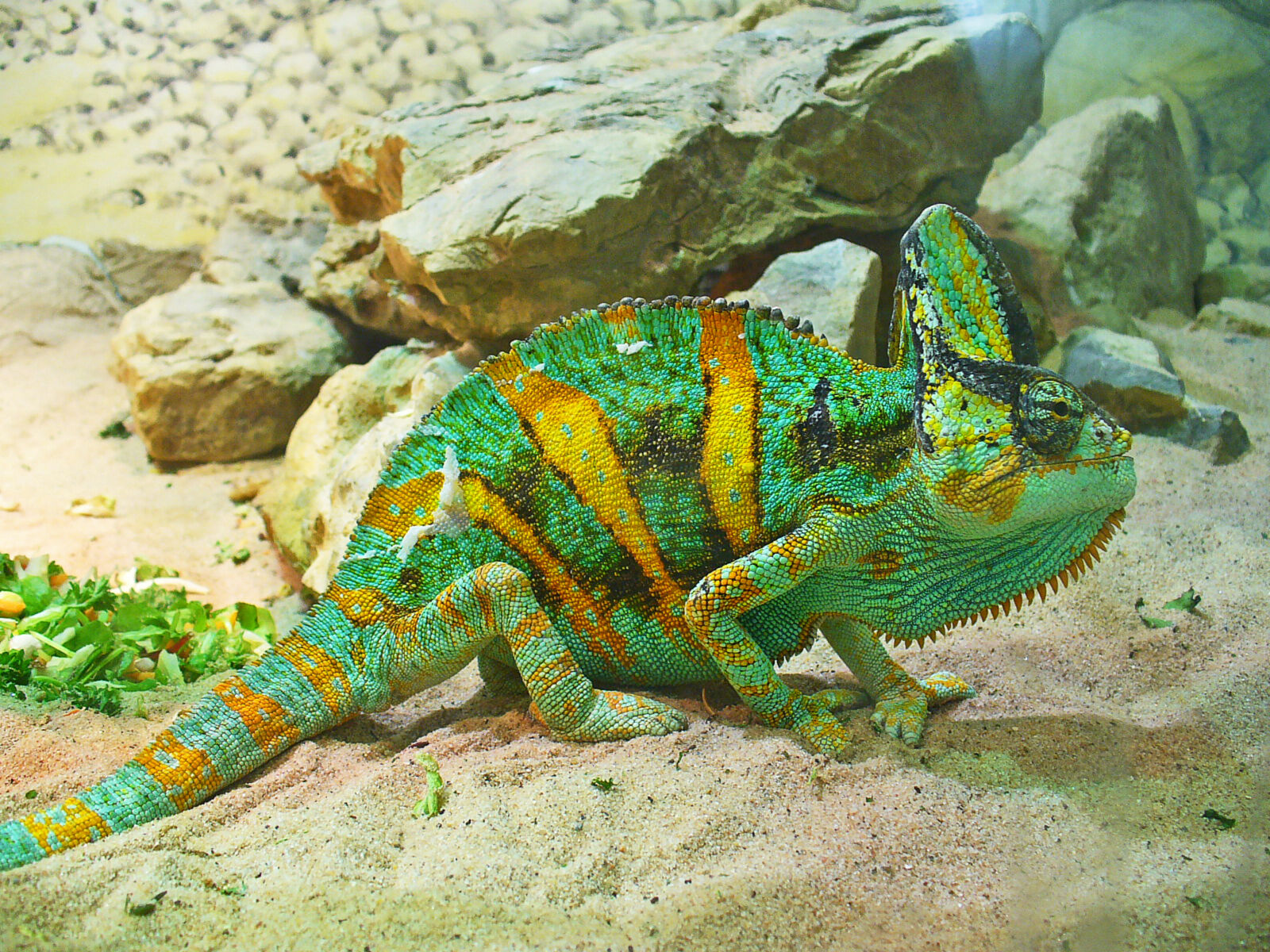
Veiled chameleons are hardy for chameleons but need tall, ventilated enclosures, high humidity and strong UVB. They live about 4–7 years.
Care guide
Enclosure
- Minimum 24×24×48 in, tall and well ventilated, with strong UVB (10–12%) about 12 hours a day.
Sources rvc.ac.uk
Feeding
- Dust live insects and remove any not eaten within 30 minutes.
Sources rvc.ac.uk
Understanding the animal
In the wild
In the wild
Researched for this exact species, not its family. Wild conditions are context, not enclosure settings.123456
| Where it lives | Southwestern Arabia, particularly Yemen and southwestern Saudi Arabia; uses shrubs and trees in vegetated wadis, foothills and cultivated landscapes. Often occupies low vegetation by day and higher branches at night. |
| Ground it lives on | arboreal; shrubs and branches; females descend to dig egg nests |
| Climate | Native habitats range from semi-arid to tropical, with monsoon rainfall approximately May–September and cooler highland conditions. Reliable species-wide wild temperature and relative-humidity ranges were not established. |
| Active | Diurnal. |
| Social life | Solitary and territorial; males display and fight over access to females. |
| Wild diet | Primarily insects; also consumes plant leaves. |
| Behavior to plan for | Uses gripping feet and a prehensile tail to climb, and captures insects with a projectile tongue. Females dig underground egg nests. |
- Animal Diversity Web: Chamaeleo calyptratus (CC BY-NC-SA 3.0)
- Stahl (1997): Captive management, breeding, and common medical problems of the veiled chameleon
- University of Florida IFAS: Florida’s Introduced Reptiles — Chameleons
- The Reptile Database: Chamaeleo calyptratus
- Veiled Chameleon Care Sheet | ReptiFiles
- Veiled Chameleon Care Sheet | Reptiles Magazine
Native climate (measured)
Native climate (measured)
| Warm-season highs | about 91°F (up to 92°F in the hottest sampled areas) |
| Cool-season lows | about 52°F (down to 50°F in the coldest sampled areas) |
| Average temperature | 72–75°F across sampled records |
| Relative humidity | 72–73% on average (driest month about 68%) |
| Rainfall | about 1288 mm a year |
Measured at 67 wild occurrence records sampled against WorldClim 2.1 climate data (1970–2000 averages). Air conditions in the range are ecological context, not enclosure settings: microhabitats such as burrows, leaf litter or basking rocks can be cooler, warmer or more humid.
Profile
Profile
Researched for this exact species. Sources are listed under In the wild above.
History
The species was described as Chamaeleo calyptratus by Duméril and Bibron in 1851 and has accumulated several later synonym names. Reptiles Magazine states that captive specimens were once difficult to obtain without relying on wild-caught animals, but the large majority sold today are captive bred.
Data and studies
The numbers
The numbers
Each bar is what one source reports. Where several sources weigh in, the dashed gold band marks their average.
Basking
Cool end about 77°F; nights no lower than about 73°F.
Humidity
Maximum recorded lifespan
Longest recorded lifespan reported by each database; typical lifespans are usually shorter.
Typical adult weight
Average adult body mass in each database (FishBase gives the maximum recorded weight).
Adult snout-to-vent length
Body length without the tail.
Incubation
Female maturity
Night temperature
Species-specific values from keeper care sheets. Basking figures are often surface readings taken with an infrared thermometer, which run hotter than air.
Care articles for this species
Care articles for this species
- Veiled Chameleon Care Sheet (ReptiFiles)
- Veiled Chameleon Care Sheet (Reptiles Magazine)
Written by keepers, breeders and vets Reptiles MagazineReptiFiles
Veterinary & husbandry research
Veterinary & husbandry research
- Serpentovirus (Nidovirus) and Orthoreovirus Coinfection in Captive Veiled Chameleons (Chamaeleo calyptratus) with Respiratory Disease Hoon-Hanks LL et al., Viruses 2020
- Characterization of fecal hormone patterns associated with the reproductive cycle in female veiled chameleons (Chamaeleo calyptratus) Kummrow MS et al., General and comparative endocrinology 2010
- Pathogenicity of the Chrysosporium anamorph of Nannizziopsis vriesii for veiled chameleons (Chamaeleo calyptratus) Paré A et al., Medical mycology 2006
- Disseminated systemic mycosis in Veiled chameleons (Chamaeleo calyptratus) caused by Chamaeleomyces granulomatis Schmidt V et al., Veterinary microbiology 2012
Peer-reviewed papers that mention this species alongside captivity, zoos, veterinary care or aquaculture. Some cover several species or mention it only in passing, so check the abstract. See all 20 on PubMed → PubMed
Sources for this sheet
- Royal Veterinary College Exotics Service: Veiled chameleon care Zoo, university or veterinaryVet-school exotics hospital factsheet, reviewed 2021–2024.
- Myhrvold et al. (2015). An amniote life-history database. Ecology 96: 3109 Peer-reviewed researchPeer-reviewed compilation of life-history data for over 21,000 birds, mammals and reptiles.
- ReptiFiles (care guides) Experienced keeper or breederWell-researched reptile care guides that cite herpetological literature and experienced keepers.
- Species+ (UNEP-WCMC and the CITES Secretariat) Zoo, university or veterinaryThe official database of species listed under CITES. UNEP (2026). The Species+ Website. Nairobi, Kenya. Compiled by UNEP-WCMC, Cambridge, UK. Available at: www.speciesplus.net. [Accessed 04/10/2026].
- USFWS International Affairs: CITES Zoo, university or veterinaryFederal agency that issues CITES permits.
- The Reptile Database Peer-reviewed researchScientist-curated catalog of every reptile species, with taxonomy and literature.
- GBIF Backbone Taxonomy (Global Biodiversity Information Facility) (CC BY 4.0) Peer-reviewed researchInternational scientific taxonomy used here for classification. GBIF Secretariat (2023). GBIF Backbone Taxonomy. Checklist dataset https://doi.org/10.15468/39omei, accessed via GBIF.org.
- Wikipedia (species article) (CC BY-SA 4.0) Community referenceFree encyclopedia; useful overviews with their own citations. Short excerpts are quoted under CC BY-SA 4.0, each credited with a link to its article.
- PubMed (U.S. National Library of Medicine) Peer-reviewed researchIndex of peer-reviewed veterinary, zoo and husbandry research.
- iNaturalist (captive observations) Community referenceCommunity observation platform run by the California Academy of Sciences and National Geographic; observations marked captive show animals living in homes, zoos and aquariums.
- Reptiles Magazine (care articles) Experienced keeper or breederEstablished reptile and amphibian hobby magazine; care articles are written by breeders, keepers and veterinarians.
More chameleons
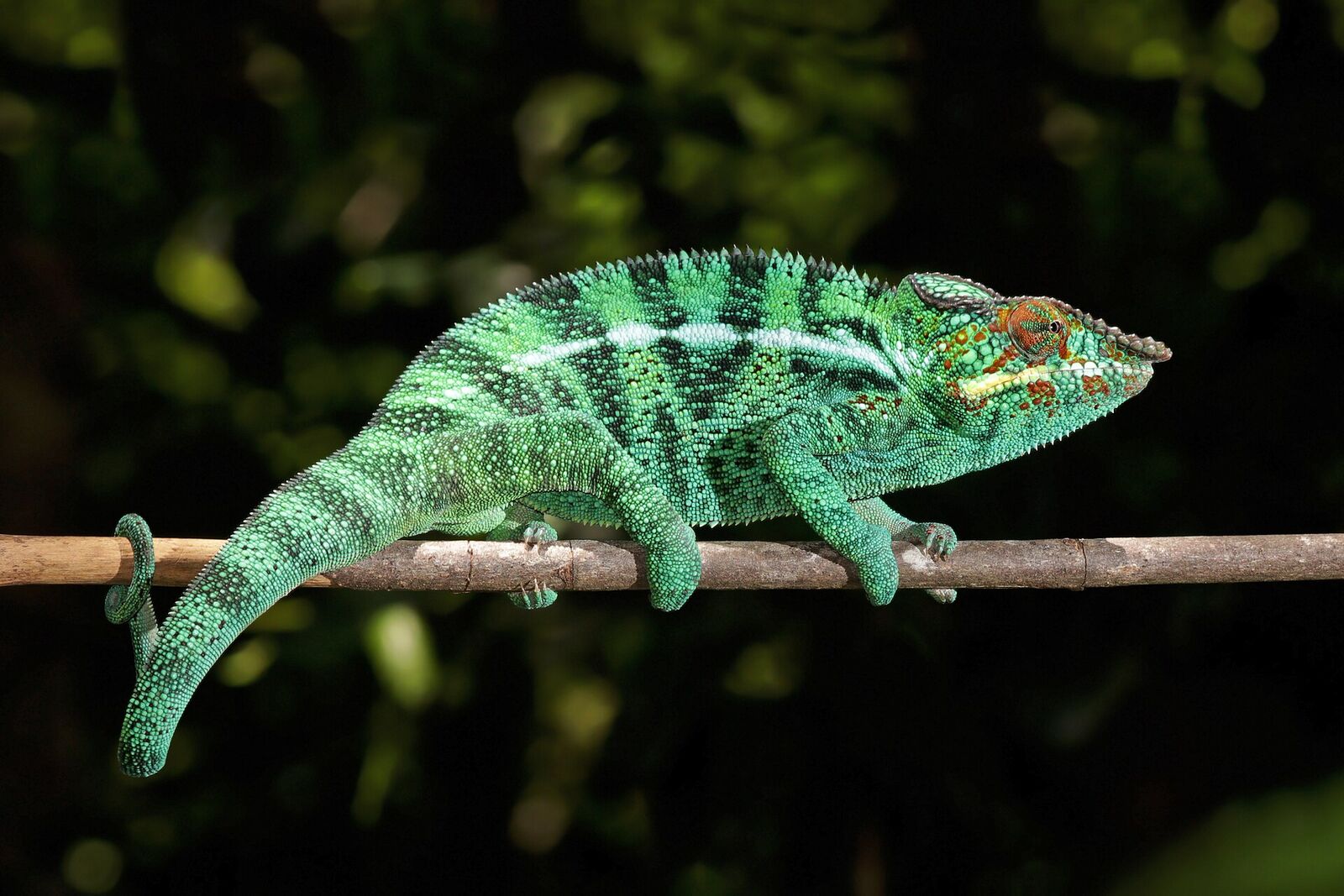
Panther chameleon
Furcifer pardalis
The most colorful chameleon of all.
Pet trade

Bearded pygmy chameleon
Rieppeleon brevicaudatus
Pet trade

Cape dwarf chameleon
Bradypodion pumilum
Pet trade

Carpet chameleon
Furcifer lateralis
Pet trade

Common chameleon
Chamaeleo chamaeleon
Zoos & aquariums

Crested chameleon
Trioceros cristatus
Pet trade