
Home / Invertebrates / Spiders / Ivory ornamental tarantula
Federal restrictions applyIvory ornamental tarantula
Poecilotheria subfusca
Invertebrates › Spiders (Araneae) › Theraphosidae (Tarantulas)
Poecilotheria subfusca, or the ivory ornamental, is a spider in the tarantula family, Theraphosidae.
From Wikipedia: Poecilotheria subfusca, CC BY-SA 4.0 (excerpt)

Care at a glance
Species-specific values
Values researched for this exact species. Air, surface and water temperatures are listed separately, and each source is kept as published rather than averaged.
| Substrate | Spiderlings and juveniles use 1–2 inches of Terra Aranea; adults use 2–3 inches. Source: thetarantulacollective.com | |
| Humidity | 65–75 % Source: thetarantulacollective.com | |
| Diet | Prey types vary by life stage; adults can eat large crickets or a large Dubia roach. Source: thetarantulacollective.com | |
| Feeding frequency | Spiderlings: twice weekly; juveniles: every 7–10 days; adults: every 2–3 weeks or as needed. Source: thetarantulacollective.com | |
| Minimum enclosure | Adults need a tall, escape-proof enclosure with a tight bark retreat. Source: academy.herpeton.net | |
| Night temperature | 64–70 °F (18–21 °C) Source: academy.herpeton.net | |
| Humidity | 70–85 % Source: academy.herpeton.net | |
| Uvb lighting | UVB and specialist basking lamps are not required; ambient room light is enough. Source: academy.herpeton.net | |
| Diet | Feed roaches, crickets, locusts where legal, and occasional worms. Source: academy.herpeton.net | |
| Feeding frequency | Adults usually do well on suitable prey every 7-14 days. Source: academy.herpeton.net | |
| Social housing | House alone except during a supervised controlled breeding introduction. Source: academy.herpeton.net | |
| Substrate | Start spiderlings with 3-5 cm of firm, moisture-holding substrate. Source: academy.herpeton.net |
Warnings
Understanding the animal
About this animal
About this animal
It is endemic to Sri Lanka. As of February 2019, the World Spider Catalog regarded Poecilotheria bara as a synonym.
From Wikipedia: Poecilotheria subfusca, CC BY-SA 4.0 (excerpt)
In the wild
In the wild
| Overview | Poecilotheria subfusca, or the ivory ornamental, is a spider in the tarantula family, Theraphosidae. It is endemic to Sri Lanka., the World Spider Catalog regarded Poecilotheria bara as a synonym. Other sources, particularly in the pet trade, have historically treated highland and lowland forms as distinct species, with the lowland forms often referred to as P. bara. — From Wikipedia: Poecilotheria subfusca, CC BY-SA 4.0 (excerpt) |
| Where it lives | Poecilotheria subfusca is a strictly arboreal species inhabiting forested regions of Sri Lanka. It occupies mature trees, favoring natural cavities, hollows, fissures beneath loose bark, and occasionally abandoned rot holes or woodpecker cavities. The species shows a strong association with old-growth or well-established secondary forest, where stable humidity and vertical structure are present. — From Wikipedia: Poecilotheria subfusca, CC BY-SA 4.0 (excerpt) |
| Behavior | Compared to other Poecilotheria species, P. subfusca is highly agile and reactive, capable of rapid vertical and lateral movement. When disturbed, it typically retreats quickly into tree cavities, but may bite if provoked. The species has been documented in a possible mutualistic association with frogs such as Ramanella nagaoi, sharing tree holes that may contain eggs or juveniles of either species. — From Wikipedia: Poecilotheria subfusca, CC BY-SA 4.0 (excerpt) |
| Appearance and size | The female is larger than the male, with a body length of 8–9 cm, while males measure approximately 6–7 cm. The species can be distinguished from other members of the genus by its large, dark opisthosoma and a folium pattern consisting of three linked dark spots that extend halfway down the opisthosoma. The female carapace is dorsally dark brown with pale margins, forming a starburst-like pattern. — From Wikipedia: Poecilotheria subfusca, CC BY-SA 4.0 (excerpt) |
| Conservation | Poecilotheria subfusca is listed as Endangered under the U.S. Endangered Species Act and is included in Appendix II of CITES. The primary threat to the species is habitat loss caused by deforestation, logging, agricultural expansion, and forest fragmentation in Sri Lanka. — From Wikipedia: Poecilotheria subfusca, CC BY-SA 4.0 (excerpt) |
Native climate (measured)
Native climate (measured)
| Warm-season highs | about 87°F (up to 91°F in the hottest sampled areas) |
| Cool-season lows | about 69°F (down to 60°F in the coldest sampled areas) |
| Average temperature | 70–80°F across sampled records |
| Relative humidity | 74–76% on average (driest month about 69%) |
| Rainfall | about 2084 mm a year |
Measured at 10 wild occurrence records sampled against WorldClim 2.1 climate data (1970–2000 averages). Air conditions in the range are ecological context, not enclosure settings: microhabitats such as burrows, leaf litter or basking rocks can be cooler, warmer or more humid.
Sources for this sheet
- 50 CFR 17.11: Endangered and threatened wildlife Zoo, university or veterinaryCurrent federal Endangered Species Act list.
- Species+ (UNEP-WCMC and the CITES Secretariat) Zoo, university or veterinaryThe official database of species listed under CITES. UNEP (2026). The Species+ Website. Nairobi, Kenya. Compiled by UNEP-WCMC, Cambridge, UK. Available at: www.speciesplus.net. [Accessed 04/10/2026].
- USFWS International Affairs: CITES Zoo, university or veterinaryFederal agency that issues CITES permits.
- GBIF Backbone Taxonomy (Global Biodiversity Information Facility) (CC BY 4.0) Peer-reviewed researchInternational scientific taxonomy used here for classification. GBIF Secretariat (2023). GBIF Backbone Taxonomy. Checklist dataset https://doi.org/10.15468/39omei, accessed via GBIF.org.
- Wikipedia (species article) (CC BY-SA 4.0) Community referenceFree encyclopedia; useful overviews with their own citations. Short excerpts are quoted under CC BY-SA 4.0, each credited with a link to its article.
- iNaturalist (captive observations) Community referenceCommunity observation platform run by the California Academy of Sciences and National Geographic; observations marked captive show animals living in homes, zoos and aquariums.
More tarantulas
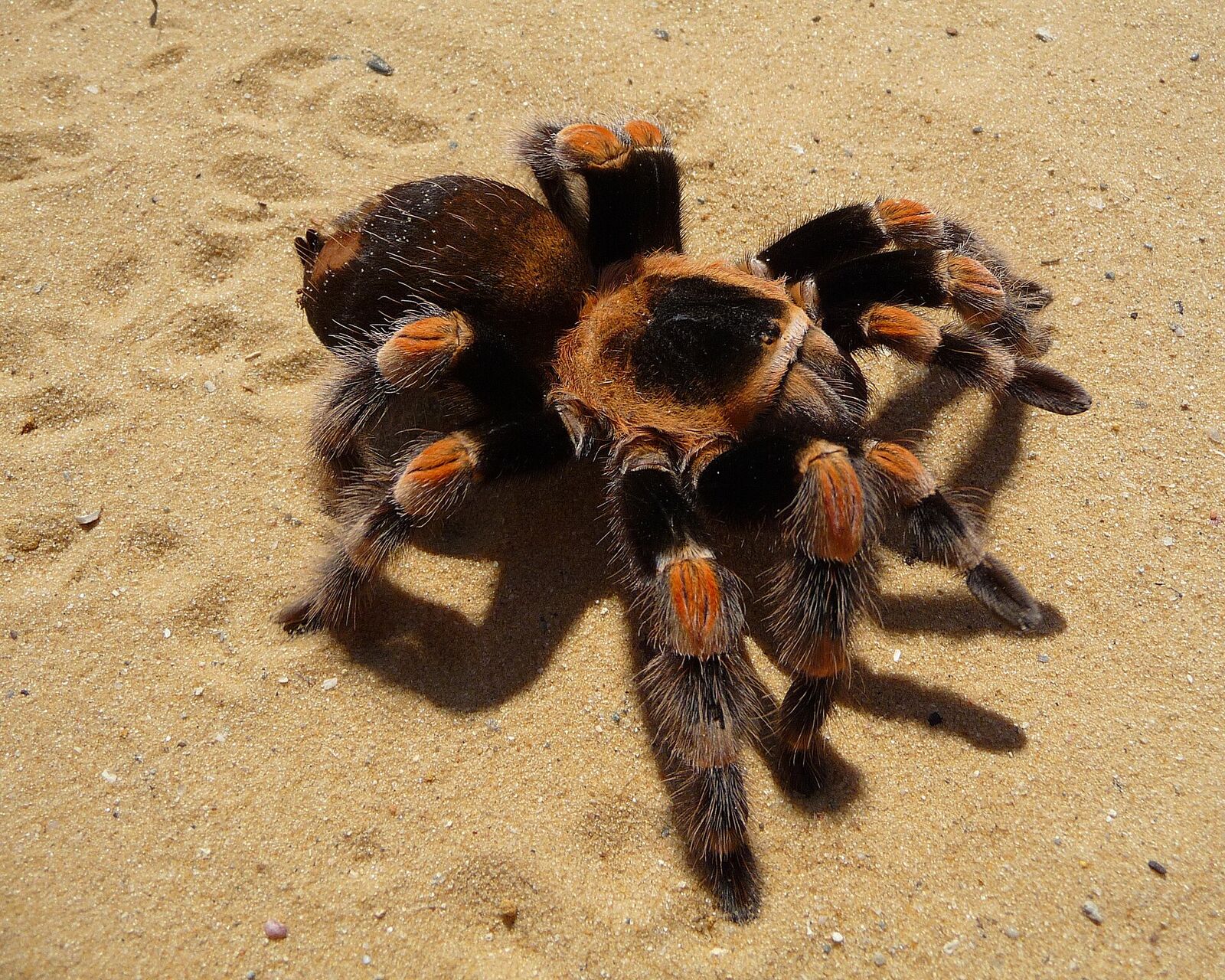
Mexican redknee tarantula
Brachypelma hamorii
A docile spider where females live 25–30 years.
Pet trade

African Horned Baboon Tarantula
Ceratogyrus darlingi
Pet trade
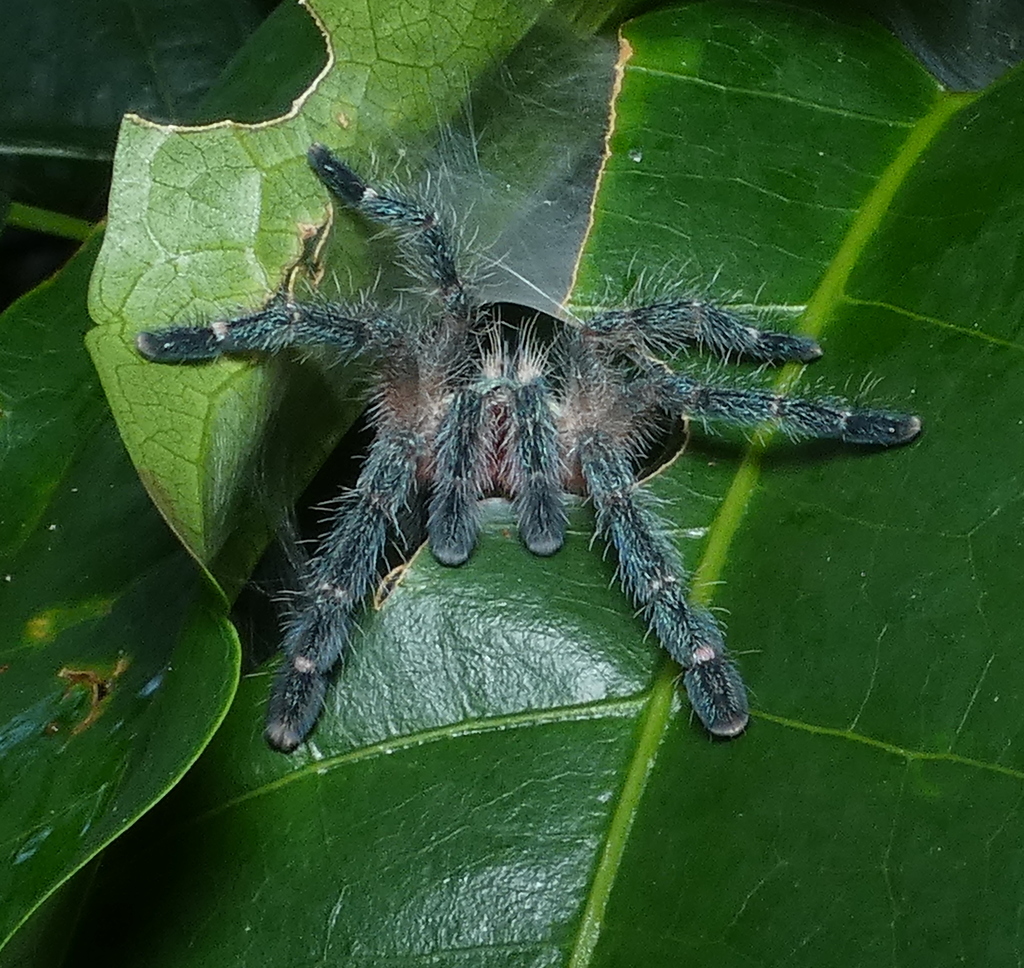
Amazon Ribbed Tarantula
Iridopelma hirsutum
Pet trade

Amula Redrump Tarantula
Brachypelma albiceps
Pet trade

Anantagiri’s Parachute Spider
Poecilotheria tigrinawesseli
Pet trade

Antilles pinktoe tarantula
Caribena versicolor
Pet trade