
Home / Birds / Parrots / Sun conure
Some federal rules applySun conure
Aratinga solstitialis
Birds › Parrots (Psittaciformes) › Psittacidae (New World and African parrots)
The sun conure (Aratinga solstitialis), also known as the sun parakeet, is a medium-sized, vibrantly colored parrot native to northeastern South America.

Care at a glance
Species-specific values
Values researched for this exact species. Air, surface and water temperatures are listed separately, and each source is kept as published rather than averaged.
| Social housing | If your job is full-time, think about raising a pair of birds. Source: parrotessentials.co.uk | |
| Diet | Offer pellets as a staple, vegetables, occasional fruit, seed mix, sprouted seeds, foraged foods, cooked grains, a mineral block, and fresh water; avoid seed-based diets. Source: parrotessentials.co.uk | |
| Minimum enclosure | At least 30” W x 30” D x 30” H for one bird. Source: petmd.com | |
| Warm side air temperature | 65–80 °F Source: petmd.com | |
| Uvb lighting | Use a bird-specific full-spectrum UV light for 10–12 hours daily, about 12–18 inches from the perch. Source: petmd.com | |
| Diet | The diet needs 60–70% whole conure pellets; vegetables, fruits, and table foods count for up to 30%, with treats capped at 10%. Source: petmd.com | |
| Feeding frequency | Use the manufacturer's instructions for daily food amounts; change fresh water daily. Source: petmd.com | |
| Social housing | May be housed alone or with one other sun conure; introduce birds slowly under close supervision. Source: petmd.com | |
| Substrate | Put habitat paper or similar paper-based bedding at the bottom of the tray. Source: petmd.com | |
| Minimum enclosure | One bird needs a cage that is 36 x 24 x 48 inches or bigger. Source: chewy.com | |
| Warm side air temperature | 65–80 °F Source: chewy.com | |
| Diet | Pellets make up 60%–70% of the diet; fruits and vegetables about 30%; treats no more than 10%. Source: chewy.com | |
| Uvb lighting | Provide full-spectrum UV light 12–18 inches from the perch for 10–12 hours daily, supplementing natural UV exposure. Source: chewy.com | |
| Social housing | Keep no more than two sun conures together, raised together; do not house other species with them. Source: chewy.com | |
| Substrate | Line the cage base with habitat paper or paper-based bedding. Source: chewy.com | |
| Minimum enclosure | At least 30 inches wide; a larger flight cage is better. Source: aquaplantshub.com | |
| Diet | Use medium-parrot pellets as the staple, plus chopped vegetables; seed is a training treat. Source: aquaplantshub.com | |
| Feeding frequency | Offer chopped vegetables daily alongside staple pellets. Source: aquaplantshub.com | |
| Social housing | A same-species companion may be housed in a very large cage; avoid housing with small birds. Source: aquaplantshub.com |
Understanding the animal
About this animal
About this animal
The adult male and female are similar in appearance, with black beaks, predominantly golden-yellow plumage, orange-flushed underparts and face, and green and blue-tipped wings and tails. Sun conures are very social birds, typically living in flocks.
From Wikipedia: Sun conure, CC BY-SA 4.0 (excerpt)
In the wild
In the wild
Researched for this exact species, not its family. Wild conditions are context, not enclosure settings.12
| Where it lives | In its modern restricted taxonomic sense, occupies northern and northeastern Roraima and adjoining southern Guyana. Uses dry semi-deciduous and seasonally flooded forests on hills and slopes, descending into wooded river valleys to feed. |
| Ground it lives on | Arboreal; uses forest trees, including cavities for roosting and nesting |
| Active | Diurnal; locally nomadic movements follow food availability. |
| Social life | Usually moderately small flocks, with breeding pairs using tree cavities. |
| Wild diet | Wild diet is poorly documented; available accounts report fruits and ripe or half-ripe seeds, berries, nuts, blossoms and buds. Detailed plant lists from older, broader species accounts may include other subsequently separated species. |
| Behavior to plan for | Gives conspicuous loud calls during movement and travels considerable distances to food. Uses forest cavities for both roosting and nesting. |
Native climate (measured)
Native climate (measured)
| Warm-season highs | about 89°F (up to 93°F in the hottest sampled areas) |
| Cool-season lows | about 49°F (down to 23°F in the coldest sampled areas) |
| Average temperature | 50–79°F across sampled records |
| Relative humidity | 68–77% on average (driest month about 67%) |
| Rainfall | about 1198 mm a year |
Measured at 21 wild occurrence records sampled against WorldClim 2.1 climate data (1970–2000 averages). Air conditions in the range are ecological context, not enclosure settings: microhabitats such as burrows, leaf litter or basking rocks can be cooler, warmer or more humid.
Data and studies
The numbers
The numbers
Each bar is what one source reports. Where several sources weigh in, the dashed gold band marks their average.
Typical adult weight
Average adult body mass in each database (FishBase gives the maximum recorded weight).
Incubation
Veterinary & husbandry research
Veterinary & husbandry research
- Sex identification of sun conure (Aratinga solstitialis) using loop-mediated isothermal amplification of W and Z spindlin chromosomes Wancham P et al., Veterinary world 2024
Peer-reviewed papers that mention this species alongside captivity, zoos, veterinary care or aquaculture. Some cover several species or mention it only in passing, so check the abstract. See all 5 on PubMed → PubMed
Sources for this sheet
- Myhrvold et al. (2015). An amniote life-history database. Ecology 96: 3109 Peer-reviewed researchPeer-reviewed compilation of life-history data for over 21,000 birds, mammals and reptiles.
- Species+ (UNEP-WCMC and the CITES Secretariat) Zoo, university or veterinaryThe official database of species listed under CITES. UNEP (2026). The Species+ Website. Nairobi, Kenya. Compiled by UNEP-WCMC, Cambridge, UK. Available at: www.speciesplus.net. [Accessed 04/10/2026].
- USFWS International Affairs: CITES Zoo, university or veterinaryFederal agency that issues CITES permits.
- 9 CFR 2.1: Animal Welfare Act licensing (USDA) Zoo, university or veterinaryWho needs a USDA license to breed, sell or exhibit animals.
- GBIF Backbone Taxonomy (Global Biodiversity Information Facility) (CC BY 4.0) Peer-reviewed researchInternational scientific taxonomy used here for classification. GBIF Secretariat (2023). GBIF Backbone Taxonomy. Checklist dataset https://doi.org/10.15468/39omei, accessed via GBIF.org.
- Wikipedia (species article) (CC BY-SA 4.0) Community referenceFree encyclopedia; useful overviews with their own citations. Short excerpts are quoted under CC BY-SA 4.0, each credited with a link to its article.
- PubMed (U.S. National Library of Medicine) Peer-reviewed researchIndex of peer-reviewed veterinary, zoo and husbandry research.
- iNaturalist (captive observations) Community referenceCommunity observation platform run by the California Academy of Sciences and National Geographic; observations marked captive show animals living in homes, zoos and aquariums.
More new world and african parrots
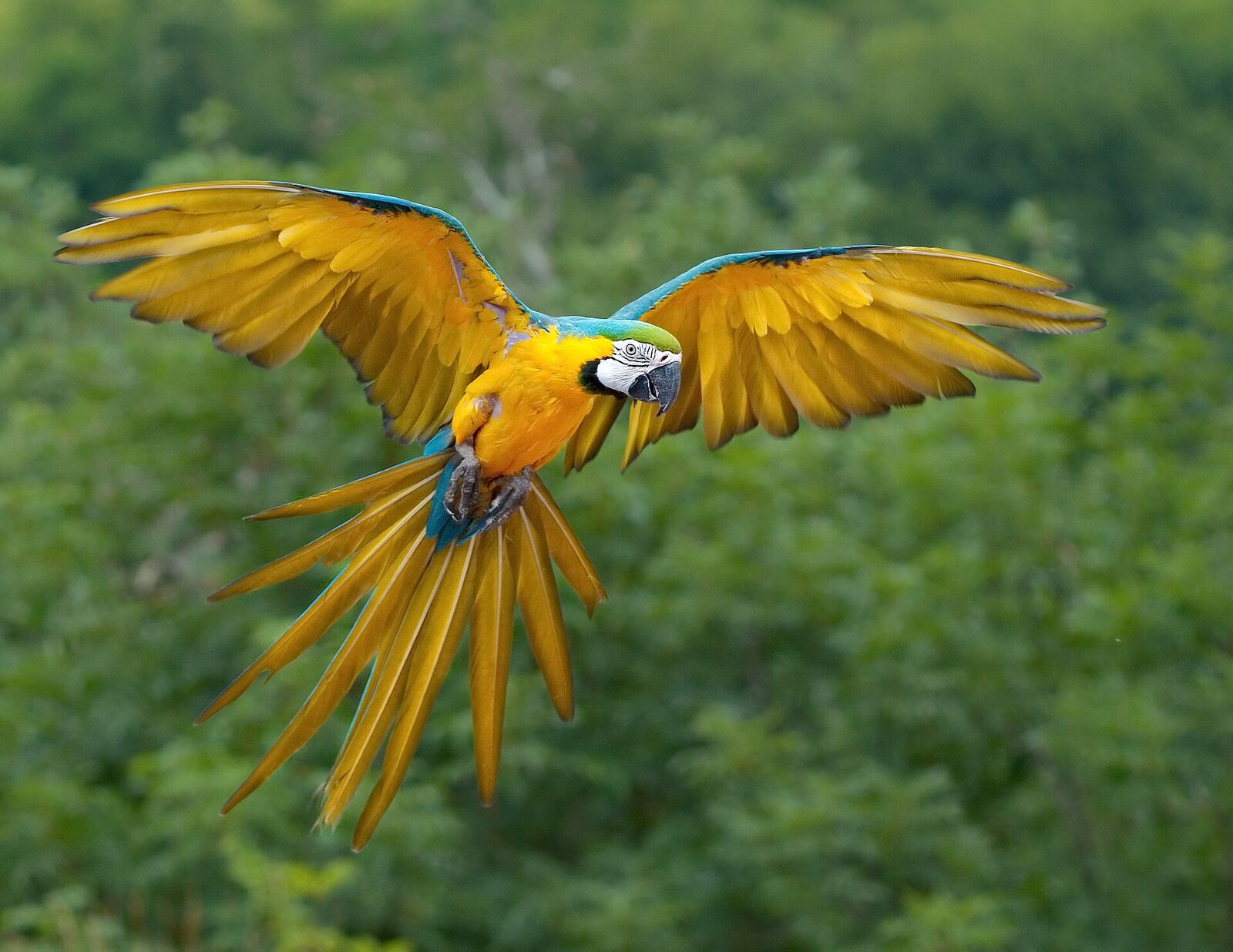
Blue-and-yellow macaw
Ara ararauna
A loud, brilliant, lifelong commitment.
Pet trade
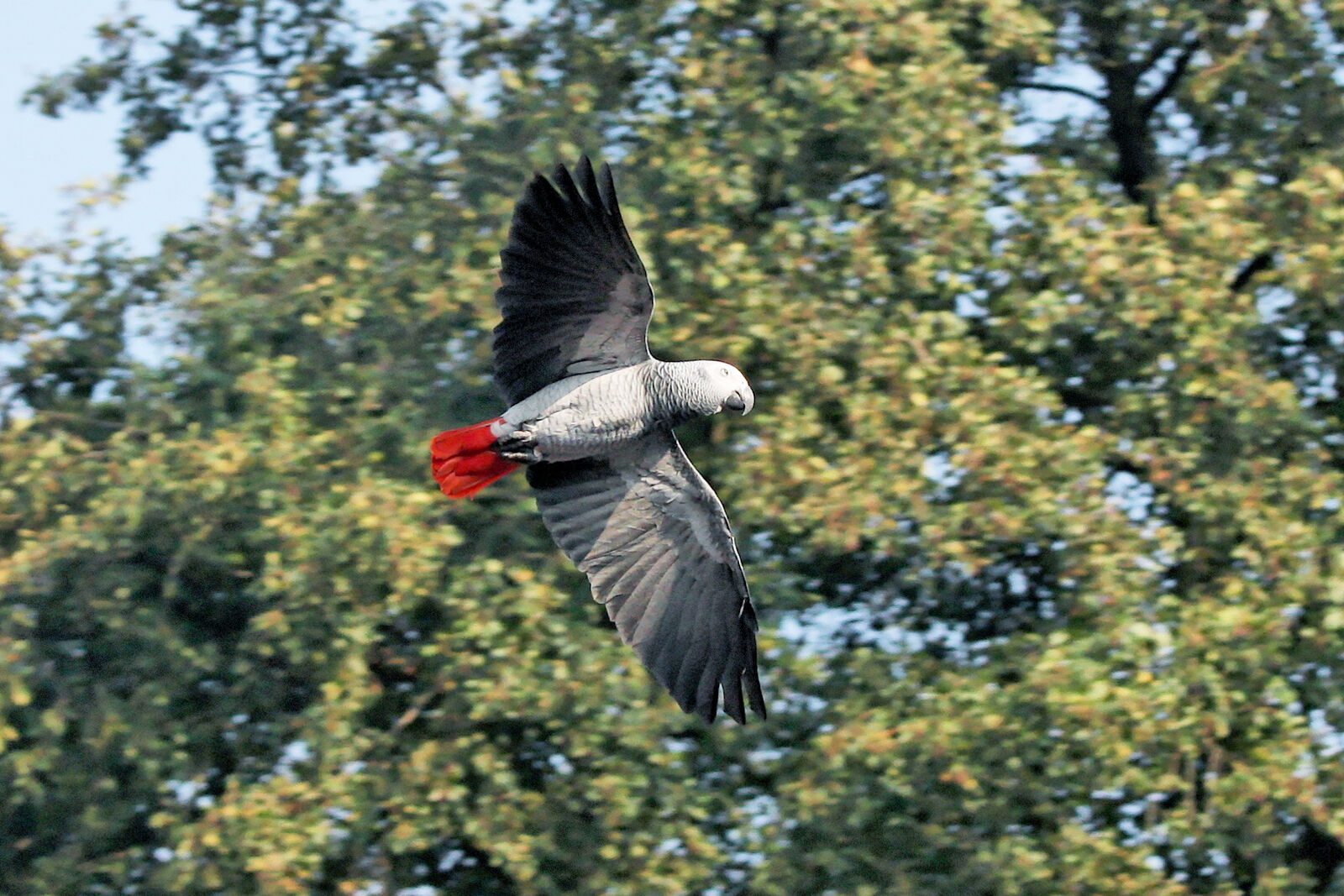
Gray parrot (Congo African grey)
Psittacus erithacus
One of the most intelligent birds on Earth.
Pet trade

Black-headed caique
Pionites melanocephalus
Pet trade

Blue-headed macaw
Primolius couloni
Aviary

Blue-throated macaw
Ara glaucogularis
Pet trade

Blue-winged (Illiger's) macaw
Primolius maracana
Pet trade