
Home / Invertebrates / Scorpions / Tanzanian red-clawed scorpion
No federal permit to keepTanzanian red-clawed scorpion
Pandinus cavimanus
Invertebrates › Scorpions (Scorpiones) › Scorpionidae (Emperor and forest scorpions)

Care at a glance
Species-specific values
Values researched for this exact species. Air, surface and water temperatures are listed separately, and each source is kept as published rather than averaged.
| Minimum enclosure | At least 45 × 30 × 30 cm for an adult. Source: academy.herpeton.net | |
| Warm side air temperature | 82–86 °F (28–30 °C) Source: academy.herpeton.net | |
| Cool side air temperature | 70–75 °F (21–24 °C) Source: academy.herpeton.net | |
| Night temperature | 64–72 °F (18–22 °C) Source: academy.herpeton.net | |
| Humidity | 55–70 % Source: academy.herpeton.net | |
| Uvb lighting | UVB is not required; provide a subdued 10–12-hour light cycle and permanent burrow darkness. Source: academy.herpeton.net | |
| Feeding frequency | Adults generally eat one or two insects every 7–14 days. Source: academy.herpeton.net | |
| Social housing | House one adult per enclosure. Source: academy.herpeton.net | |
| Substrate | Use 20–25 cm of compacted topsoil, clay and some sand or coco fibre that holds a tunnel. Source: academy.herpeton.net |
Understanding the animal
Native climate (measured)
Native climate (measured)
| Warm-season highs | about 91°F (up to 99°F in the hottest sampled areas) |
| Cool-season lows | about 67°F (down to 61°F in the coldest sampled areas) |
| Average temperature | 77–82°F across sampled records |
| Relative humidity | 62–81% on average (driest month about 66%) |
| Rainfall | about 1410 mm a year |
Measured at 85 wild occurrence records sampled against WorldClim 2.1 climate data (1970–2000 averages). Air conditions in the range are ecological context, not enclosure settings: microhabitats such as burrows, leaf litter or basking rocks can be cooler, warmer or more humid.
Sources for this sheet
- GBIF Backbone Taxonomy (Global Biodiversity Information Facility) (CC BY 4.0) Peer-reviewed researchInternational scientific taxonomy used here for classification. GBIF Secretariat (2023). GBIF Backbone Taxonomy. Checklist dataset https://doi.org/10.15468/39omei, accessed via GBIF.org.
More emperor and forest scorpions
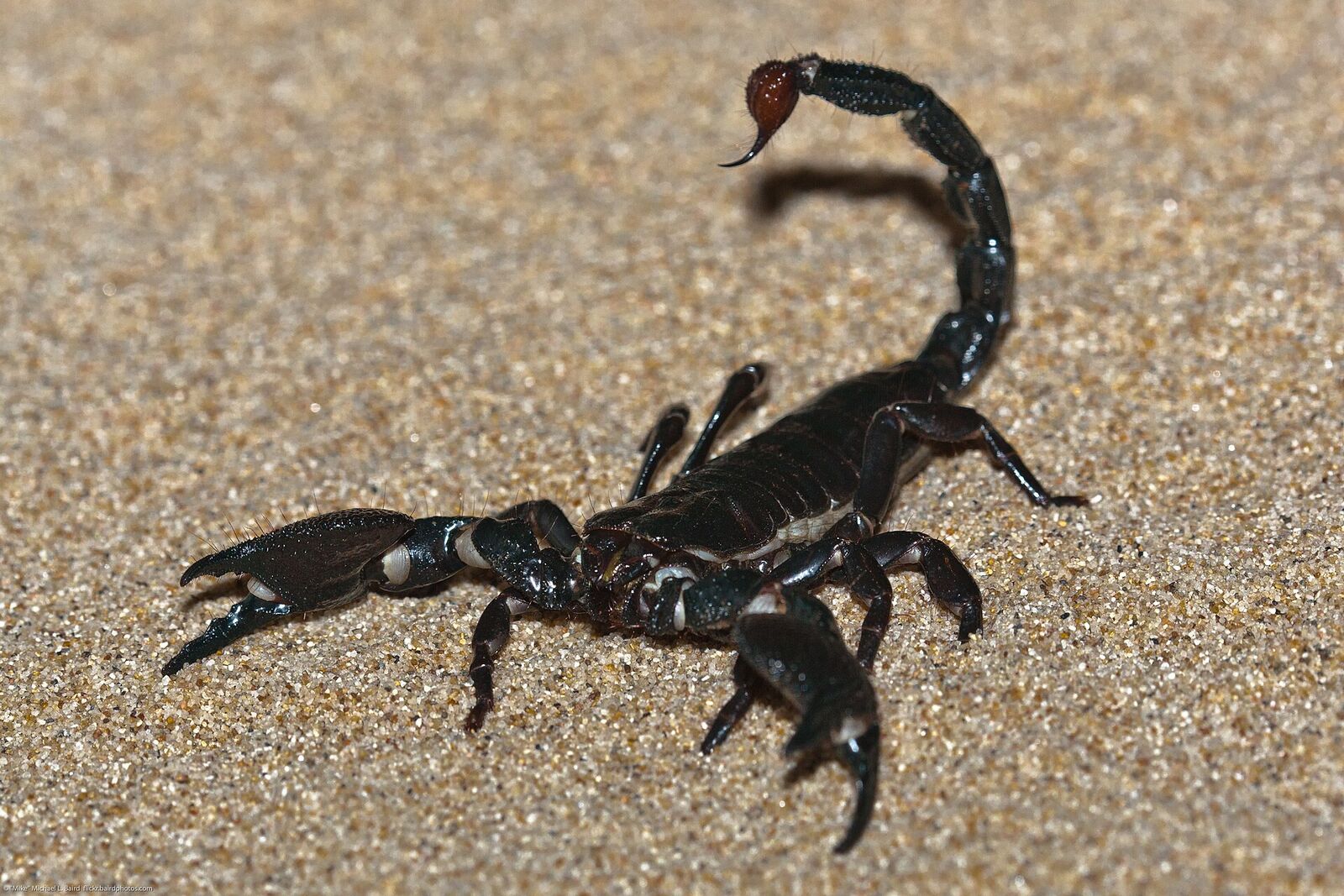
Emperor scorpion
Pandinus imperator
A big, shy scorpion with a mild sting.
Pet trade

Asian forest scorpion
Heterometrus spinifer
Pet trade

Asian giant forest scorpion
Heterometrus laoticus
Pet trade
Heterometrus longimanus
Heterometrus longimanus
Pet trade

Heterometrus silenus
Heterometrus silenus
Pet trade
Scorpion
Pandinus dictator
Pet trade