
Home / Amphibians / Salamanders and newts / Danube crested newt
Federal restrictions applyDanube crested newt
Triturus dobrogicus
Amphibians › Salamanders and newts (Caudata) › Salamandridae (Newts and fire salamanders)
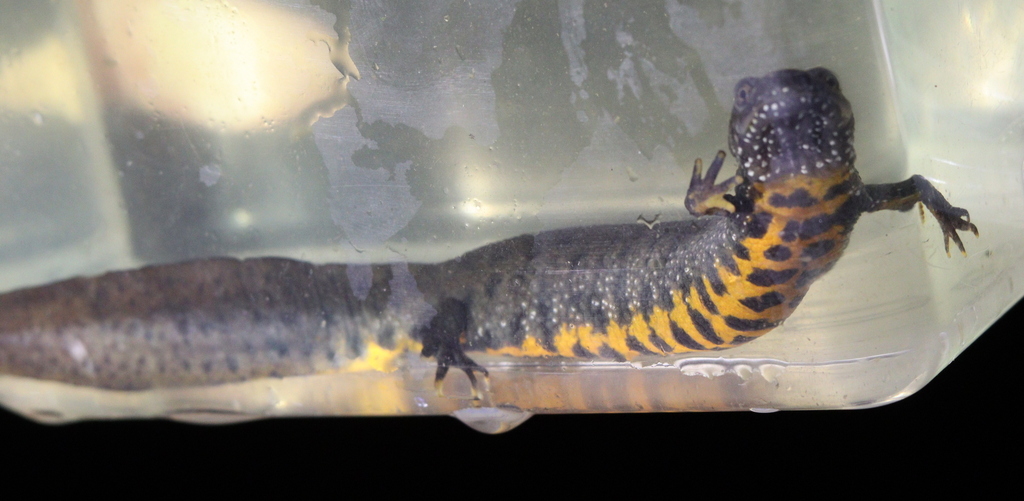
The Danube crested newt or Danube newt (Triturus dobrogicus) is a species of newt found in central and eastern Europe, along the basin of the Danube river and some of its tributaries and in the Dnieper delta.
From Wikipedia: Danube crested newt, CC BY-SA 4.0 (excerpt)
Care at a glance
Species-specific values
Values researched for this exact species. Air, surface and water temperatures are listed separately, and each source is kept as published rather than averaged.
| Minimum enclosure | A paludarium is best; natural setup with soil or coconut coir, plants, moss, rocks or wood, and water. Source: wildlifepondaquarium.co.uk | |
| Basking surface temperature | 50–77 °F (10–25 °C) Source: wildlifepondaquarium.co.uk | |
| Humidity | 85–100 % Source: wildlifepondaquarium.co.uk | |
| Uvb lighting | A 5% UVB is sufficient, but UVB is not essential for this species. Source: wildlifepondaquarium.co.uk | |
| Diet | Offer appropriately sized standard insect foods; in water, live or frozen foods are suitable. Calcium supplement is recommended. Source: wildlifepondaquarium.co.uk | |
| Substrate | Soil or coconut coir; bioactive setups may include worms, springtails, woodlice, and other insects in the soil. Source: wildlifepondaquarium.co.uk |
Warnings
Understanding the animal
About this animal
About this animal
It has a smaller and more slender body than the other crested newts in genus Triturus but like these, males develop a conspicuous jagged seam on back and tail during breeding season. For half of the year or longer, adults live in slow-flowing river margins, lakes, or ponds, where reproduction takes place.
From Wikipedia: Danube crested newt, CC BY-SA 4.0 (excerpt)
In the wild
In the wild
| Overview | The Danube crested newt or Danube newt (Triturus dobrogicus) is a species of newt found in central and eastern Europe, along the basin of the Danube river and some of its tributaries and in the Dnieper delta. It has a smaller and more slender body than the other crested newts in genus Triturus but like these, males develop a conspicuous jagged seam on back and tail during breeding season. For half of the year or longer, adults live in slow-flowing river margins, lakes, or ponds, where reproduction takes place. — From Wikipedia: Danube crested newt, CC BY-SA 4.0 (excerpt) |
| Where it lives | The Danube crested newt is found in three allopatric areas of distribution from central to eastern Europe: *Pannonian basin: From easternmost Austria through Czech Republic (small part in the southeast), Slovakia, Hungary, nordeast Slovenia (river Mura backwaters), northern Croatia, Bosnia-Hercegovina (marginally), northern Serbia to the east of Romania and southeast of Ukraine (Transcarpathian region). — From Wikipedia: Danube crested newt, CC BY-SA 4.0 (excerpt) |
| Behavior | Danube crested newts have the longest aquatic phase in the genus Triturus. Adults move to their breeding sites in February or March and usually stay there for six months; occasionally, they may even stay longer or return to the water in autumn. Males court females with a display of ritualised body movements. — From Wikipedia: Danube crested newt, CC BY-SA 4.0 (excerpt) |
| Appearance and size | Measuring 13 to 15 cm long in total, sometimes up to 18 cm in females, the Danube crested newt is the smallest crested newt species. It has a more slender, elongate body than the other species, well adapted to swimming, with a narrow head and relatively short limbs. — From Wikipedia: Danube crested newt, CC BY-SA 4.0 (excerpt) |
| History and naming | The Danube crested newt was described as a variety of the northern crested newt (Triturus cristatus) by C. Kiritzescu in 1903. Later, it was considered a subspecies until genetic analysis supported its recognition as a separate species in the crested newt species complex. The northern crested newt is its sister species, according to phylogenomic studies. — From Wikipedia: Danube crested newt, CC BY-SA 4.0 (excerpt) |
| Conservation | The population of the Danube crested newt has declined significantly, and the International Union for Conservation of Nature has assessed its conservation status as "least concern". The main threat is habitat destruction by humans, especially through drainage, damming, or pollution. — From Wikipedia: Danube crested newt, CC BY-SA 4.0 (excerpt) |
Native climate (measured)
Native climate (measured)
| Warm-season highs | about 80°F (up to 82°F in the hottest sampled areas) |
| Cool-season lows | about 24°F (down to 22°F in the coldest sampled areas) |
| Average temperature | 48–52°F across sampled records |
| Relative humidity | 73–75% on average (driest month about 65%) |
| Rainfall | about 571 mm a year, spread fairly evenly |
| Winters | Cool to cold winters (lows around 24°F) in much of its native range. Seasonal slowdown may be relevant, but species-specific biology determines whether brumation or hibernation occurs. |
Measured at 76 wild occurrence records sampled against WorldClim 2.1 climate data (1970–2000 averages). Air conditions in the range are ecological context, not enclosure settings: microhabitats such as burrows, leaf litter or basking rocks can be cooler, warmer or more humid.
Profile
Profile
Researched for this exact species. Sources are listed under In the wild above.
History
The Danube crested newt was described as a variety of the northern crested newt (Triturus cristatus) by C. Kiritzescu in 1903. Later, it was considered a subspecies until genetic analysis supported its recognition as a separate species in the crested newt species complex. The northern crested newt is its sister species, according to phylogenomic studies.
From Wikipedia: Danube crested newt, CC BY-SA 4.0 (excerpt)
Sources for this sheet
- 50 CFR Part 16: Injurious wildlife (Lacey Act) Zoo, university or veterinaryCurrent federal regulation, read from eCFR.
- U.S. Association of Reptile Keepers v. Zinke (D.C. Cir. 2017) Zoo, university or veterinaryAppeals ruling that the Lacey Act's shipping ban does not cover moves between the continental states.
- AmphibiaWeb (University of California, Berkeley) (CC BY-NC) Peer-reviewed researchUniversity-hosted database of amphibian biology and conservation.
- GBIF Backbone Taxonomy (Global Biodiversity Information Facility) (CC BY 4.0) Peer-reviewed researchInternational scientific taxonomy used here for classification. GBIF Secretariat (2023). GBIF Backbone Taxonomy. Checklist dataset https://doi.org/10.15468/39omei, accessed via GBIF.org.
- Wikipedia (species article) (CC BY-SA 4.0) Community referenceFree encyclopedia; useful overviews with their own citations. Short excerpts are quoted under CC BY-SA 4.0, each credited with a link to its article.
- iNaturalist (captive observations) Community referenceCommunity observation platform run by the California Academy of Sciences and National Geographic; observations marked captive show animals living in homes, zoos and aquariums.
More newts and fire salamanders

Algerian newt
Pleurodeles poireti
Zoos & aquariums

Algerian ribbed newt
Pleurodeles nebulosus
Pet trade

Alpine newt
Ichthyosaura alpestris
Pet trade

California newt
Taricha torosa
Pet trade

Chinese fire-bellied newt
Hypselotriton orientalis
Pet trade

Chinese warty newt
Paramesotriton chinensis
Zoos & aquariums