
Home / Reptiles / Lizards / Agamidae / Eyed Dabb Lizard
Some federal rules applyEyed Dabb Lizard
Uromastyx ocellata
Reptiles › Lizards (Lacertilia) › Agamidae (Agamas and dragons)
Uromastyx ocellata is a species of agamid lizard native to northeastern Africa.
From Wikipedia: Uromastyx ocellata, CC BY-SA 4.0 (excerpt)

Care at a glance
Species-specific values
Values researched for this exact species. Air, surface and water temperatures are listed separately, and each source is kept as published rather than averaged.
| Minimum enclosure | At least 120 x 60 x 60 cm for one adult. Source: academy.herpeton.net | |
| Basking surface temperature | 113–131 °F (45–55 °C) Source: academy.herpeton.net | |
| Warm side air temperature | 82–95 °F (28–35 °C) Source: academy.herpeton.net | |
| Cool side air temperature | 75–84 °F (24–29 °C) Source: academy.herpeton.net | |
| Humidity | 20–40 % Source: academy.herpeton.net | |
| Uvb lighting | Use strong linear UVB and target about 4.5-6 UVI at the basking animal's back height. Source: academy.herpeton.net | |
| Diet | Varied leafy weeds, greens, and flowers; fruit should be rare and animal protein is inappropriate. Source: academy.herpeton.net | |
| Feeding frequency | Young ones eat daily while grown ones eat most days; tailor amounts based on their shape. Source: academy.herpeton.net | |
| Social housing | House singly. Source: academy.herpeton.net | |
| Substrate | Once quarantine ends, spread 15-20 cm of sandy, firm soil. Source: academy.herpeton.net |
Understanding the animal
About this animal
About this animal
It is known as the ocellated spinytail, eyed dabb lizard, and ocellated uromastyx.
From Wikipedia: Uromastyx ocellata, CC BY-SA 4.0 (excerpt)
In the wild
In the wild
| Overview | Uromastyx ocellata is a species of agamid lizard native to northeastern Africa. It is known as the ocellated spinytail, eyed dabb lizard, and ocellated uromastyx. — From Wikipedia: Uromastyx ocellata, CC BY-SA 4.0 (excerpt) |
| Where it lives | Uromastyx ocellata is native to northeastern Africa, where it can be found in southern Egypt, Sudan, Eritrea, Djibouti, Ethiopia (near the Somali border), and northwestern Somalia. — From Wikipedia: Uromastyx ocellata, CC BY-SA 4.0 (excerpt) |
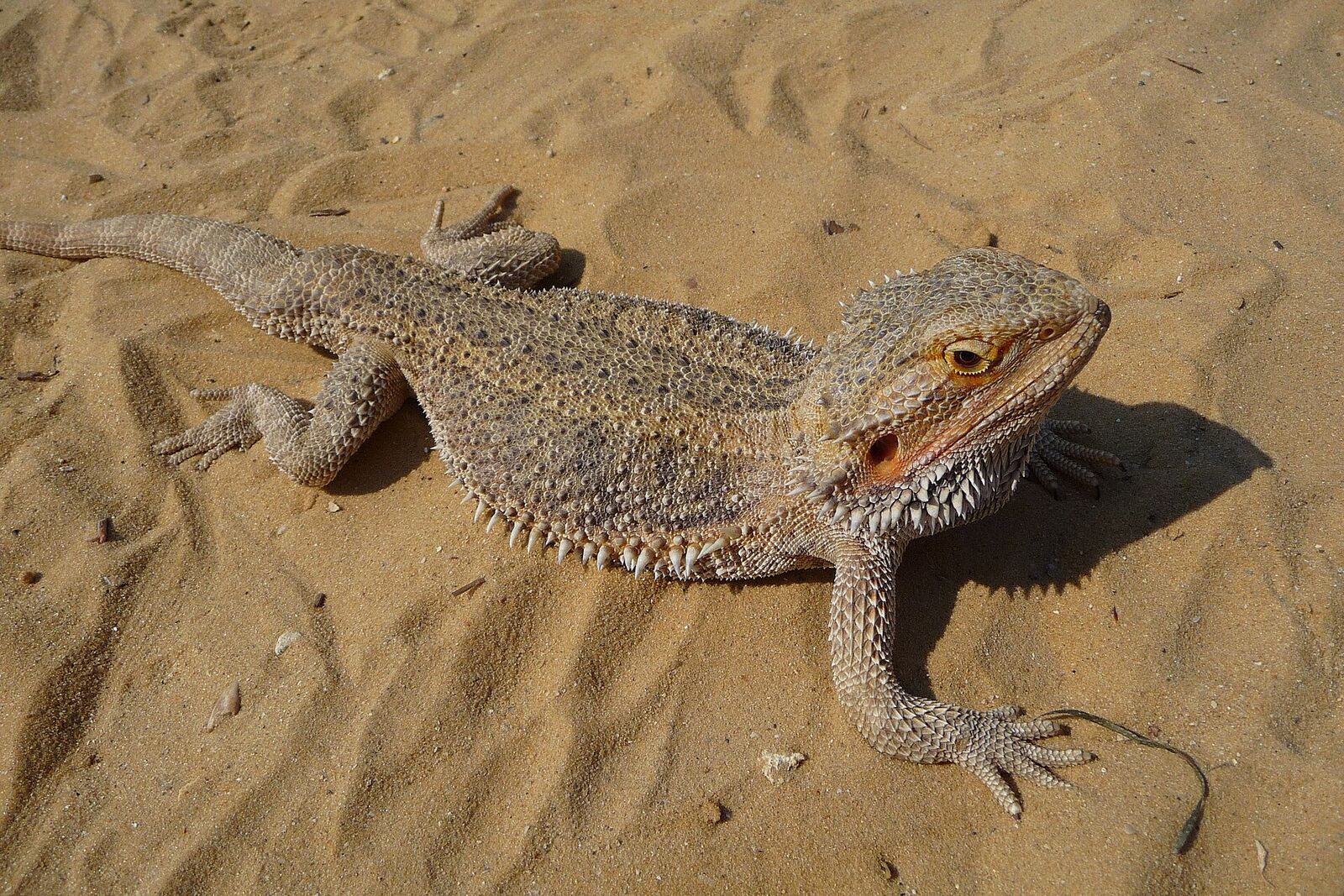
| Appearance and size | Uromastyx ocellata is a medium-small species of Uromastyx, usually weighing 225 g and reaching an average length of around 28 cm. Males usually have a bright blue coloration with yellow and orange spots down their backs while females are usually lighter in coloration, but are typically larger than males. — From Wikipedia: Uromastyx ocellata, CC BY-SA 4.0 (excerpt) |
Read about this species in the wild at The Reptile Database.
Native climate (measured)
Native climate (measured)
| Warm-season highs | about 100°F (up to 106°F in the hottest sampled areas) |
| Cool-season lows | about 53°F (down to 46°F in the coldest sampled areas) |
| Average temperature | 72–85°F across sampled records |
| Relative humidity | 38–52% on average (driest month about 34%) |
| Rainfall | about 39 mm a year |
Measured at 16 wild occurrence records sampled against WorldClim 2.1 climate data (1970–2000 averages). Air conditions in the range are ecological context, not enclosure settings: microhabitats such as burrows, leaf litter or basking rocks can be cooler, warmer or more humid.
Profile
Profile
Researched for this exact species. Sources are listed under In the wild above.
Data and studies
The numbers
The numbers
Each bar is what one source reports. Where several sources weigh in, the dashed gold band marks their average.
Maximum recorded lifespan
Longest recorded lifespan reported by each database; typical lifespans are usually shorter.
Incubation
Sources for this sheet
- Myhrvold et al. (2015). An amniote life-history database. Ecology 96: 3109 Peer-reviewed researchPeer-reviewed compilation of life-history data for over 21,000 birds, mammals and reptiles.
- Species+ (UNEP-WCMC and the CITES Secretariat) Zoo, university or veterinaryThe official database of species listed under CITES. UNEP (2026). The Species+ Website. Nairobi, Kenya. Compiled by UNEP-WCMC, Cambridge, UK. Available at: www.speciesplus.net. [Accessed 04/10/2026].
- USFWS International Affairs: CITES Zoo, university or veterinaryFederal agency that issues CITES permits.
- The Reptile Database Peer-reviewed researchScientist-curated catalog of every reptile species, with taxonomy and literature.
- GBIF Backbone Taxonomy (Global Biodiversity Information Facility) (CC BY 4.0) Peer-reviewed researchInternational scientific taxonomy used here for classification. GBIF Secretariat (2023). GBIF Backbone Taxonomy. Checklist dataset https://doi.org/10.15468/39omei, accessed via GBIF.org.
- Wikipedia (species article) (CC BY-SA 4.0) Community referenceFree encyclopedia; useful overviews with their own citations. Short excerpts are quoted under CC BY-SA 4.0, each credited with a link to its article.
- iNaturalist (captive observations) Community referenceCommunity observation platform run by the California Academy of Sciences and National Geographic; observations marked captive show animals living in homes, zoos and aquariums.
More agamas and dragons
Bearded dragon
Pogona vitticeps
Sun-loving, friendly and endlessly popular.
Pet trade

(Sulawesi) Sailfin Lizard
Hydrosaurus celebensis
Pet trade

(Sulawesi) Sailfin Lizard (Hydrosaurus microlophus)
Hydrosaurus microlophus
Pet trade

Australian water dragon
Intellagama lesueurii
Pet trade

Bent's Mastigure
Uromastyx benti
Pet trade

Black-necked agama
Acanthocercus atricollis
Zoos & aquariums