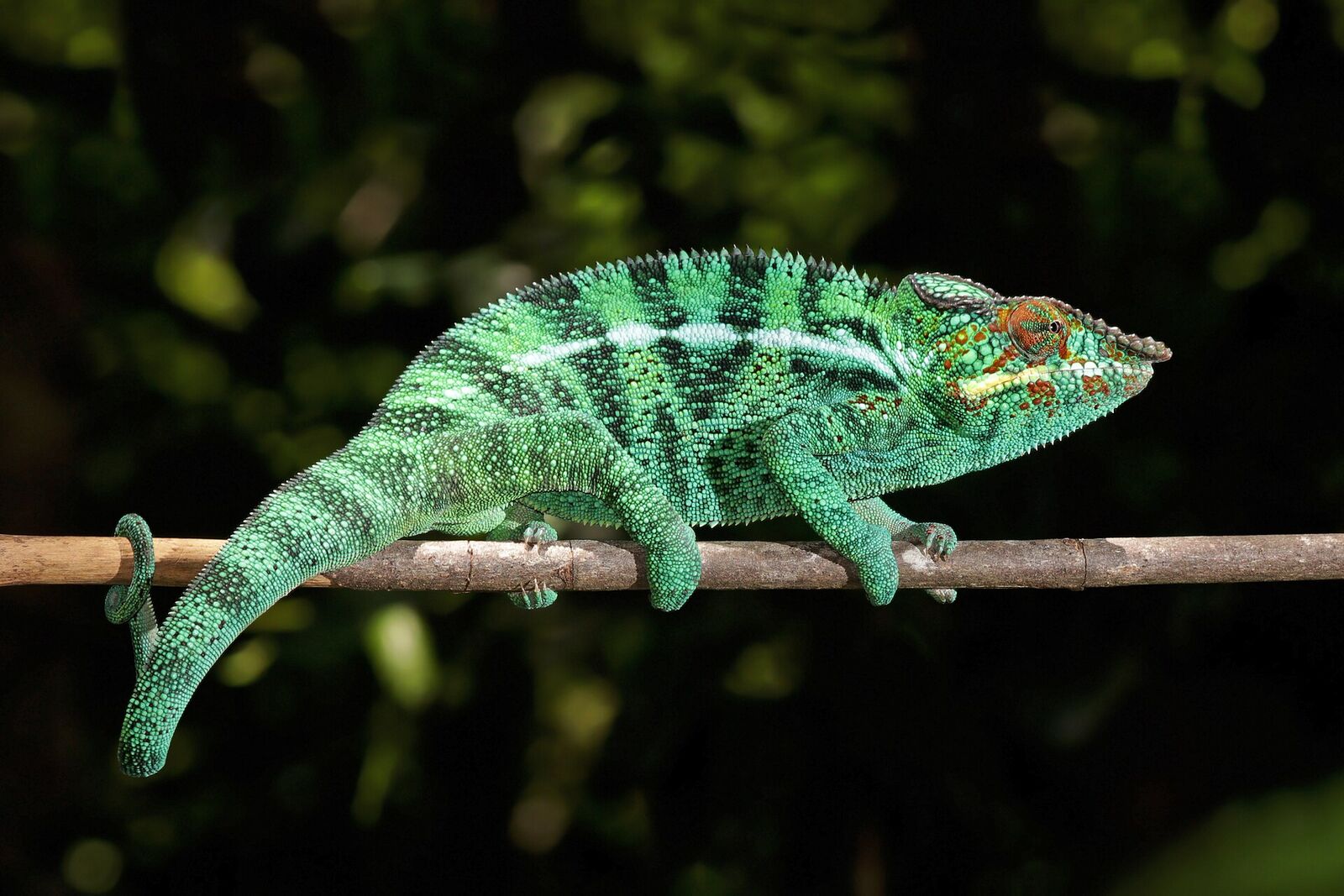
Home / Reptiles / Lizards / Veiled chameleon
Some federal rules apply In-depth sheetVeiled chameleon
Chamaeleo calyptratus
Reptiles › Lizards (Lacertilia) › Chamaeleonidae (Chameleons)
Veiled chameleons are hardy for chameleons but need tall, ventilated enclosures, high humidity and strong UVB. They live about 4–7 years.
Care guide
Enclosure
- Minimum 24×24×48 in, tall and well ventilated, with strong UVB (10–12%) about 12 hours a day.
Sources 58
Feeding
- Dust live insects and remove any not eaten within 30 minutes.
Sources 58
Show the group care guide for chameleons
Chameleons
Applies to most species in this group. Habitat: Tropical and montane forests. Individual species can differ, so compare with the species numbers above and the linked sources.
Housing & setup
- Screen or hybrid enclosures with lots of live plants and branches; good airflow.
- Daily misting or a dripper; chameleons rarely drink from bowls.
- Montane species (Jackson's, Meller's) need cooler temperatures than veiled or panther chameleons.
Climate & lighting
Starting point only: Jackson and panther day/night regimes differ; VCA and RF also disagree and must remain separate. Check the species-specific values for this animal where shown.
| Basking spot | 85–95°F |
| Warm side / daytime | 75–85°F |
| Cool side | 65–75°F |
| Humidity | 50–80% |
- UVB: Required.
Diet
- Gut-loaded insects dusted with calcium and multivitamins on a schedule.
Social life
- Solitary; even seeing another chameleon can stress them.
Handling
- Minimal handling; they're display animals.
Health watch
- Dehydration, MBD, eye problems and stress from handling or seeing other chameleons.
- House singly.
Understanding the animal
In the wild
In the wild
Researched for this exact species, not its family. Good care copies these conditions.123456
| Where it lives | Southwestern Arabia, particularly Yemen and southwestern Saudi Arabia; uses shrubs and trees in vegetated wadis, foothills and cultivated landscapes. Often occupies low vegetation by day and higher branches at night. |
| Ground it lives on | arboreal; shrubs and branches; females descend to dig egg nests |
| Climate | Native habitats range from semi-arid to tropical, with monsoon rainfall approximately May–September and cooler highland conditions. Reliable species-wide wild temperature and relative-humidity ranges were not established. |
| Active | Diurnal. |
| Social life | Solitary and territorial; males display and fight over access to females. |
| Wild diet | Primarily insects; also consumes plant leaves. |
| Behavior to plan for | Uses gripping feet and a prehensile tail to climb, and captures insects with a projectile tongue. Females dig underground egg nests. |
What this means for care
- Provide densely planted climbing routes and elevated sleeping branches.
- House separately with visual barriers between individuals.
- Provide females with a substantial diggable laying area.
- Include hydration and drying cycles; vegetated wadi habitats do not support constant desert dryness.
- Animal Diversity Web: Chamaeleo calyptratus
- Stahl (1997): Captive management, breeding, and common medical problems of the veiled chameleon
- University of Florida IFAS: Florida’s Introduced Reptiles — Chameleons
- The Reptile Database: Chamaeleo calyptratus
- Veiled Chameleon Care Sheet | ReptiFiles
- Veiled Chameleon Care Sheet | Reptiles Magazine
Native climate (measured)
Native climate (measured)
| Warm-season highs | about 91°F (up to 92°F in the hottest sampled areas) |
| Cool-season lows | about 52°F (down to 50°F in the coldest sampled areas) |
| Average temperature | 72–75°F across sampled records |
| Relative humidity | 72–73% on average (driest month about 68%) |
| Rainfall | about 1288 mm a year |
Measured at 67 wild occurrence records sampled against WorldClim 2.1 climate data (1970–2000 averages). Air conditions in the range are ecological context, not enclosure settings: microhabitats such as burrows, leaf litter or basking rocks can be cooler, warmer or more humid.
Profile
Profile
Researched for this exact species. Sources are listed under In the wild above.
History
The species was described as Chamaeleo calyptratus by Duméril and Bibron in 1851 and has accumulated several later synonym names. Reptiles Magazine states that captive specimens were once difficult to obtain without relying on wild-caught animals, but the large majority sold today are captive bred.
Keeper tips
- Use a tall, well-ventilated enclosure; ReptiFiles recommends at least 24 x 24 x 48 inches and preferably larger.
- Provide branches and vines for climbing.
- Provide abundant live or artificial foliage, with live foliage preferred by ReptiFiles.
- ReptiFiles recommends UVB lighting and an additional LED plant/light bar.
- Use temperature and humidity gauges to monitor enclosure conditions.
- Provide a misting and dripping water system as recommended by ReptiFiles.
Behaviors reported
- Lives primarily above the ground in trees and other vegetation.
- Can occupy both dry areas and wetter mountain-associated habitats.
- Is described by Animal Diversity Web as aggressive.
Unique adaptations
- Wide, splayed zygodactyl feet.
- Bulging eyes that can move independently.
- A curled tail.
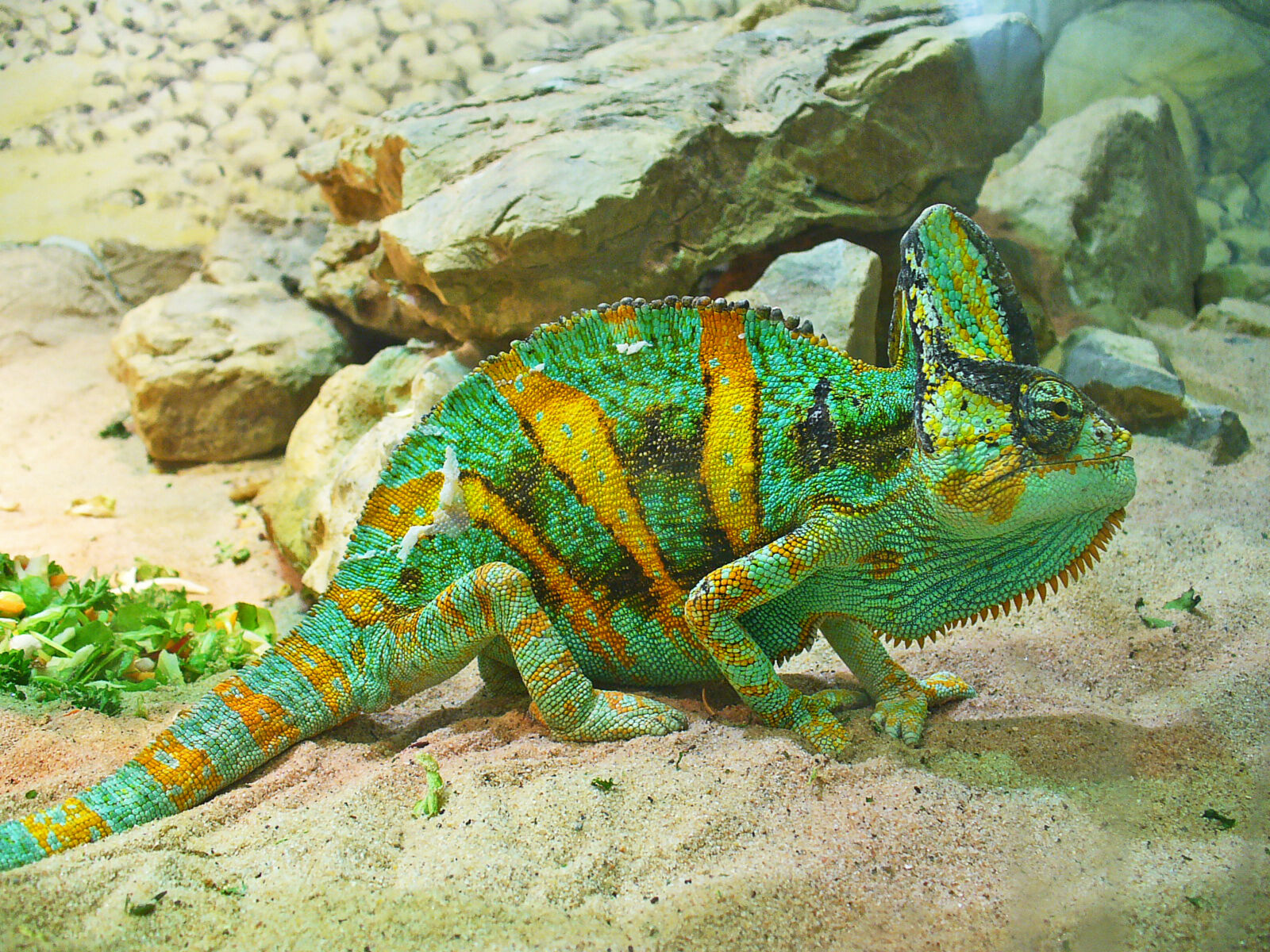
- A prominent casque on the head, especially large in mature males.
Remarkable facts
- Males can reach roughly 17-24 inches in total length, while females are smaller.
- Males have larger casques than females and are born with tarsal spurs that allow easy sex determination.
- Animal Diversity Web reports sexual maturity at about 4-5 months.
- The Reptile Database identifies the species as oviparous.
- Reported lifespan is generally shorter in females than males; sources give males about 6-8 years or up to 8 years and females roughly 4-6 years or about 5 years.
- Introduced populations are reported in Florida, and Reptiles Magazine also reports established populations on Maui, Hawaii.
From the sources
From the sources
Quoted from the matching sections of reputable sources for this exact species. Specialist databases are used first; Wikipedia (community-edited, CC BY-SA 4.0) only fills gaps. Other sources are short credited quotes.
| Overview | The veiled chameleon (Chamaeleo calyptratus) is a species of chameleon (family Chamaeleonidae) native to the Arabian Peninsula in Yemen and Saudi Arabia. Other common names include cone-head chameleon, Yemen chameleon, and Yemeni chameleon. They are born pastel green and without their distinctive casques on their head. When newly hatched veiled chameleons are surprised, they may drop to the ground and turn a bright red color due to stress. — Wikipedia (community-edited) |
| Where it lives | Range: Yemen, SW Saudi Arabia (up to 2500 m). — The Reptile Database |
| Wild diet | The veiled chameleon is an insectivore. — Animal Diversity Web |
| Behavior | Veiled chameleons are shy in nature. — Animal Diversity Web |
| Reproduction | The lifespan of a veiled chameleon is usually five years for females and up to eight years for males (Crabtree, 1999). — Animal Diversity Web |
| Appearance and size | The veiled chameleon is characterized as an aggressive, brightly colored chameleon. — Animal Diversity Web |
| History and naming | Named after Greek kalyptra > L. calyptra, veil or cover; Latin -atus/a/um, adjectival suffix: veiled or covered, denoting the presence of an extremely elevated casque (Charles Klaver, pers. comm., 11 Jan 2023). — The Reptile Database |
| Conservation | Wild chameleon populations are experiencing growing pressures on a variety of fronts, causing some environmentalists to sound alarms concerning the long-term survival of these animals. — Animal Diversity Web |
Data and studies
The numbers
The numbers
Each bar is what one source reports. Where several sources weigh in, the dashed gold band marks their average.
Basking
Cool end about 77°F; nights no lower than about 73°F.
Humidity
Maximum recorded lifespan
Longest recorded lifespan reported by each database; typical lifespans are usually shorter.
Typical adult weight
Average adult body mass in each database (FishBase gives the maximum recorded weight).
Incubation
Female maturity
Night temperature
Species-specific values from keeper care sheets. Basking figures are often surface readings taken with an infrared thermometer, which run hotter than air.
Care articles for this species
Care articles for this species
- Veiled Chameleon Care Sheet (ReptiFiles)
- Veiled Chameleon Care Sheet (Reptiles Magazine)
Veterinary & husbandry research
Veterinary & husbandry research
- Serpentovirus (Nidovirus) and Orthoreovirus Coinfection in Captive Veiled Chameleons (Chamaeleo calyptratus) with Respiratory Disease Hoon-Hanks LL et al., Viruses 2020
- Characterization of fecal hormone patterns associated with the reproductive cycle in female veiled chameleons (Chamaeleo calyptratus) Kummrow MS et al., General and comparative endocrinology 2010
- Pathogenicity of the Chrysosporium anamorph of Nannizziopsis vriesii for veiled chameleons (Chamaeleo calyptratus) Paré A et al., Medical mycology 2006
- Disseminated systemic mycosis in Veiled chameleons (Chamaeleo calyptratus) caused by Chamaeleomyces granulomatis Schmidt V et al., Veterinary microbiology 2012
Peer-reviewed papers that mention this species alongside captivity, zoos, veterinary care or aquaculture. Some cover several species or mention it only in passing, so check the abstract. See all 20 on PubMed → 170
Sources for this sheet
- Royal Veterinary College Exotics Service: Veiled chameleon care Zoo, university or veterinaryVet-school exotics hospital factsheet, reviewed 2021–2024.
- Myhrvold et al. (2015). An amniote life-history database. Ecology 96: 3109 Peer-reviewed researchPeer-reviewed compilation of life-history data for over 21,000 birds, mammals and reptiles.
- ReptiFiles (care guides) Experienced keeper or breederWell-researched reptile care guides that cite herpetological literature and experienced keepers.
- Species+ (UNEP-WCMC and the CITES Secretariat) Zoo, university or veterinaryThe official database of species listed under CITES.
- USFWS International Affairs: CITES Zoo, university or veterinaryFederal agency that issues CITES permits.
- Merck Veterinary Manual: Management and husbandry of reptiles Zoo, university or veterinaryThe Merck Veterinary Manual: a standard veterinary reference written and reviewed by veterinary specialists.
- Merck Veterinary Manual: Nutritional, metabolic and endocrine diseases of reptiles Zoo, university or veterinaryThe Merck Veterinary Manual: a standard veterinary reference written and reviewed by veterinary specialists.
- Royal Veterinary College Exotics Service: Panther chameleon care Zoo, university or veterinaryVet-school exotics hospital factsheet, reviewed 2021–2024.
- ReptiFiles: Jackson's chameleon lighting and temperatures Zoo, university or veterinaryAdded in the 2026 source-checked care-guide review.
- ReptiFiles: Jackson's chameleon humidity and water Zoo, university or veterinaryAdded in the 2026 source-checked care-guide review.
- ReptiFiles: Panther chameleon care sheet Zoo, university or veterinaryAdded in the 2026 source-checked care-guide review.
- VCA Animal Hospitals: Care and Housing for Chameleons Zoo, university or veterinaryAdded in the 2026 source-checked care-guide review.
- The Reptile Database Peer-reviewed researchScientist-curated catalog of every reptile species, with taxonomy and literature.
- GBIF Backbone Taxonomy (Global Biodiversity Information Facility) Peer-reviewed researchInternational scientific taxonomy used here for classification.
- Wikipedia (species article) Community referenceFree encyclopedia; useful overviews with their own citations. Intro text is quoted under CC BY-SA 4.0.
- PubMed (U.S. National Library of Medicine) Peer-reviewed researchIndex of peer-reviewed veterinary, zoo and husbandry research.
- iNaturalist (captive observations) Community referenceCommunity observation platform run by the California Academy of Sciences and National Geographic; observations marked captive show animals living in homes, zoos and aquariums.
- Reptiles Magazine (care articles) Experienced keeper or breederEstablished reptile and amphibian hobby magazine; care articles are written by breeders, keepers and veterinarians.