
Home / Amphibians / Frogs and toads / Western toad
No federal permit to keepWestern toad
Anaxyrus boreas
Amphibians › Frogs and toads (Anura) › Bufonidae (Toads)
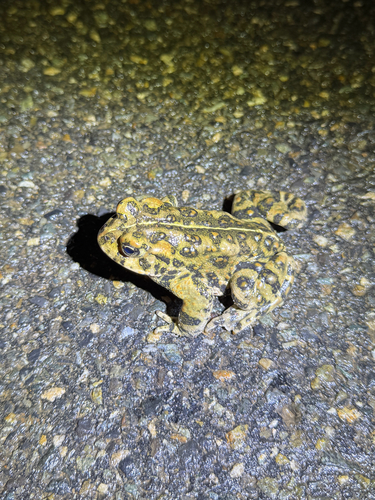
The western toad (Anaxyrus boreas) is a large toad species, between 5.6 and 13 cm (2.2 and 5.1 in) long, native to western North America.
From Wikipedia: Western toad, CC BY-SA 4.0 (excerpt)
Care at a glance
Species-specific values
Values researched for this exact species. Air, surface and water temperatures are listed separately, and each source is kept as published rather than averaged.
| Minimum enclosure | 10-gallon aquarium for one Western toad or a pair. Source: reptilescove.com | |
| Humidity | High humidity is unnecessary; a large water bowl should provide adequate humidity, with occasional misting. Source: reptilescove.com | |
| Uvb lighting | Fluorescent 2.0-strength lighting in the 5000K–6500K daylight spectrum provides UVB and UVA. Source: reptilescove.com | |
| Diet | Use crickets as the staple; earthworms, mealworms, tomato hornworms, and wax worms can be occasional variety. Source: reptilescove.com | |
| Feeding frequency | Dust adult food weekly; dust juvenile food up to three times weekly. Source: reptilescove.com | |
| Social housing | A 10-gallon aquarium is recommended for one toad or a pair. Source: reptilescove.com | |
| Substrate | Use untreated organic soil that allows burrowing; keep it lightly damp. Source: reptilescove.com |
Warnings
Understanding the animal
About this animal
About this animal
A. boreas is frequently encountered during the wet season on roads, or near water at other times. It can jump a considerable distance for a toad.
From Wikipedia: Western toad, CC BY-SA 4.0 (excerpt)
In the wild
In the wild
| Overview | The western toad (Anaxyrus boreas) is a large toad species, between 5.6 and 13 cm long, native to western North America. A. boreas is frequently encountered during the wet season on roads, or near water at other times. It can jump a considerable distance for a toad. Breeding occurs between March and July in mountainous areas, and as early as January in lower-elevation regions. — From Wikipedia: Western toad, CC BY-SA 4.0 (excerpt) |
| Where it lives | The boreal toad is found in the Rocky Mountains in aspen (Populus spp.) groves and riparian forests. In Colorado, the largest populations are typically found in areas characterized by willows (Salix spp.), bog birch (Betula glandulosa), and shrubby cinquefoil (Potentilla fruticosa). In the Pacific Northwest, the western toad occurs in mountain meadows and less commonly in Douglas fir forests (Pseudotsuga menziesii). — From Wikipedia: Western toad, CC BY-SA 4.0 (excerpt) |
| Appearance and size | It has a white or cream dorsal stripe, and is dusky gray or greenish dorsally with skin glands concentrated within the dark blotches. Its parotoid glands are oval, widely separated, and larger than the upper eyelids. It has a mottled venter and horizontal pupils but lacks cranial crests. — From Wikipedia: Western toad, CC BY-SA 4.0 (excerpt) |
Native climate (measured)
Native climate (measured)
| Warm-season highs | about 87°F (up to 95°F in the hottest sampled areas) |
| Cool-season lows | about 40°F (down to 36°F in the coldest sampled areas) |
| Average temperature | 58–64°F across sampled records |
| Relative humidity | 52–61% on average (driest month about 51%) |
| Rainfall | about 434 mm a year, with strong wet and dry seasons |
| Winters | Cool to cold winters (lows around 40°F) in much of its native range. Seasonal slowdown may be relevant, but species-specific biology determines whether brumation or hibernation occurs. |
Measured at 85 wild occurrence records sampled against WorldClim 2.1 climate data (1970–2000 averages). Air conditions in the range are ecological context, not enclosure settings: microhabitats such as burrows, leaf litter or basking rocks can be cooler, warmer or more humid.
Data and studies
The numbers
The numbers
Each bar is what one source reports. Where several sources weigh in, the dashed gold band marks their average.
Maximum recorded lifespan
Longest recorded lifespan reported by each database; typical lifespans are usually shorter. The AnAge record comes from an animal in human care.
Incubation
Female maturity
Veterinary & husbandry research
Veterinary & husbandry research
- A hormone priming regimen and hibernation affect oviposition in the boreal toad (Anaxyrus boreas boreas) Calatayud NE et al., Theriogenology 2015
- Isolation of a Bohle-like iridovirus from boreal toads housed within a cosmopolitan aquarium collection Cheng K et al., Diseases of aquatic organisms 2014
- Spermiation response to exogenous hormone therapy in hibernated and non-hibernated boreal toads (Anaxyrus boreas boreas) Kouba AJ et al., Reproduction, fertility, and development 2022
Peer-reviewed papers that mention this species alongside captivity, zoos, veterinary care or aquaculture. Some cover several species or mention it only in passing, so check the abstract. See all 10 on PubMed → PubMed
Sources for this sheet
- AnAge: The Animal Ageing and Longevity Database (Human Ageing Genomic Resources) (CC BY 3.0) Peer-reviewed researchCurated, referenced longevity and life-history records for thousands of species; maximum lifespans are often from zoo animals.
- AmphibiaWeb (University of California, Berkeley) (CC BY-NC) Peer-reviewed researchUniversity-hosted database of amphibian biology and conservation.
- Wikipedia (species article) (CC BY-SA 4.0) Community referenceFree encyclopedia; useful overviews with their own citations. Short excerpts are quoted under CC BY-SA 4.0, each credited with a link to its article.
- PubMed (U.S. National Library of Medicine) Peer-reviewed researchIndex of peer-reviewed veterinary, zoo and husbandry research.
- iNaturalist (captive observations) Community referenceCommunity observation platform run by the California Academy of Sciences and National Geographic; observations marked captive show animals living in homes, zoos and aquariums.
More toads
American toad
Anaxyrus americanus
Pet trade

Asian common toad
Duttaphrynus melanostictus
Pet trade
Cane toad
Rhinella marina
Pet trade

Colorado river toad
Incilius alvarius
Pet trade

Common European toad
Bufo bufo
Pet trade

Cuban toad
Peltophryne peltocephala
Zoos & aquariums