
Home / Reptiles / Turtles and tortoises / Yellow-bellied slider
Some federal rules applyYellow-bellied slider
Trachemys scripta
Reptiles › Turtles and tortoises (Testudines) › Emydidae (Pond turtles and box turtles)
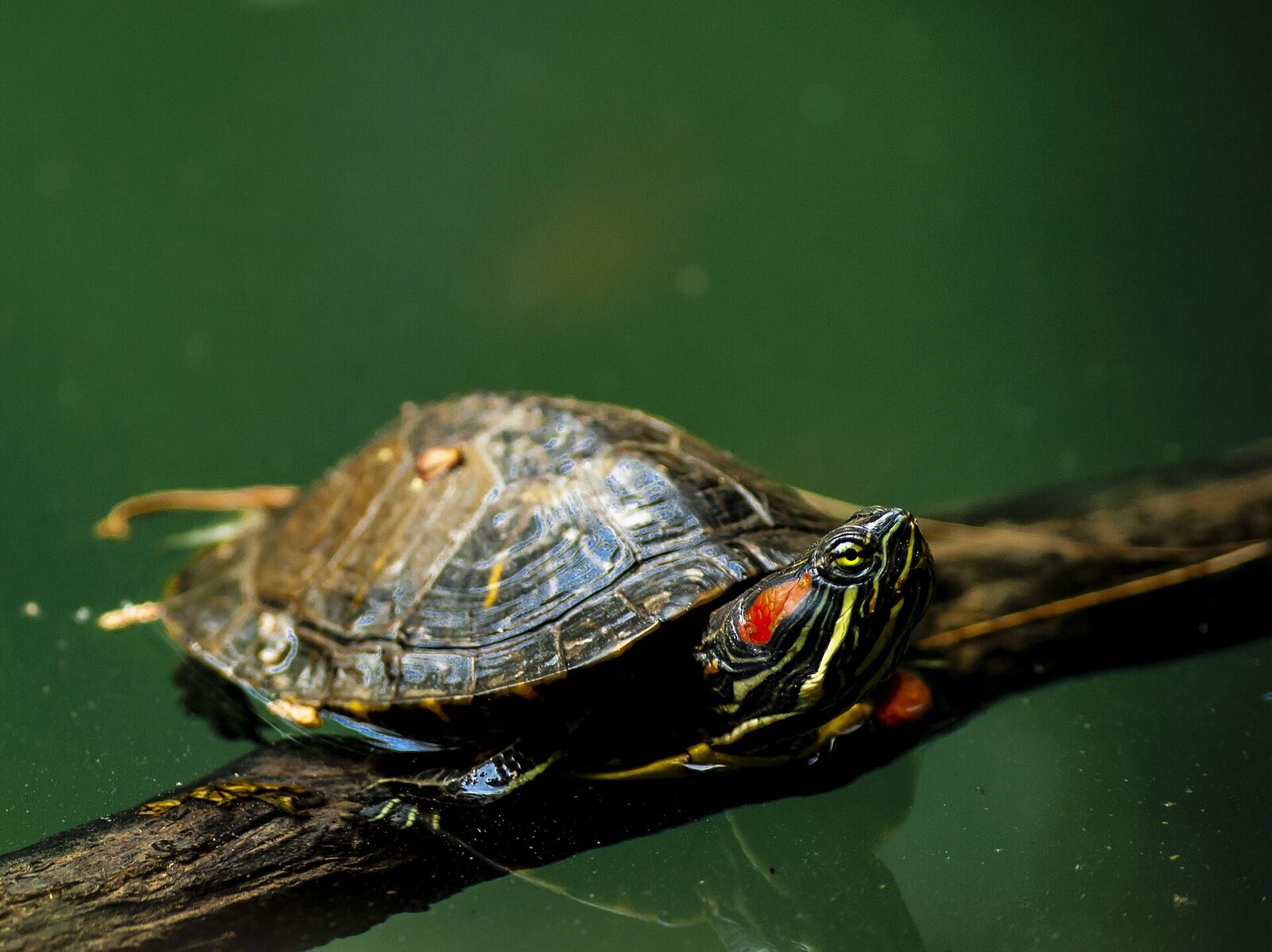
The yellow-bellied slider (Trachemys scripta scripta) is a subspecies of the pond slider (Trachemys scripta), a semiaquatic turtle belonging to the family Emydidae.

Care at a glance
Species-specific values
Values researched for this exact species. Air, surface and water temperatures are listed separately, and each source is kept as published rather than averaged.
| Minimum enclosure | Recommended enclosure for one adult is 60 gallons. Source: austinsturtlepage.com | |
| Water temperature | 75–80 °F Source: austinsturtlepage.com | |
| Diet | Offer commercial turtle food and chopped vegetables, with feeder fish and insects as treats. Source: austinsturtlepage.com | |
| Social housing | The article says red-eared sliders, cooters, maps, and painted turtles work well with this species. Source: austinsturtlepage.com |
Understanding the animal
About this animal
About this animal
It is native to the southeastern United States, specifically from Florida to southeastern Virginia, and is the most common turtle species in its range. It is found in a wide variety of habitats, including slow-moving rivers, floodplain swamps, marshes, seasonal wetlands, and permanent ponds.
From Wikipedia: Yellow-bellied slider, CC BY-SA 4.0 (excerpt)
In the wild
In the wild
Researched for this exact species, not its family. Wild conditions are context, not enclosure settings.1234
| Where it lives | Southeastern United States from southeastern Virginia through northern Florida and Alabama. Occupies rivers, ditches, sloughs, lakes and ponds with vegetation and emergent basking surfaces. |
| Ground it lives on | Soft pond or stream bottoms; logs and banks for basking and land for nesting. |
| Active | Diurnal basking; seasonal dormancy details for this exact subspecies were not established from the consulted sources. |
| Wild diet | Young mostly eat insects, small fish, mollusks and amphibians; adults add substantial aquatic plants, algae and other vegetation while retaining animal foods. |
| Behavior to plan for | Hauls onto logs or banks to bask. Females leave water and dig terrestrial nests, often in sunny sites. |
Native climate (measured)
Native climate (measured)
| Warm-season highs | about 91°F (up to 94°F in the hottest sampled areas) |
| Cool-season lows | about 39°F (down to 30°F in the coldest sampled areas) |
| Average temperature | 60–73°F across sampled records |
| Relative humidity | 68–72% on average (driest month about 65%) |
| Rainfall | about 1276 mm a year, spread fairly evenly |
| Winters | Cool to cold winters (lows around 39°F) in much of its native range. Seasonal slowdown may be relevant, but species-specific biology determines whether brumation or hibernation occurs. |
Measured at 65 wild occurrence records sampled against WorldClim 2.1 climate data (1970–2000 averages). Air conditions in the range are ecological context, not enclosure settings: microhabitats such as burrows, leaf litter or basking rocks can be cooler, warmer or more humid.
Profile
Profile
Researched for this exact species. Sources are listed under In the wild above.
History
Yellow-bellied sliders have become popular pets, and sliders in the genus Trachemys have been traded internationally in very large numbers. Their taxonomy has also undergone revisions, with several forms formerly treated as Trachemys scripta subspecies elevated or reassigned.
Data and studies
The numbers
The numbers
Each bar is what one source reports. Where several sources weigh in, the dashed gold band marks their average.
Maximum recorded lifespan
Longest recorded lifespan reported by each database; typical lifespans are usually shorter. The AnAge record comes from an animal in human care.
Typical adult weight
Average adult body mass in each database (FishBase gives the maximum recorded weight).
Clutch size
Average per litter or clutch.
Incubation
Female maturity
Sources for this sheet
- AnAge: The Animal Ageing and Longevity Database (Human Ageing Genomic Resources) (CC BY 3.0) Peer-reviewed researchCurated, referenced longevity and life-history records for thousands of species; maximum lifespans are often from zoo animals.
- Myhrvold et al. (2015). An amniote life-history database. Ecology 96: 3109 Peer-reviewed researchPeer-reviewed compilation of life-history data for over 21,000 birds, mammals and reptiles.
- 21 CFR 1240.62: Turtles under 4 inches (FDA) Zoo, university or veterinaryFederal ban on selling small turtles.
- Clint's Reptiles (YouTube): Red-Eared Slider, The Best Pet Turtle? Expert educator & keeperClint Laidlaw, PhD in Biology Education and MS in Evolutionary Ecology; owner of Clint's Reptile Room and a longtime keeper. His "Best Pet?" series reviews each species' care in depth.
- The Reptile Database Peer-reviewed researchScientist-curated catalog of every reptile species, with taxonomy and literature.
- GBIF Backbone Taxonomy (Global Biodiversity Information Facility) (CC BY 4.0) Peer-reviewed researchInternational scientific taxonomy used here for classification. GBIF Secretariat (2023). GBIF Backbone Taxonomy. Checklist dataset https://doi.org/10.15468/39omei, accessed via GBIF.org.
- Species+ (UNEP-WCMC and the CITES Secretariat) Zoo, university or veterinaryThe official database of species listed under CITES. UNEP (2026). The Species+ Website. Nairobi, Kenya. Compiled by UNEP-WCMC, Cambridge, UK. Available at: www.speciesplus.net. [Accessed 04/10/2026].
- Wikipedia (species article) (CC BY-SA 4.0) Community referenceFree encyclopedia; useful overviews with their own citations. Short excerpts are quoted under CC BY-SA 4.0, each credited with a link to its article.
- iNaturalist (captive observations) Community referenceCommunity observation platform run by the California Academy of Sciences and National Geographic; observations marked captive show animals living in homes, zoos and aquariums.
More pond turtles and box turtles
Red-eared slider
Trachemys scripta elegans
America's classic pet turtle, built to last decades.
Pet trade

Alabama map turtle
Graptemys pulchra
Zoos & aquariums

Baja California slider
Trachemys nebulosa
Pet trade

Barbour's map turtle
Graptemys barbouri
Zoos & aquariums

Black-knobbed map turtle
Graptemys nigrinoda
Pet trade

Blanding's turtle
Emydoidea blandingii
Pet trade