Home / Reptiles / Lizards / African fat-tailed gecko
No federal permit to keepAfrican fat-tailed gecko
Hemitheconyx caudicinctus
Reptiles › Lizards (Lacertilia) › Eublepharidae (Leopard, banded and cave geckos)
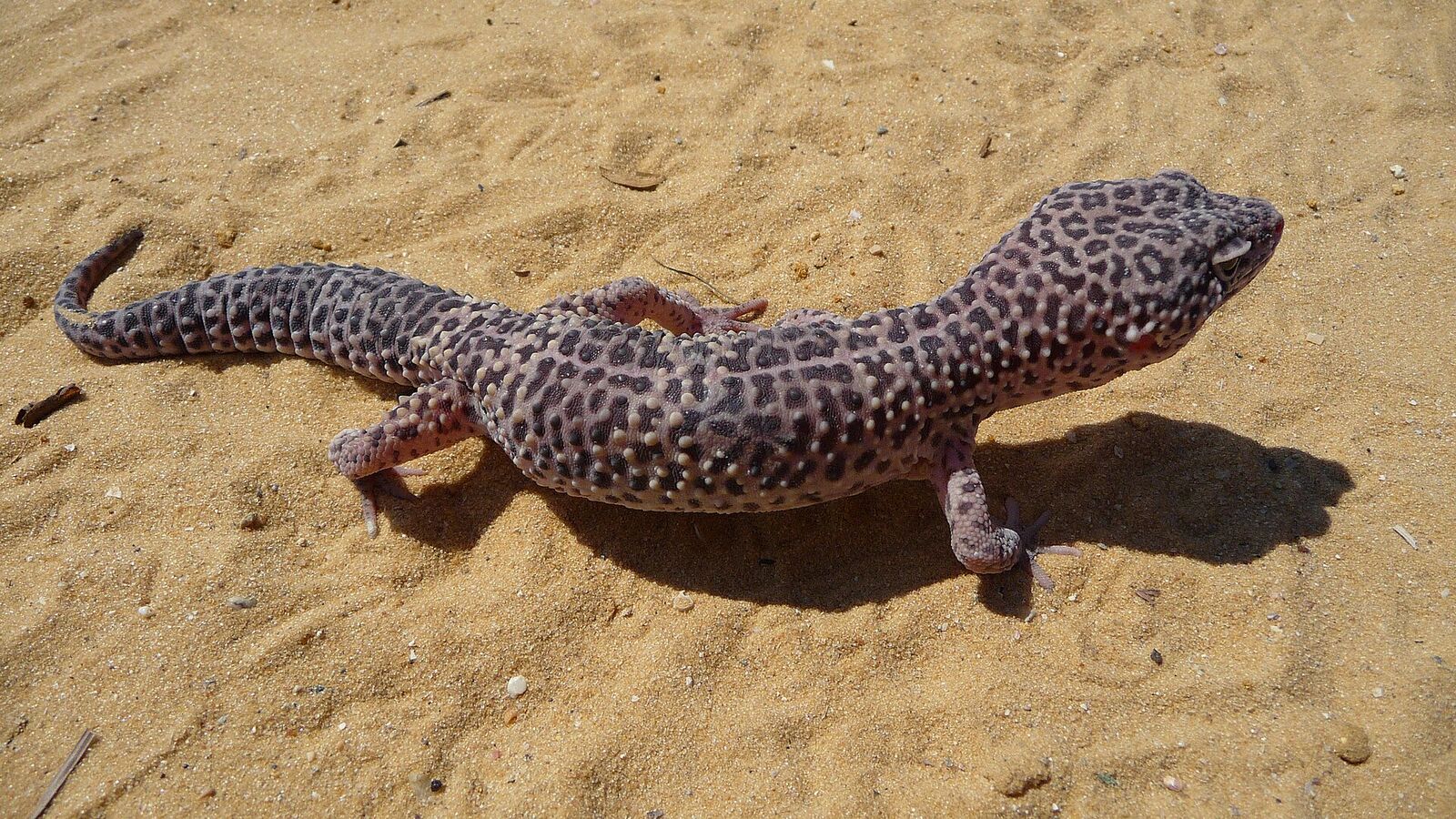
The African fat-tailed gecko or fat-tail gecko (Hemitheconyx caudicinctus) is a ground-dwelling species of gecko from West Africa and Cameroon.
Intro from Wikipedia (CC BY-SA 4.0)

Care at a glance
Species-specific values
Values researched for this exact species. Where they differ from the group guide below, follow these. Air, surface and water temperatures are listed separately, and each source is kept as published rather than averaged.
| Warm hide temperature | 90–94 °F rainy/warm season; author’s seasonal husbandry recommendation | 210 |
| Cool zone temperature | 72–77 °F rainy/warm season; author’s seasonal husbandry recommendation | 210 |
| Air temperature night | 72–77 °F rainy/warm season; author’s seasonal husbandry recommendation | 210 |
| Humidity day | 70–80 % RH rainy/warm season; author’s seasonal husbandry recommendation | 210 |
| Humidity night | 100 % RH rainy/warm season; author’s seasonal husbandry recommendation | 210 |
| Warm hide temperature | 79 °F dry/cool season; author’s seasonal husbandry recommendation | 210 |
| Cool zone temperature | 68–74 °F dry/cool season; author’s seasonal husbandry recommendation | 210 |
| Air temperature night | 63–64 °F dry/cool season; author’s seasonal husbandry recommendation | 210 |
| Humidity day | 50 % RH dry/cool season; author’s seasonal husbandry recommendation | 210 |
| Humidity night | 70–75 % RH dry/cool season; author’s seasonal husbandry recommendation | 210 |
| Enclosure minimum | length: 36 in; width: 18 in; height: 18 in Single adult | 210 |
| Adult total length | 8–10 in | 210 |
| Lifespan typical captive | 15–20 years Keeper-reported expectation; longer possible | 210 |
| Social | Individual housing preferred. | 210 |
| Diet | Varied feeder insects with calcium and appropriate vitamin supplementation. | 210 |
Care guide
Eyelid geckos (leopard, fat-tailed and cave geckos)
Applies to most species in this group. Habitat: Arid scrub to humid forest floor. Individual species can differ, so compare with the species numbers above and the linked sources.
Housing & setup
- Floor space over height; a warm hide, a cool hide and a humid hide.
- For leopard geckos, overhead heating is preferred; any supplemental heat mat must be thermostat-controlled.
Climate & lighting
Starting point only: Leopard and African fat-tailed geckos need substantially different moisture regimes; family-wide values are misleading. Check the species-specific values for this animal where shown.
| Warm side / daytime | 88–92°F |
| Cool side | 72–78°F |
| Humidity | 30–50% |
- UVB: Low-level UVB recommended.
Diet
- Insects (crickets, roaches, mealworms) dusted with calcium and multivitamins.
- Never use loose sand for juveniles; impaction risk.
Health watch
- Hardy. Watch for stuck shed on toes and for weight loss.
- Cave geckos (Goniurosaurus) need cooler, more humid setups than leopard geckos.
Understanding the animal
In the wild
In the wild
Researched for this exact species, not its family. Good care copies these conditions.123
| Where it lives | West African wooded and open savanna from Senegal toward Cameroon. At Wa, Ghana, animals used soil in open savanna and daytime rodent-burrow chambers rather than rock outcrops. |
| Ground it lives on | savanna soil with underground burrows |
| Climate | At Wa, active animals were found at 72–89°F air temperature and 17–95% relative humidity; most captures followed rain. Regional days ranged 72–102°F in the rainy season and 61–104°F in the dry season, extremes buffered underground. |
| Active | Nocturnal, mostly from roughly an hour after sunset to midnight; reduced dry-season activity, but not universal aestivation. |
| Social life | Territorial. Captive observations indicate that males should not be housed together and that females may also compete, with solitary housing favored outside breeding. |
| Wild diet | Wild observations document feeding on emerging winged termites; complete wild prey proportions are unavailable. |
| Behavior to plan for | Uses deep burrows as daytime refuges and escapes into holes. Rain and elevated humidity stimulate surface activity. |
What this means for care
- Provide burrow-like shelters and diggable soil.
- Offer a moisture gradient with a humid retreat.
- Use the measured active-night conditions as ecological context, not daytime regional extremes as enclosure targets.
Native climate (measured)
Native climate (measured)
| Warm-season highs | about 99°F (up to 102°F in the hottest sampled areas) |
| Cool-season lows | about 65°F (down to 61°F in the coldest sampled areas) |
| Average temperature | 79–83°F across sampled records |
| Relative humidity | 53–69% on average (driest month about 32%) |
| Rainfall | about 1054 mm a year, with strong wet and dry seasons |
Measured at 42 wild occurrence records sampled against WorldClim 2.1 climate data (1970–2000 averages). Air conditions in the range are ecological context, not enclosure settings: microhabitats such as burrows, leaf litter or basking rocks can be cooler, warmer or more humid.
Profile
Profile
Researched for this exact species. Sources are listed under In the wild above.
History
The species was described by Duméril in 1851.
Keeper tips
- Provide multiple ground-level hides.
- Maintain moderately warm conditions rather than extreme heat.
- House individuals separately unless intentionally breeding.
- Feed varied invertebrate prey.
- Provide occasional moderate humidity to assist shedding.
Behaviors reported
- Waves or undulates its tail while hunting or when nervous.
- Consumes shed skin.
- Hides during daylight.
- Defends territories from other geckos.
Unique adaptations
- The thick tail stores energy.
- The tail resembles the head and can divert predator attacks.
- Tail autotomy allows escape from predators.
- A lost tail can regenerate.
Remarkable facts
- The species is native to West Africa.
- It is a ground-dwelling eublepharid gecko.
- It has movable eyelids and vertical pupils.
- It lacks the adhesive toe lamellae characteristic of many climbing geckos.
- Adults are typically around 7-8 inches long.
From the sources
From the sources
Quoted from the matching sections of reputable sources for this exact species. Specialist databases are used first; Wikipedia (community-edited, CC BY-SA 4.0) only fills gaps. Other sources are short credited quotes.
| Overview | The African fat-tailed gecko or fat-tail gecko (Hemitheconyx caudicinctus) is a ground-dwelling species of gecko from West Africa and Cameroon. — Wikipedia (community-edited) |
| Where it lives | Range: Cameroon, Nigeria, Senegal, Togo, Mali, Ivory Coast, Gambia, Benin, Burkina Faso, Niger, Ghana ?, Liberia ?, Guinea (Conakry), Sierra Leone ? — The Reptile Database |
| Wild diet | African fat-tailed geckos have a primarily insectivorous diet, feeding on various kinds of insects and other invertebrates within their habitats, such as worms, crickets, possibly beetles or cockroaches, etc. — Wikipedia (community-edited) |
| Behavior | The African fat-tailed gecko is equipped with the ability to lose its tail when threatened or attacked. If the tail is lost, the new tail will have a more rounded shape, similar to the head. It may not match the body coloration and pattern of the gecko. — Wikipedia (community-edited) |
| Reproduction | Exhibits temperature‐dependent sex determination (TSD) fide Cornejo-Páramo et al. 2020 (and references therein). — The Reptile Database |
| Appearance and size | Diagnosis (genus): Digits free, short, stout, cylindrical, not dilated, tips pointed, covered above with scales, not denticulate laterally, below granular, clawed, the claws partially retractile between three scales. — The Reptile Database |
| History and naming | Named after Latin cauda = tail, and Latin cinctus, surrounded, encircled, presumably referring to the light and dark bands or the girdled appearance of the tail. — The Reptile Database |
Data and studies
Researched care notes
Researched care notes
Findings checked against veterinary, zoo, welfare, keeper and peer-reviewed sources. Air, basking-surface and water temperatures are kept separate, and where sources disagree both are shown. “Study” notes report what a paper measured, not a universal rule.
African Fat-Tailed Gecko
- ReptiFiles recommends at least 90 × 45 × 45 cm for one adult and generally solitary housing; the dimensions are guidance, not a proven biological minimum.1
- Provide multiple secure hiding places, digging substrate and low climbing structures for exploration.1
- Temperature / season: the guide gives a warm-hide target of 32–34°C during its warm-season schedule; it does not clearly identify that hide value as air or surface temperature.1
- Humidity / season: the same guide recommends 70–80% daytime RH in its wet season and about 50% in its dry season; its nighttime peaks are not a recommendation for continuous saturation.1
- Uvb: ReptiFiles recommends basking UVI 1–2 at the animal's back; lamp distance must account for fixture and intervening mesh.1
- Use varied appropriately sized feeder insects, with juvenile feeding more frequent than adult feeding and portions adjusted to body condition.1
- Temperature: the warm-season guide gives a cool zone of 22–25°C; its cool-zone wording likewise leaves the air-versus-surface measurement type unspecified.1
The numbers
The numbers
Each bar is what one source reports. Where several sources weigh in, the dashed gold band marks their average.
Maximum recorded lifespan
Longest recorded lifespan reported by each database; typical lifespans are usually shorter. The AnAge record comes from an animal in human care.
Typical adult weight
Average adult body mass in each database (FishBase gives the maximum recorded weight).
Incubation
Cool side
Species-specific values from keeper care sheets. Basking figures are often surface readings taken with an infrared thermometer, which run hotter than air.
Night temperature
Species-specific values from keeper care sheets. Basking figures are often surface readings taken with an infrared thermometer, which run hotter than air.
Humidity
Species-specific values from keeper care sheets. Basking figures are often surface readings taken with an infrared thermometer, which run hotter than air.
Care articles for this species
Care articles for this species
- African Fat-Tailed Gecko Care Sheet (ReptiFiles)
- African Fat-Tailed Gecko Care Sheet (Reptiles Magazine)
Sources for this sheet
- AnAge: The Animal Ageing and Longevity Database (Human Ageing Genomic Resources) Peer-reviewed researchCurated, referenced longevity and life-history records for thousands of species; maximum lifespans are often from zoo animals.
- Myhrvold et al. (2015). An amniote life-history database. Ecology 96: 3109 Peer-reviewed researchPeer-reviewed compilation of life-history data for over 21,000 birds, mammals and reptiles.
- ReptiFiles (care guides) Experienced keeper or breederWell-researched reptile care guides that cite herpetological literature and experienced keepers.
- Merck Veterinary Manual: Management and husbandry of reptiles Zoo, university or veterinaryThe Merck Veterinary Manual: a standard veterinary reference written and reviewed by veterinary specialists.
- Merck Veterinary Manual: Nutritional, metabolic and endocrine diseases of reptiles Zoo, university or veterinaryThe Merck Veterinary Manual: a standard veterinary reference written and reviewed by veterinary specialists.
- VCA Animal Hospitals: Leopard geckos, care Zoo, university or veterinaryLarge veterinary hospital network; vet-written client handouts.
- ReptiFiles: Leopard gecko lighting, temperatures and humidity Experienced keeper or breederAdded in the 2026 source-checked care-guide review.
- ReptiFiles: African fat-tailed gecko care sheet Experienced keeper or breederAdded in the 2026 source-checked care-guide review.
- Clint's Reptiles (YouTube): African Fat-tailed Gecko, The Best Pet Lizard? Expert educator & keeperClint Laidlaw, PhD in Biology Education and MS in Evolutionary Ecology; owner of Clint's Reptile Room and a longtime keeper. His "Best Pet?" series reviews each species' care in depth.
- The Reptile Database Peer-reviewed researchScientist-curated catalog of every reptile species, with taxonomy and literature.
- GBIF Backbone Taxonomy (Global Biodiversity Information Facility) Peer-reviewed researchInternational scientific taxonomy used here for classification.
- Wikipedia (species article) Community referenceFree encyclopedia; useful overviews with their own citations. Intro text is quoted under CC BY-SA 4.0.
- iNaturalist (captive observations) Community referenceCommunity observation platform run by the California Academy of Sciences and National Geographic; observations marked captive show animals living in homes, zoos and aquariums.
- Reptiles Magazine (care articles) Experienced keeper or breederEstablished reptile and amphibian hobby magazine; care articles are written by breeders, keepers and veterinarians.