Home / Reptiles / Lizards / Argentine black and white tegu
Some federal rules applyArgentine black and white tegu
Salvator merianae
Reptiles › Lizards (Lacertilia) › Teiidae (Tegus and whiptails)
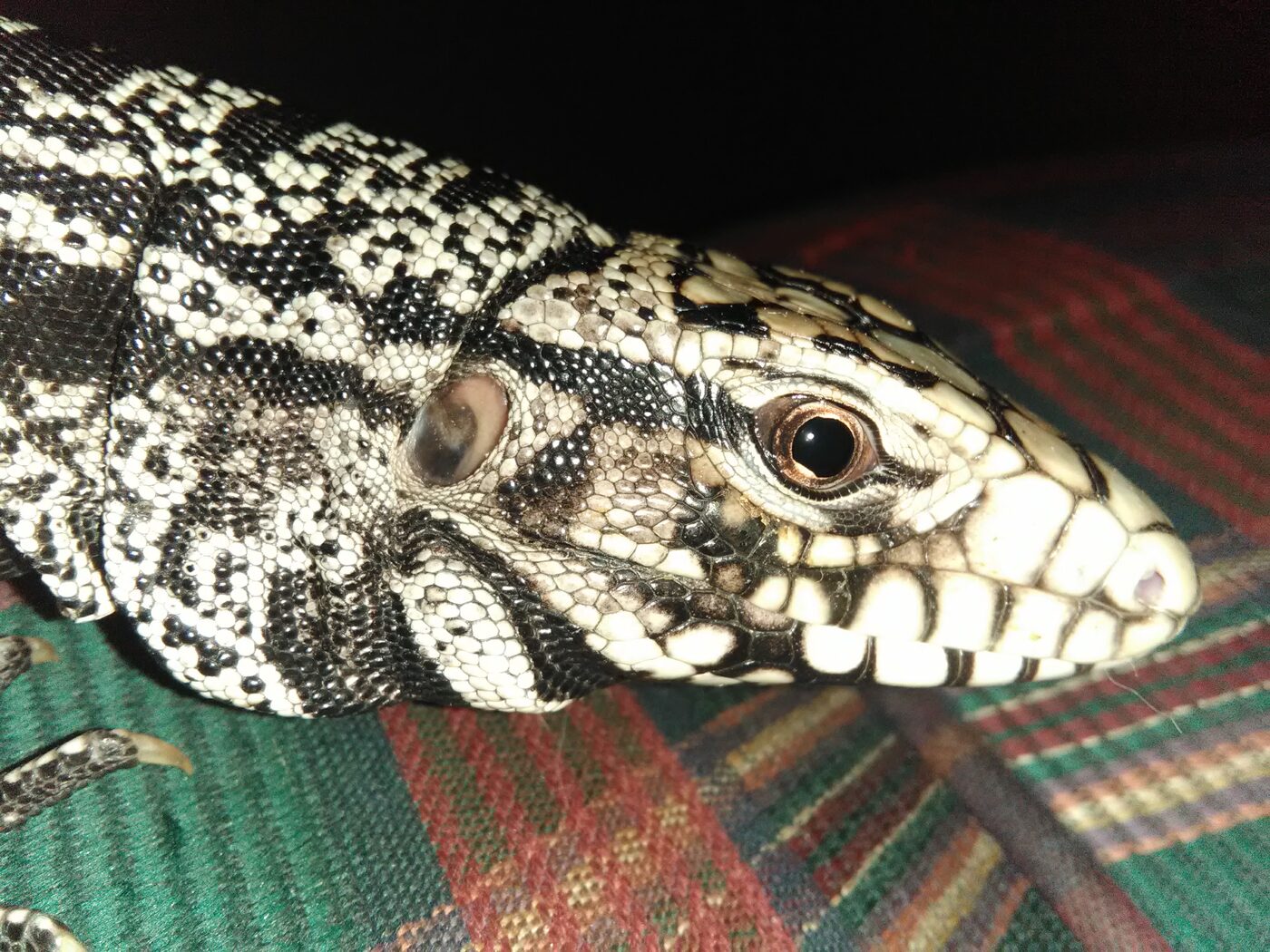
The Argentine black and white tegu (Salvator merianae), also commonly known as the Argentine giant tegu, the black and white tegu, the blue tegu, and the huge tegu, is a species of lizard in the family Teiidae.
Care at a glance
Species-specific values
Values researched for this exact species. Where they differ from the group guide below, follow these. Air, surface and water temperatures are listed separately, and each source is kept as published rather than averaged.
| Basking surface temperature | 125–135 °F RF Argentine/Colombian tegu regime; not all whiptails. | 243 |
| Warm air temperature | 90–95 °F | 243 |
| Cool air temperature | 75–85 °F | 243 |
| Night air temperature | 68–74 °F Active-season husbandry, not brumation. | 243 |
| Relative humidity | 70–80 % | 243 |
| Humid hide relative humidity | 90–100 % | 243 |
Care guide
Tegus and whiptails
Applies to most species in this group. Habitat: South American grasslands and forests. Individual species can differ, so compare with the species numbers above and the linked sources.
Housing & setup
- Tegus need very large enclosures (8×4 ft floor or larger for adult Argentine tegus) with deep burrowing substrate.
- Hot basking, strong UVB, and a large water tub.
Climate & lighting
Starting point only: Identified Argentine tegus use different targets from the old guide; the family also includes much smaller whiptails. Check the species-specific values for this animal where shown.
| Basking spot | 110–120°F |
| Warm side / daytime | 85–90°F |
| Cool side | 75–80°F |
| Humidity | 60–80% |
- UVB: Required (strong).
Diet
- Omnivores: whole prey, lean meats, eggs, insects and some fruit. Caiman lizards eat snails and fish.
Handling
- Captive-bred tegus that are handled regularly are often very tame.
Health watch
- Obesity, MBD and stress-related aggression; Argentine tegus brumate for months in winter.
Understanding the animal
About this animal
About this animal
The species is the largest of the "tegu" lizards. It is an omnivorous species, which inhabits the tropical rain forests, savannas, and semideserts of eastern and central South America.
Quoted from the Wikipedia article “Argentine black and white tegu” (CC BY-SA 4.0) 174
In the wild
In the wild
Researched for this exact species, not its family. Good care copies these conditions.12345
| Where it lives | Open and forested habitats in Brazil, Paraguay, Uruguay, Argentina and Bolivia, including disturbed land. Forages on the ground and retreats into burrows. |
| Ground it lives on | Soil and leaf litter, including underground burrows. |
| Climate | Tropical/subtropical seasonal climate with cooler, often drier winters and dormancy. Wild air-temperature and humidity ranges were not established; reported active body temperatures of 89.6–95°F are not ambient climate. |
| Active | Diurnal; prolonged winter dormancy lasting several months. |
| Social life | Breeding males show territorial and mate-searching behavior; stable group structure was not established. |
| Wild diet | Plants, fruits, invertebrates, vertebrates, eggs and carrion. |
| Behavior to plan for | An active terrestrial forager that digs and uses burrows for shelter and dormancy. Spring reproductive activity can increase aggression. |
What this means for care
- Provide deep diggable soil and a substantial retreat.
- Offer an omnivorous diet rather than only animal prey.
- Allow for seasonal changes in activity and appetite.
Native climate (measured)
Native climate (measured)
| Warm-season highs | about 85°F (up to 88°F in the hottest sampled areas) |
| Cool-season lows | about 45°F (down to 40°F in the coldest sampled areas) |
| Average temperature | 60–70°F across sampled records |
| Relative humidity | 70–79% on average (driest month about 68%) |
| Rainfall | about 1261 mm a year, spread fairly evenly |
Measured at 131 wild occurrence records sampled against WorldClim 2.1 climate data (1970–2000 averages). Air conditions in the range are ecological context, not enclosure settings: microhabitats such as burrows, leaf litter or basking rocks can be cooler, warmer or more humid.
Profile
Profile
Researched for this exact species. Sources are listed under In the wild above.
History
The species was originally described as Salvator merianae in 1839. Beginning in 1845 it was treated for 154 years as a synonym of Tupinambis teguixin, regained species status as Tupinambis merianae in 1995, and was reassigned to the resurrected genus Salvator in 2012.
Keeper tips
- Expect substantial activity during the animal's wakeful season.
- Be aware that cooler autumn conditions can trigger brumation.
- Account for the species' large adult size when planning housing.
Behaviors reported
- Enters brumation in autumn as ambient temperature drops.
- Shows a high level of activity during the wakeful part of the year.
- Is noted for unusually high intelligence and relatively gentle behavior.
Unique adaptations
- It is the only known nonavian reptile reported in the source to become partly endothermic during the breeding season.
- Its ecological similarity to monitor lizards represents convergent evolution despite the groups being only distantly related.
Remarkable facts
- It is the largest of the tegu lizards.
- It belongs to the family Teiidae.
- Salvator differs from Tupinambis in having two loreal scales between the eye and nostril rather than one.
- The species is oviparous.
- Salvator merianae is the type species of the genus Salvator.
- The specific name merianae honors naturalist and artist Maria Sibylla Merian.
From the sources
From the sources
Quoted from the matching sections of reputable sources for this exact species. Specialist databases are used first; Wikipedia (community-edited, CC BY-SA 4.0) only fills gaps. Other sources are short credited quotes.
| Overview | The Argentine black and white tegu (Salvator merianae), also commonly known as the Argentine giant tegu, the black and white tegu, the blue tegu, and the huge tegu, is a species of lizard in the family Teiidae. The species is the largest of the "tegu" lizards. It is an omnivorous species, which inhabits the tropical rain forests, savannas, and semideserts of eastern and central South America. It is native to south and southeastern Brazil, Uruguay, eastern Paraguay, Bolivia, and Argentina. — Wikipedia (community-edited) |
| Where it lives | As one of its common names would suggest, Salvator merianae is native to Argentina, but also to Brazil, Paraguay, Bolivia, and Uruguay. Significant populations of Argentine black and white tegus occur in the southern United States and the Brazilian coast. — Wikipedia (community-edited) |
| Wild diet | Tegus are omnivorous; juveniles in the wild have been observed to eat a wide range of vertebrates, invertebrates, fruits, and seeds. A non-exhaustive list includes insects, annelids, crustaceans, spiders, snails, small birds, fish, frogs, other lizards, snakes, rodents, armadillos, bananas, grapes, mangoes, and papayas. Tegus are notorious egg predators, seeking out eggs from the nests of birds and other reptiles. — Wikipedia (community-edited) |
| Appearance and size | Diagnosis (genus): Salvator is the only genus of Teiidae with the combination of two loreals, smooth ventrals, and a subcylindrical tail with two divided caudal annuli alternating with complete annuli. — The Reptile Database |
| History and naming | Named after Anna Maria Sibylla Graff, nee Merian (1647-1717), who was born in Frankfurt into a Swiss family and lived most of her life in Germany, then in the Netherlands. — The Reptile Database |
Data and studies
The numbers
The numbers
Each bar is what one source reports. Where several sources weigh in, the dashed gold band marks their average.
Maximum recorded lifespan
Longest recorded lifespan reported by each database; typical lifespans are usually shorter.
Typical adult weight
Average adult body mass in each database (FishBase gives the maximum recorded weight).
Incubation
Veterinary & husbandry research
Veterinary & husbandry research
- Metabolic and Hormonal Changes Associated with Vitellogenesis in Salvator merianae Lizards Sánchez-Loria O et al., Zoological science 2021
- Hormonal correlates of the annual cycle of activity and body temperature in the South-American tegu lizard (Salvator merianae) Zena LA et al., General and comparative endocrinology 2020
- Eggs of tegu lizard, Salvator merianae (Duméril & Bilbron, 1839) (Squamata; Teiidae) damaged by fungal infections Carvalho AM et al., Brazilian journal of biology = Revista brasleira de biologia 2020
- Interactions between the invasive Burmese python, Python bivittatus Kuhl, and the local mosquito community in Florida, USA Reeves LE et al., PloS one 2018
Peer-reviewed papers that mention this species alongside captivity, zoos, veterinary care or aquaculture. Some cover several species or mention it only in passing, so check the abstract. See all 11 on PubMed → 170
Sources for this sheet
- Myhrvold et al. (2015). An amniote life-history database. Ecology 96: 3109 Peer-reviewed researchPeer-reviewed compilation of life-history data for over 21,000 birds, mammals and reptiles.
- Species+ (UNEP-WCMC and the CITES Secretariat) Zoo, university or veterinaryThe official database of species listed under CITES.
- USFWS International Affairs: CITES Zoo, university or veterinaryFederal agency that issues CITES permits.
- Merck Veterinary Manual: Management and husbandry of reptiles Zoo, university or veterinaryThe Merck Veterinary Manual: a standard veterinary reference written and reviewed by veterinary specialists.
- Merck Veterinary Manual: Nutritional, metabolic and endocrine diseases of reptiles Zoo, university or veterinaryThe Merck Veterinary Manual: a standard veterinary reference written and reviewed by veterinary specialists.
- ReptiFiles: Colombian and Argentine tegu humidity, lighting and heat Zoo, university or veterinaryAdded in the 2026 source-checked care-guide review.
- Clint's Reptiles (YouTube): Argentine Tegu, The Best Pet Lizard? Expert educator & keeperClint Laidlaw, PhD in Biology Education and MS in Evolutionary Ecology; owner of Clint's Reptile Room and a longtime keeper. His "Best Pet?" series reviews each species' care in depth.
- The Reptile Database Peer-reviewed researchScientist-curated catalog of every reptile species, with taxonomy and literature.
- GBIF Backbone Taxonomy (Global Biodiversity Information Facility) Peer-reviewed researchInternational scientific taxonomy used here for classification.
- Wikipedia (species article) Community referenceFree encyclopedia; useful overviews with their own citations. Intro text is quoted under CC BY-SA 4.0.
- PubMed (U.S. National Library of Medicine) Peer-reviewed researchIndex of peer-reviewed veterinary, zoo and husbandry research.
- iNaturalist (captive observations) Community referenceCommunity observation platform run by the California Academy of Sciences and National Geographic; observations marked captive show animals living in homes, zoos and aquariums.
