
Home / Reptiles / Lizards / Teiidae / Western whiptail
No federal permit to keepWestern whiptail
Aspidoscelis tigris
Reptiles › Lizards (Lacertilia) › Teiidae (Tegus and whiptails)
The western whiptail (Aspidoscelis tigris) is a species of lizard in the family Teiidae.
From Wikipedia: Western whiptail, CC BY-SA 4.0 (excerpt)

Care at a glance
Species-specific values
Values researched for this exact species. Air, surface and water temperatures are listed separately, and each source is kept as published rather than averaged.
| Minimum enclosure | Recommended minimum for one adult: 47.3″ × 23.7″ × 29.6″ (120 × 60 × 75 cm), usable internal length × depth × height. Source: thecreaturecorner.com | |
| Uvb lighting | Install UVB with verified intensity at the animal's level plus total shade; specific UVI requirements remain unstated. Source: thecreaturecorner.com | |
| Diet | Offer varied, appropriately sized, well-fed feeder insects with coordinated calcium and multivitamin supplementation. Source: thecreaturecorner.com | |
| Feeding frequency | Base portions and frequency on age, condition, and the individual's established feeding record. Source: thecreaturecorner.com | |
| Social housing | Keep one animal. Source: thecreaturecorner.com | |
| Substrate | Use diggable soil/sand, with about 15 cm as a practical starting allowance; increase depth if burrowing is restricted. Source: thecreaturecorner.com | |
| Seasonal cooling | Do not impose cooling or brumation based on geographic weather averages; identify the form and its established seasonal routine first. Source: thecreaturecorner.com |
Understanding the animal
About this animal
About this animal
The species is found throughout most of the southwestern United States and northern Mexico. Most of its populations appear stable, and it is not listed as endangered in any of the states comprising its range.
From Wikipedia: Western whiptail, CC BY-SA 4.0 (excerpt)
In the wild
In the wild
| Overview | The western whiptail (Aspidoscelis tigris) is a species of lizard in the family Teiidae. The species is found throughout most of the southwestern United States and northern Mexico. Most of its populations appear stable, and it is not listed as endangered in any of the states comprising its range. It lives in a wide variety of habitats, including deserts and semiarid shrubland, usually in areas with sparse vegetation; it also may be found in woodland, open dry forest, and riparian growth. — From Wikipedia: Western whiptail, CC BY-SA 4.0 (excerpt) |
| Where it lives | The western whiptail is widespread throughout northern Mexico and the western United States. In the US it can be found in the states of Arizona, California, Colorado, Idaho, Nevada, New Mexico, Oregon, and Utah. It is found in hot dry regions, typically with sparse foliage. — From Wikipedia: Western whiptail, CC BY-SA 4.0 (excerpt) |
| Wild diet | The western whiptail mostly eats insects, spiders, scorpions, lepidopterans, crickets, grasshoppers, and beetles. They use their jaws instead of their tongue to capture their prey. — From Wikipedia: Western whiptail, CC BY-SA 4.0 (excerpt) |
| Reproduction | The western whiptail's chromosomes show that it is polyploid. It is also a bisexual species, containing both males and females, unlike other species of Aspidoscelis which are all-female. Usually in the northern end of its range, mating occurs in the first half of June, and females begin to lay eggs in late June. — From Wikipedia: Western whiptail, CC BY-SA 4.0 (excerpt) |
| Appearance and size | The western whiptail has a long and slender body, small grainy scales on its back, and larger rectangular scales on its belly. The upper side often has light stripes, and the throat can be pinkish or somewhat orange in adults. The maximum snout-to-vent length (SVL) is 102 mm (about 4 inches), and maximum total length (including tail) is 305 mm (about 12 inches). — From Wikipedia: Western whiptail, CC BY-SA 4.0 (excerpt) |
Read about this species in the wild at The Reptile Database.
Native climate (measured)
Native climate (measured)
| Warm-season highs | about 94°F (up to 103°F in the hottest sampled areas) |
| Cool-season lows | about 31°F (down to 16°F in the coldest sampled areas) |
| Average temperature | 48–72°F across sampled records |
| Relative humidity | 40–52% on average (driest month about 31%) |
| Rainfall | about 284 mm a year |
| Winters | Cool to cold winters (lows around 31°F) in much of its native range. Seasonal slowdown may be relevant, but species-specific biology determines whether brumation or hibernation occurs. |
Measured at 1234 wild occurrence records sampled against WorldClim 2.1 climate data (1970–2000 averages). Air conditions in the range are ecological context, not enclosure settings: microhabitats such as burrows, leaf litter or basking rocks can be cooler, warmer or more humid.
Profile
Profile
Researched for this exact species. Sources are listed under In the wild above.
Data and studies
The numbers
The numbers
Each bar is what one source reports. Where several sources weigh in, the dashed gold band marks their average.
Maximum recorded lifespan
Longest recorded lifespan reported by each database; typical lifespans are usually shorter.
Typical adult weight
Average adult body mass in each database (FishBase gives the maximum recorded weight).
Adult snout-to-vent length
Body length without the tail.
Sources for this sheet
- Myhrvold et al. (2015). An amniote life-history database. Ecology 96: 3109 Peer-reviewed researchPeer-reviewed compilation of life-history data for over 21,000 birds, mammals and reptiles.
- The Reptile Database Peer-reviewed researchScientist-curated catalog of every reptile species, with taxonomy and literature.
- GBIF Backbone Taxonomy (Global Biodiversity Information Facility) (CC BY 4.0) Peer-reviewed researchInternational scientific taxonomy used here for classification. GBIF Secretariat (2023). GBIF Backbone Taxonomy. Checklist dataset https://doi.org/10.15468/39omei, accessed via GBIF.org.
- Wikipedia (species article) (CC BY-SA 4.0) Community referenceFree encyclopedia; useful overviews with their own citations. Short excerpts are quoted under CC BY-SA 4.0, each credited with a link to its article.
- iNaturalist (captive observations) Community referenceCommunity observation platform run by the California Academy of Sciences and National Geographic; observations marked captive show animals living in homes, zoos and aquariums.
More tegus and whiptails
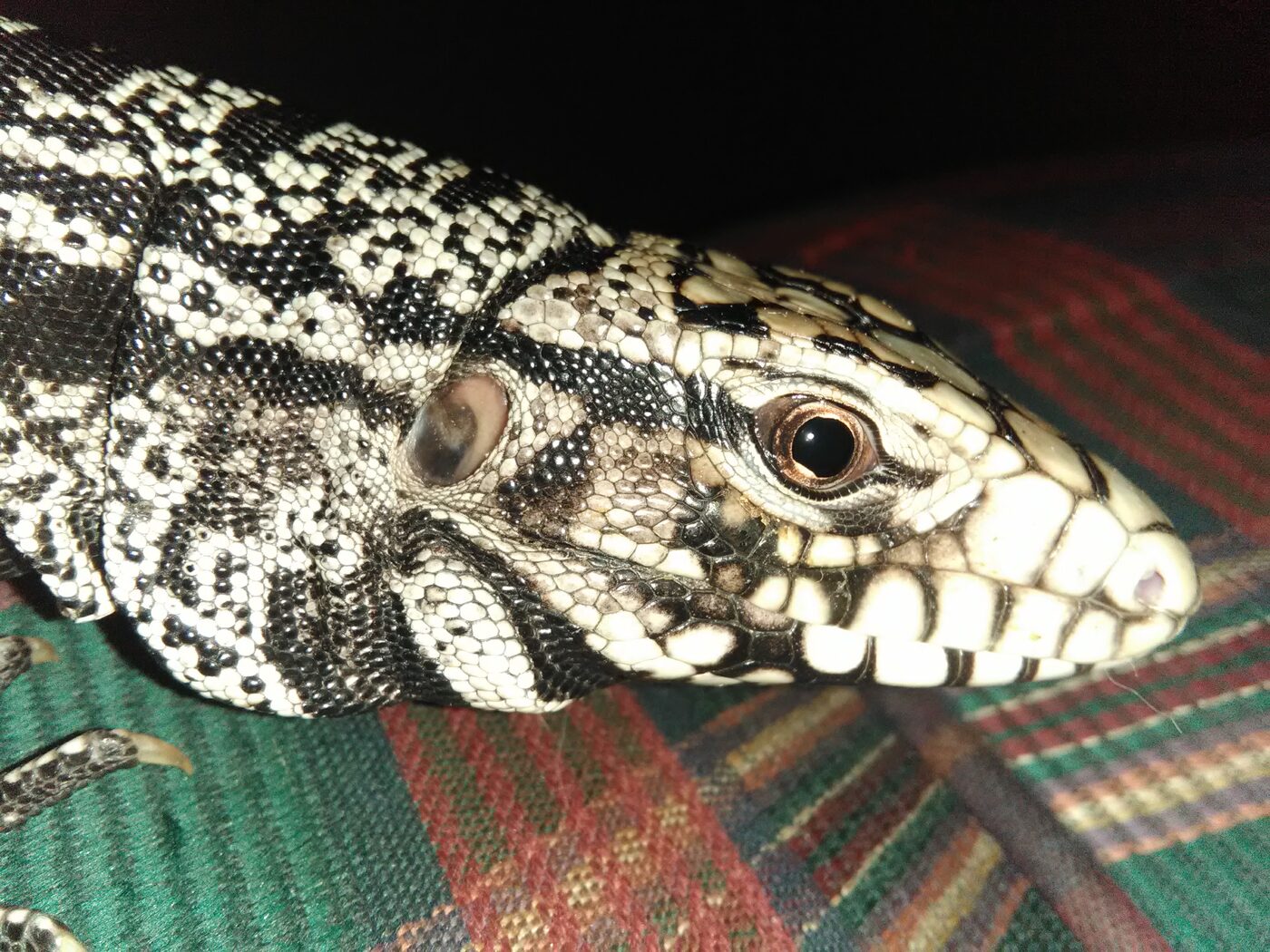
Argentine black and white tegu
Salvator merianae
Pet trade

Crocodile tegu
Crocodilurus amazonicus
Pet trade
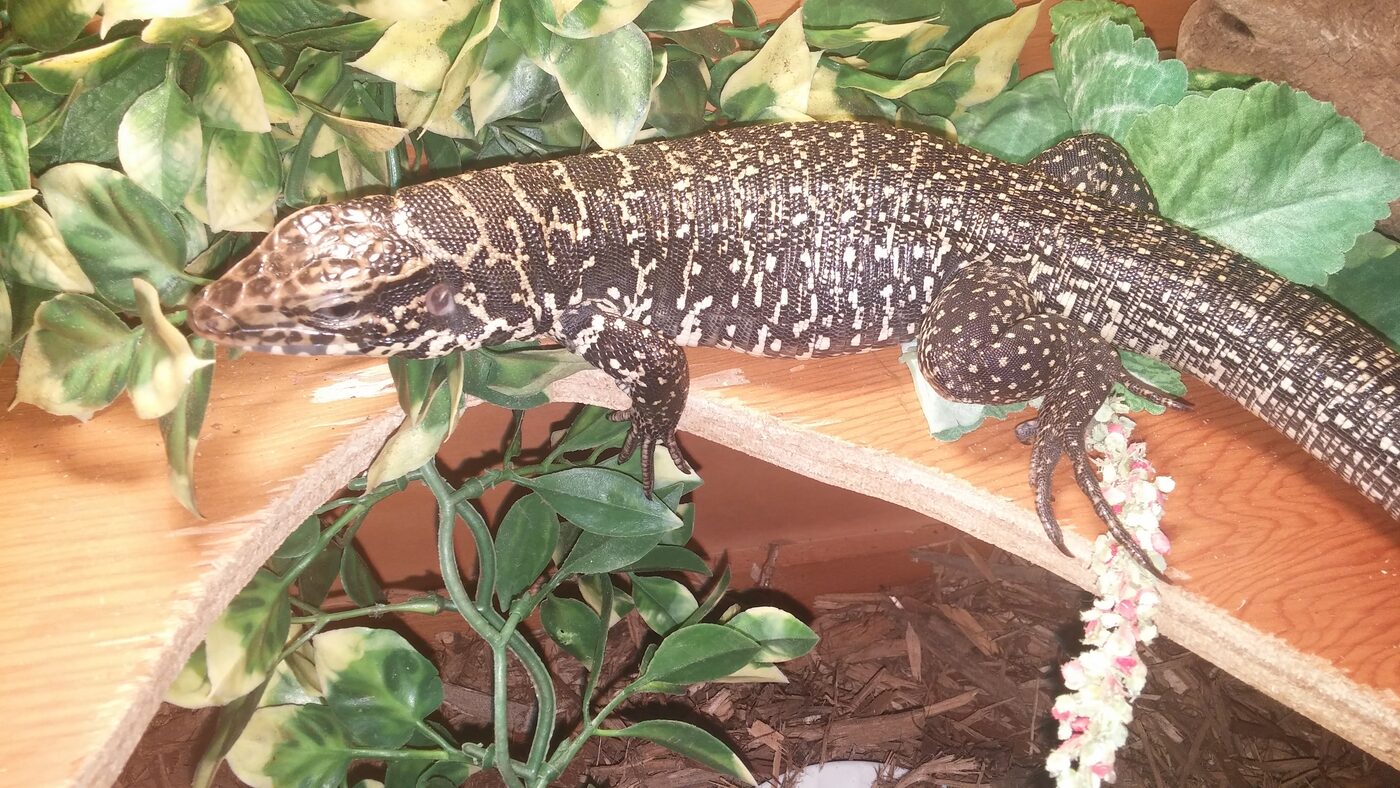
Gold (Colombian) tegu
Tupinambis teguixin
Pet trade

Northern caiman lizard
Dracaena guianensis
Pet trade

Red tegu
Salvator rufescens
Pet trade