Home / Reptiles / Lizards / Red tegu
Some federal rules applyRed tegu
Salvator rufescens
Reptiles › Lizards (Lacertilia) › Teiidae (Tegus and whiptails)
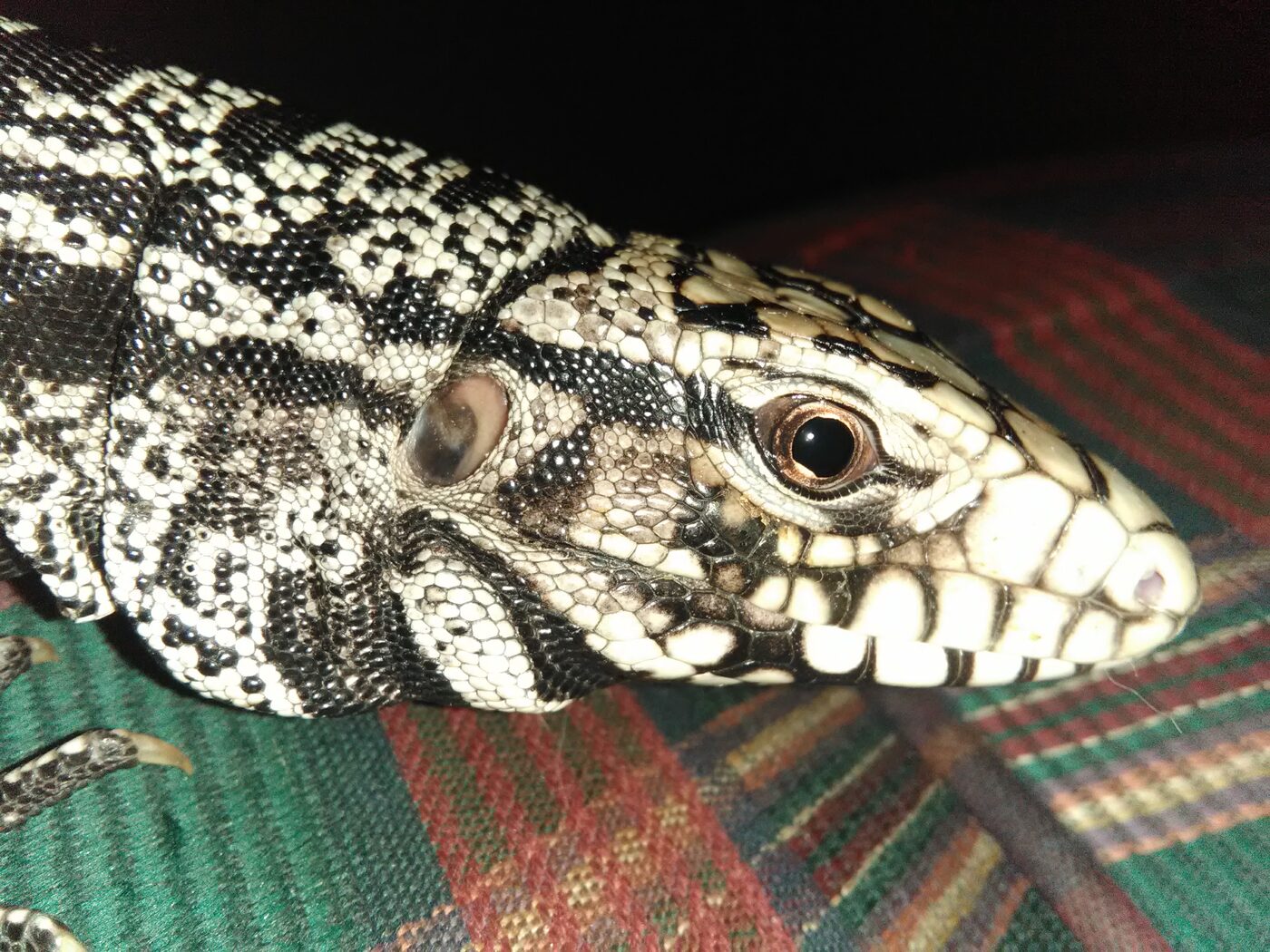
The red tegu (Salvator rufescens) is a lizard native to western Argentina, Bolivia and Paraguay.

Care at a glance
Species-specific values
Values researched for this exact species. Where they differ from the group guide below, follow these. Air, surface and water temperatures are listed separately, and each source is kept as published rather than averaged.
| Basking surface temperature | 125–135 °F RF Argentine/Colombian tegu regime; not all whiptails. | 243 |
| Warm air temperature | 90–95 °F | 243 |
| Cool air temperature | 75–85 °F | 243 |
| Night air temperature | 68–74 °F Active-season husbandry, not brumation. | 243 |
| Relative humidity | 70–80 % | 243 |
| Humid hide relative humidity | 90–100 % | 243 |
Care guide
Tegus and whiptails
Applies to most species in this group. Habitat: South American grasslands and forests. Individual species can differ, so compare with the species numbers above and the linked sources.
Housing & setup
- Tegus need very large enclosures (8×4 ft floor or larger for adult Argentine tegus) with deep burrowing substrate.
- Hot basking, strong UVB, and a large water tub.
Climate & lighting
Starting point only: Identified Argentine tegus use different targets from the old guide; the family also includes much smaller whiptails. Check the species-specific values for this animal where shown.
| Basking spot | 110–120°F |
| Warm side / daytime | 85–90°F |
| Cool side | 75–80°F |
| Humidity | 60–80% |
- UVB: Required (strong).
Diet
- Omnivores: whole prey, lean meats, eggs, insects and some fruit. Caiman lizards eat snails and fish.
Handling
- Captive-bred tegus that are handled regularly are often very tame.
Health watch
- Obesity, MBD and stress-related aggression; Argentine tegus brumate for months in winter.
Understanding the animal
About this animal
About this animal
It is sold in the pet trade around the world due to its ease of care and relatively docile nature.
Quoted from the Wikipedia article “Red tegu” (CC BY-SA 4.0) 174
In the wild
In the wild
Quoted from the matching sections of reputable sources for this exact species. Specialist databases are used first; Wikipedia (community-edited, CC BY-SA 4.0) only fills gaps. Other sources are short credited quotes.
| Overview | The red tegu (Salvator rufescens) is a lizard native to western Argentina, Bolivia and Paraguay. It is sold in the pet trade around the world due to its ease of care and relatively docile nature. — Wikipedia (community-edited) |
| Wild diet | The red tegu is a very opportunistic feeder. Wild specimens will eat a variety of plant and animal matter: fruits, vegetables, insects, rodents, birds, and fish. Red tegus raised in captivity will often be more picky eaters, especially as juveniles, and may prefer a diet of mostly meat. — Wikipedia (community-edited) |
| Behavior | In the wild, red tegus are diurnal and terrestrial. Living in a temperate climate in Argentina, they brumate in the winter, burying themselves and remaining largely dormant during the coldest periods, in some areas for up to seven months. They also burrow as a matter of habit at other times of year. — Wikipedia (community-edited) |
| Reproduction | Red tegus have been shown to be valuable model organisms in studies on reproductive biology. A 2016 study found that males exhibit a trade-off between investment in secondary sexual traits, seasonally, such as enlarged jaw muscles used in mate competition, and post-copulatory sperm characteristics. — Wikipedia (community-edited) |
| Appearance and size | SVL 614 mm, (2) two loreal scales, (3) 7-20 total femoral pores, (4) 121-151 dorsals, (5) 130-187 scales around midbody, (6) 13-20 fourth finger lamellae, (7) scales on nape of same size as dorsals, (8) dorsal scales smooth, (9) row of scales between mentals and infralabials present, (10) temporals smaller than dorsals, (11) 25-34 prefemorals (after PÉRES & COLLI 2004). — The Reptile Database |
| History and naming | Named after the present participle of the Latin “rufescere”, which means “to become reddish”. — The Reptile Database |
Native climate (measured)
Native climate (measured)
| Warm-season highs | about 91°F (up to 95°F in the hottest sampled areas) |
| Cool-season lows | about 41°F (down to 32°F in the coldest sampled areas) |
| Average temperature | 59–76°F across sampled records |
| Relative humidity | 55–64% on average (driest month about 48%) |
| Rainfall | about 649 mm a year |
| Winters | Cool to cold winters (lows around 41°F) in much of its native range. Seasonal slowdown may be relevant, but species-specific biology determines whether brumation or hibernation occurs. |
Measured at 112 wild occurrence records sampled against WorldClim 2.1 climate data (1970–2000 averages). Air conditions in the range are ecological context, not enclosure settings: microhabitats such as burrows, leaf litter or basking rocks can be cooler, warmer or more humid.
Profile
Profile
Researched for this exact species. Sources are listed under In the wild above.
History
Named after the present participle of the Latin “rufescere”, which means “to become reddish”.
Data and studies
The numbers
The numbers
Each bar is what one source reports. Where several sources weigh in, the dashed gold band marks their average.
Maximum recorded lifespan
Longest recorded lifespan reported by each database; typical lifespans are usually shorter.
Typical adult weight
Average adult body mass in each database (FishBase gives the maximum recorded weight).
Incubation
Sources for this sheet
- Myhrvold et al. (2015). An amniote life-history database. Ecology 96: 3109 Peer-reviewed researchPeer-reviewed compilation of life-history data for over 21,000 birds, mammals and reptiles.
- Species+ (UNEP-WCMC and the CITES Secretariat) Zoo, university or veterinaryThe official database of species listed under CITES.
- USFWS International Affairs: CITES Zoo, university or veterinaryFederal agency that issues CITES permits.
- Merck Veterinary Manual: Management and husbandry of reptiles Zoo, university or veterinaryThe Merck Veterinary Manual: a standard veterinary reference written and reviewed by veterinary specialists.
- Merck Veterinary Manual: Nutritional, metabolic and endocrine diseases of reptiles Zoo, university or veterinaryThe Merck Veterinary Manual: a standard veterinary reference written and reviewed by veterinary specialists.
- ReptiFiles: Colombian and Argentine tegu humidity, lighting and heat Zoo, university or veterinaryAdded in the 2026 source-checked care-guide review.
- The Reptile Database Peer-reviewed researchScientist-curated catalog of every reptile species, with taxonomy and literature.
- GBIF Backbone Taxonomy (Global Biodiversity Information Facility) Peer-reviewed researchInternational scientific taxonomy used here for classification.
- Wikipedia (species article) Community referenceFree encyclopedia; useful overviews with their own citations. Intro text is quoted under CC BY-SA 4.0.
- iNaturalist (captive observations) Community referenceCommunity observation platform run by the California Academy of Sciences and National Geographic; observations marked captive show animals living in homes, zoos and aquariums.