
Home / Reptiles / Lizards / Teiidae / Gold (Colombian) tegu
Some federal rules applyGold (Colombian) tegu
Tupinambis teguixin
Reptiles › Lizards (Lacertilia) › Teiidae (Tegus and whiptails)
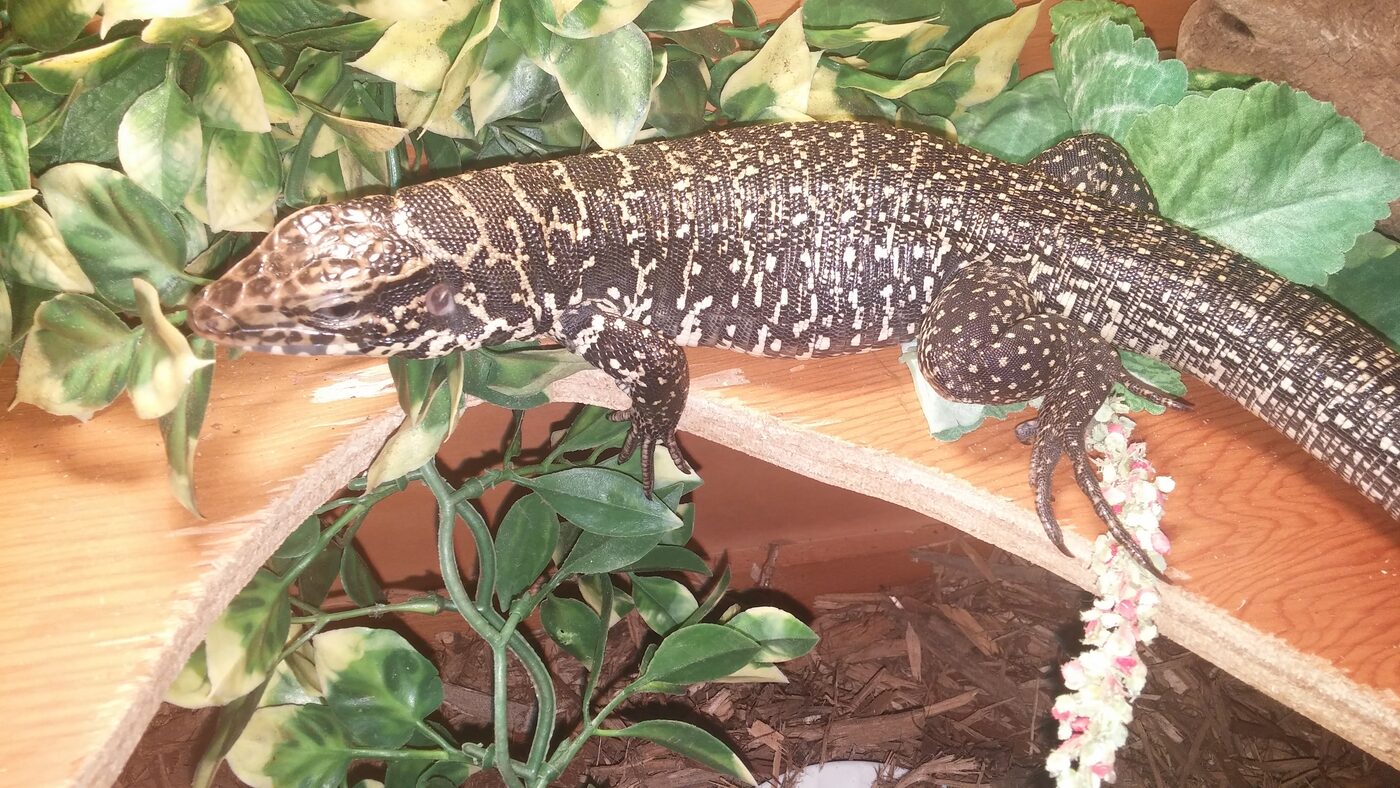
The gold tegu (Tupinambis teguixin), also known as the golden tegu, common tegu, black tegu, Colombian black and white tegu and tiger lizard or "matte" (in Trinidad), is a species of tegu.
From Wikipedia: Gold tegu, CC BY-SA 4.0 (excerpt)
Care at a glance
Species-specific values
Values researched for this exact species. Air, surface and water temperatures are listed separately, and each source is kept as published rather than averaged.
| Diet | Offer insects, rodents, cooked meats, fish, eggs, and adult tegu fruits. Source: thetyedyediguana.com | |
| Feeding frequency | Daily feeding for juveniles and babies; adults need lean food daily and fatty food 2-3 times per week. Source: thetyedyediguana.com | |
| Social housing | May be kept alone or in pairs; avoid housing two males together. Source: thetyedyediguana.com | |
| Substrate | Use absorbent peat moss or coconut fiber; provide thick substrate for digging and burrowing. Source: thetyedyediguana.com | |
| Minimum enclosure | Adult minimum cage: 6 ft long × 3 ft deep × 3 ft high. Source: thetyedyediguana.com | |
| Basking surface temperature | 100–110 °F Source: thetyedyediguana.com | |
| Cool side air temperature | 75 °F Source: thetyedyediguana.com | |
| Humidity | 60–80 % Source: thetyedyediguana.com | |
| Uvb lighting | The diurnal species requires a UVB lamp. Source: thetyedyediguana.com |
Understanding the animal
In the wild
In the wild
| Overview | The gold tegu (Tupinambis teguixin), also known as the golden tegu, common tegu, black tegu, Colombian black and white tegu and tiger lizard or "matte" (in Trinidad), is a species of tegu. — From Wikipedia: Gold tegu, CC BY-SA 4.0 (excerpt) |
| Where it lives | Gold tegus live in the tropical forests of northern and central South America, as well as in Panama. Its South American range extends to the island of Trinidad. — From Wikipedia: Gold tegu, CC BY-SA 4.0 (excerpt) |
| Wild diet | They feed on insects, other invertebrates (such as snails), small mammals, other reptiles (such as smaller lizards and small snakes), birds, and fish; it takes nest eggs of birds, turtles, and caimans. It sometimes eats fruit and honey. — From Wikipedia: Gold tegu, CC BY-SA 4.0 (excerpt) |
Read about this species in the wild at The Reptile Database.
Native climate (measured)
Native climate (measured)
| Warm-season highs | about 90°F (up to 95°F in the hottest sampled areas) |
| Cool-season lows | about 70°F (down to 68°F in the coldest sampled areas) |
| Average temperature | 78–80°F across sampled records |
| Relative humidity | 77–84% on average (driest month about 74%) |
| Rainfall | about 2665 mm a year |
Measured at 139 wild occurrence records sampled against WorldClim 2.1 climate data (1970–2000 averages). Air conditions in the range are ecological context, not enclosure settings: microhabitats such as burrows, leaf litter or basking rocks can be cooler, warmer or more humid.
Profile
Profile
Researched for this exact species. Sources are listed under In the wild above.
More photos
Data and studies
The numbers
The numbers
Each bar is what one source reports. Where several sources weigh in, the dashed gold band marks their average.
Maximum recorded lifespan
Longest recorded lifespan reported by each database; typical lifespans are usually shorter. The AnAge record comes from an animal in human care.
Typical adult weight
Average adult body mass in each database (FishBase gives the maximum recorded weight).
Adult snout-to-vent length
Body length without the tail.
Incubation
Veterinary & husbandry research
Veterinary & husbandry research
- [The first report of Amblyomma fuscum Neumann, 1907 (Acari Ixodidae) on the lizard Tupinambis teguixin (L.) at the Municipality of Glorinha, State of Rio Grande do Sul, Brazil] Martins JR et al., Revista brasileira de parasitologia veterinaria = Brazilian journal of veterinary parasitology: Orgao Oficial do Colegio Brasileiro de Parasitologia Veterinaria 2007
Peer-reviewed papers that mention this species alongside captivity, zoos, veterinary care or aquaculture. Some cover several species or mention it only in passing, so check the abstract. PubMed
Sources for this sheet
- AnAge: The Animal Ageing and Longevity Database (Human Ageing Genomic Resources) (CC BY 3.0) Peer-reviewed researchCurated, referenced longevity and life-history records for thousands of species; maximum lifespans are often from zoo animals.
- Myhrvold et al. (2015). An amniote life-history database. Ecology 96: 3109 Peer-reviewed researchPeer-reviewed compilation of life-history data for over 21,000 birds, mammals and reptiles.
- Species+ (UNEP-WCMC and the CITES Secretariat) Zoo, university or veterinaryThe official database of species listed under CITES. UNEP (2026). The Species+ Website. Nairobi, Kenya. Compiled by UNEP-WCMC, Cambridge, UK. Available at: www.speciesplus.net. [Accessed 04/10/2026].
- USFWS International Affairs: CITES Zoo, university or veterinaryFederal agency that issues CITES permits.
- The Reptile Database Peer-reviewed researchScientist-curated catalog of every reptile species, with taxonomy and literature.
- GBIF Backbone Taxonomy (Global Biodiversity Information Facility) (CC BY 4.0) Peer-reviewed researchInternational scientific taxonomy used here for classification. GBIF Secretariat (2023). GBIF Backbone Taxonomy. Checklist dataset https://doi.org/10.15468/39omei, accessed via GBIF.org.
- Wikipedia (species article) (CC BY-SA 4.0) Community referenceFree encyclopedia; useful overviews with their own citations. Short excerpts are quoted under CC BY-SA 4.0, each credited with a link to its article.
- PubMed (U.S. National Library of Medicine) Peer-reviewed researchIndex of peer-reviewed veterinary, zoo and husbandry research.
- iNaturalist (captive observations) Community referenceCommunity observation platform run by the California Academy of Sciences and National Geographic; observations marked captive show animals living in homes, zoos and aquariums.
More tegus and whiptails
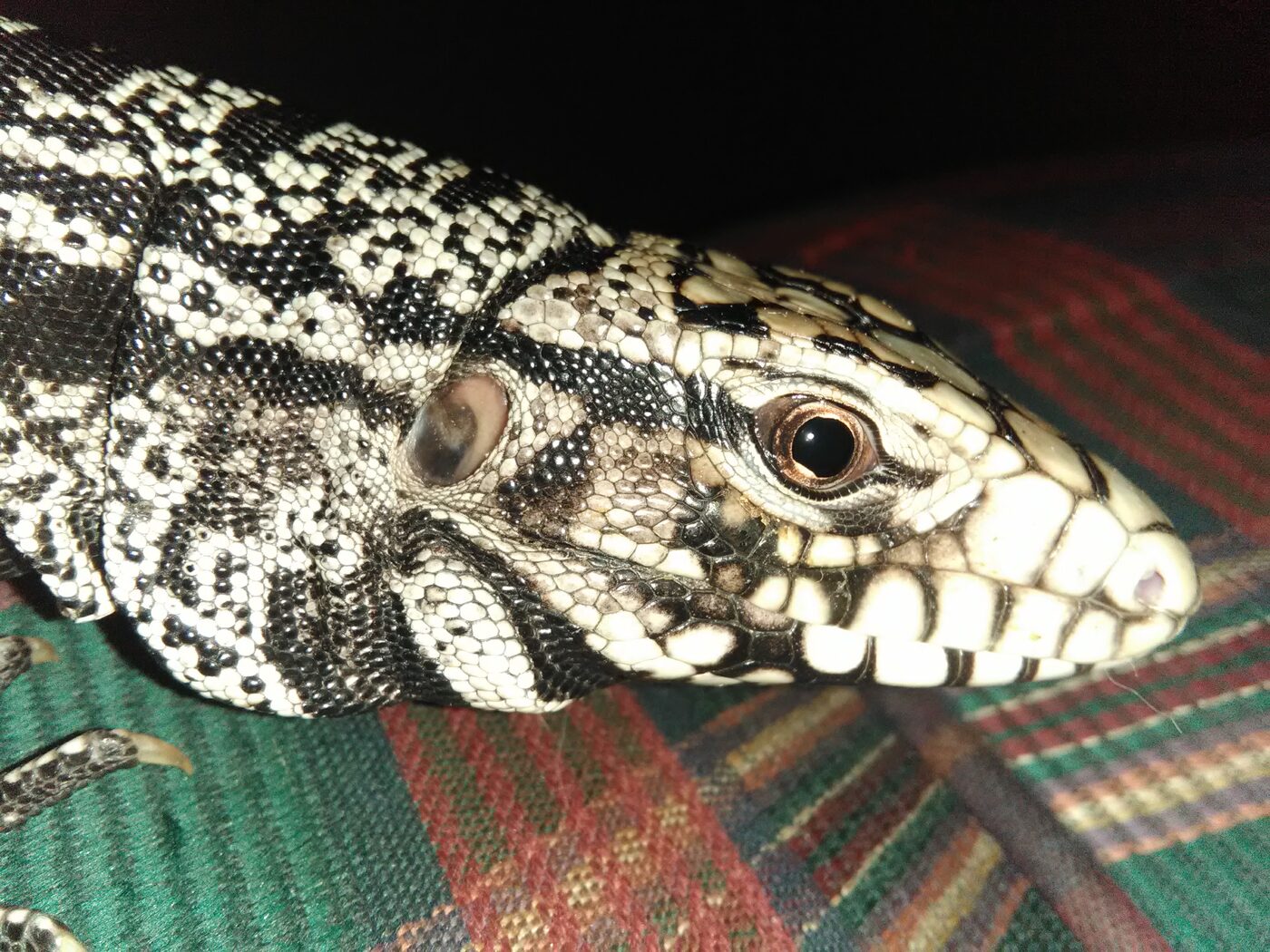
Argentine black and white tegu
Salvator merianae
Pet trade

Crocodile tegu
Crocodilurus amazonicus
Pet trade

Northern caiman lizard
Dracaena guianensis
Pet trade

Red tegu
Salvator rufescens
Pet trade

Western whiptail
Aspidoscelis tigris
Pet trade