
Home / Reptiles / Lizards / Iguanidae / Common chuckwalla
No federal permit to keepCommon chuckwalla
Sauromalus ater
Reptiles › Lizards (Lacertilia) › Iguanidae (Iguanas)
Sauromalus ater, also known as the common chuckwalla or northern chuckwalla, is a species of lizard in the family Iguanidae.

Care at a glance
Species-specific values
Values researched for this exact species. Air, surface and water temperatures are listed separately, and each source is kept as published rather than averaged.
| Minimum enclosure | At least 8 ft² of floor space and 18 inches of height; recommended enclosure is 4′L x 2′W x 2′H. Source: reptifiles.com | |
| Basking surface temperature | 110–125 °F Source: reptifiles.com | |
| Cool side air temperature | 78–88 °F Source: reptifiles.com | |
| Night temperature | at least 65 °F Source: reptifiles.com | |
| Uvb lighting | Use a 22-inch Arcadia T5 HO Dragon 14% UVB kit to achieve UVI 4.5–6.0 in the basking area. Source: reptifiles.com | |
| Social housing | Groups can be housed together with a larger enclosure, but males should never be housed together. Source: reptifiles.com | |
| Seasonal cooling | Provide a seasonal light cycle of 14 hours daily in summer and 8–10 hours in winter, with gradual adjustments. Source: reptifiles.com |
Understanding the animal
About this animal
About this animal
It inhabits the Sonoran and Mojave Deserts of the Southwestern United States and northwestern Mexico. Its range extends from eastern California, Utah, and Nevada south to Baja California and Sonora.
From Wikipedia: Sauromalus ater, CC BY-SA 4.0 (excerpt)
In the wild
In the wild
Researched for this exact species, not its family. Wild conditions are context, not enclosure settings.12345
| Where it lives | Rocky Mojave, Sonoran and Colorado desert scrub in the southwestern United States and northwestern Mexico. Especially associated with creosote habitat containing boulders and outcrops. |
| Ground it lives on | Large rocks and narrow crevices, plus sandy well-drained nesting soil. |
| Climate | Arid desert with strong daily and seasonal changes; retreats into crevices during extremes. Numerical wild temperature and humidity ranges were not established. |
| Active | Diurnal; strongest activity in spring/early summer, with cold-season inactivity in cooler areas. |
| Social life | Males and females defend territories; males may tolerate females. |
| Wild diet | Flowers, fruits and leaves of desert shrubs and other perennial and annual plants. |
| Behavior to plan for | Basks on rocks and retreats into cracks, inflating its body to resist removal. Females dig nests in friable soil. |
Native climate (measured)
Native climate (measured)
| Warm-season highs | about 102°F (up to 109°F in the hottest sampled areas) |
| Cool-season lows | about 38°F (down to 32°F in the coldest sampled areas) |
| Average temperature | 62–73°F across sampled records |
| Relative humidity | 33–35% on average (driest month about 24%) |
| Rainfall | about 220 mm a year |
| Winters | Cool to cold winters (lows around 38°F) in much of its native range. Seasonal slowdown may be relevant, but species-specific biology determines whether brumation or hibernation occurs. |
Measured at 105 wild occurrence records sampled against WorldClim 2.1 climate data (1970–2000 averages). Air conditions in the range are ecological context, not enclosure settings: microhabitats such as burrows, leaf litter or basking rocks can be cooler, warmer or more humid.
Profile
Profile
Researched for this exact species. Sources are listed under In the wild above.
History
United States populations were previously widely known as Sauromalus obesus, although that name is no longer officially recognized according to the supplied Wikipedia source. The common name 'chuckwalla' is derived from the Shoshone word tcaxxwal, or the related Cahuilla form caxwal.
Data and studies
The numbers
The numbers
Each bar is what one source reports. Where several sources weigh in, the dashed gold band marks their average.
Maximum recorded lifespan
Longest recorded lifespan reported by each database; typical lifespans are usually shorter. The AnAge record comes from an animal in human care.
Typical adult weight
Average adult body mass in each database (FishBase gives the maximum recorded weight).
Adult snout-to-vent length
Body length without the tail.
Incubation
Female maturity
Basking spot
Species-specific values from keeper care sheets. Basking figures are often surface readings taken with an infrared thermometer, which run hotter than air.
Night temperature
Species-specific values from keeper care sheets. Basking figures are often surface readings taken with an infrared thermometer, which run hotter than air.
Humidity
Species-specific values from keeper care sheets. Basking figures are often surface readings taken with an infrared thermometer, which run hotter than air.
Care articles for this species
Care articles for this species
- Common Chuckwalla Care Sheet (ReptiFiles)
Written by keepers, breeders and vets Reptiles MagazineReptiFiles
Sources for this sheet
- AnAge: The Animal Ageing and Longevity Database (Human Ageing Genomic Resources) (CC BY 3.0) Peer-reviewed researchCurated, referenced longevity and life-history records for thousands of species; maximum lifespans are often from zoo animals.
- Myhrvold et al. (2015). An amniote life-history database. Ecology 96: 3109 Peer-reviewed researchPeer-reviewed compilation of life-history data for over 21,000 birds, mammals and reptiles.
- ReptiFiles (care guides) Experienced keeper or breederWell-researched reptile care guides that cite herpetological literature and experienced keepers.
- Clint's Reptiles (YouTube): Chuckwalla, The Best Pet Lizard? It Just Might Be! Expert educator & keeperClint Laidlaw, PhD in Biology Education and MS in Evolutionary Ecology; owner of Clint's Reptile Room and a longtime keeper. His "Best Pet?" series reviews each species' care in depth.
- The Reptile Database Peer-reviewed researchScientist-curated catalog of every reptile species, with taxonomy and literature.
- GBIF Backbone Taxonomy (Global Biodiversity Information Facility) (CC BY 4.0) Peer-reviewed researchInternational scientific taxonomy used here for classification. GBIF Secretariat (2023). GBIF Backbone Taxonomy. Checklist dataset https://doi.org/10.15468/39omei, accessed via GBIF.org.
- Wikipedia (species article) (CC BY-SA 4.0) Community referenceFree encyclopedia; useful overviews with their own citations. Short excerpts are quoted under CC BY-SA 4.0, each credited with a link to its article.
- iNaturalist (captive observations) Community referenceCommunity observation platform run by the California Academy of Sciences and National Geographic; observations marked captive show animals living in homes, zoos and aquariums.
More iguanas
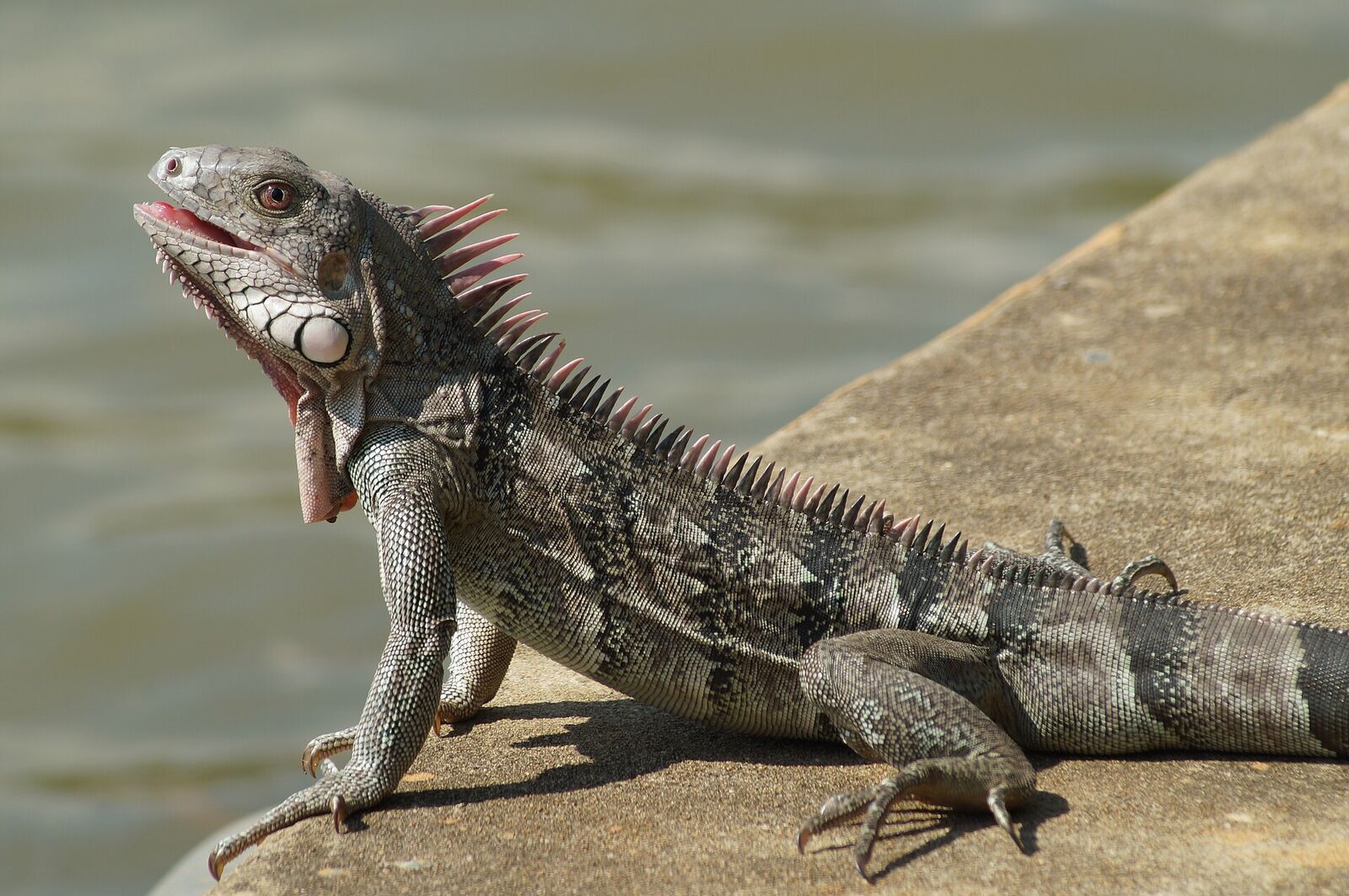
Green iguana
Iguana iguana
A 6-foot vegetarian with a whip of a tail.
Pet trade

Black spiny-tailed iguana
Ctenosaura similis
Pet trade

Cuban rock iguana
Cyclura nubila
Pet trade

Desert iguana
Dipsosaurus dorsalis
Pet trade

Fiji banded iguana
Brachylophus fasciatus
Pet trade

Mexican spiny-tailed iguana
Ctenosaura pectinata
Pet trade