
Home / Reptiles / Lizards / Iguanidae / Fiji banded iguana
Federal restrictions applyFiji banded iguana
Brachylophus fasciatus
Reptiles › Lizards (Lacertilia) › Iguanidae (Iguanas)
Brachylophus fasciatus, the Lau banded iguana, is an arboreal species of lizard endemic to the Lau Islands of the eastern part of the Fijian archipelago.
From Wikipedia: Brachylophus fasciatus, CC BY-SA 4.0 (excerpt)

Care at a glance
Species-specific values
Values researched for this exact species. Air, surface and water temperatures are listed separately, and each source is kept as published rather than averaged.
| Minimum enclosure | A pair of adults should have an enclosure at least 4x2x4 feet. Source: allreptiles.ca | |
| Minimum enclosure | Juveniles can be housed in a 24x18x24-inch enclosure. Source: allreptiles.ca | |
| Basking surface temperature | 85–95 °F Source: allreptiles.ca | |
| Warm side air temperature | No separate warm-side range is given; the article recommends a basking area and cooler-side range. Source: allreptiles.ca | |
| Cool side air temperature | 75–80 °F Source: allreptiles.ca | |
| Humidity | 60–80 % Source: allreptiles.ca | |
| Uvb lighting | UVB lighting is essential; use a full-spectrum reptile bulb. Source: allreptiles.ca | |
| Diet | Primarily herbivorous; eat leafy greens, flowers, and occasional fruits. Source: allreptiles.ca | |
| Feeding frequency | Offer calcium, vitamin A, or multivitamin in small amounts once per week if supplementing. Source: allreptiles.ca | |
| Social housing | For a pair of adults, the article recommends an enclosure of at least 4x2x4 feet. Source: allreptiles.ca | |
| Substrate | Suitable options include bioactive substrate, cypress mulch, coconut husk, or reptile bark with soil blends. Source: allreptiles.ca |
Warnings
Understanding the animal
About this animal
About this animal
It is also found in Tonga, where it was probably introduced by humans. It is one of the few species of iguanas found outside of the New World and one of the most geographically isolated members of the family Iguanidae.
From Wikipedia: Brachylophus fasciatus, CC BY-SA 4.0 (excerpt)
In the wild
In the wild
| Overview | Brachylophus fasciatus, the Lau banded iguana, is an arboreal species of lizard endemic to the Lau Islands of the eastern part of the Fijian archipelago. It is also found in Tonga, where it was probably introduced by humans. It is one of the few species of iguanas found outside of the New World and one of the most geographically isolated members of the family Iguanidae. Populations of these iguanas have been declining over the past century due to habitat destruction, and more significantly, the introduction of mongoose and house cats to the islands. — From Wikipedia: Brachylophus fasciatus, CC BY-SA 4.0 (excerpt) |
| Where it lives | The Lau banded iguana is endemic to the Lau Islands of Fiji. Its recent range is known to extend from Vanua Balavu in the north to Fulaga and Ogea in the south, including at least eleven islands. Previously it was reported from Moce and Oneata, and it may have once been present throughout the Lau group. — From Wikipedia: Brachylophus fasciatus, CC BY-SA 4.0 (excerpt) |
| Wild diet | Fiji banded iguanas are herbivorous; they feed on the leaves, fruit, and flowers of trees and shrubs, particularly hibiscus flowers of the Vau tree (Hibiscus tiliaceus) and fruit such as banana and papaya. Captive hatchlings have been observed eating insects; however, adults usually will not. — From Wikipedia: Brachylophus fasciatus, CC BY-SA 4.0 (excerpt) |
| Behavior | The species is diurnal, spending their days foraging, basking and watching over their territories by day and retreating to the treetops at night. Male iguanas are highly visual, and aggressively defend their territories from rival males. The iguanas will deepen their green coloration to intensify their bands, and bob their heads and intimidate intruders by lunging at them with open mouths. — From Wikipedia: Brachylophus fasciatus, CC BY-SA 4.0 (excerpt) |
| Reproduction | Courtship is similar to other iguanids, with males approaching and tongue flicking the female's back, forelimbs and nuchal regions after a series of rapid head bobs. The breeding season occurs during the month of November. The Fiji banded iguana is oviparous and has a long incubation period of 160–170 days. — From Wikipedia: Brachylophus fasciatus, CC BY-SA 4.0 (excerpt) |
| Conservation | The biggest threats this iguana faces is habitat loss due to fires, storms, agricultural development, and competition from feral goats. A secondary threat is introduced predators in the forms of rats, mongoose, and cats which prey on the iguanas and their eggs. Additionally the iguana has been hunted as a food source and for the illegal exotic animal trade. — From Wikipedia: Brachylophus fasciatus, CC BY-SA 4.0 (excerpt) |
Read about this species in the wild at The Reptile Database.
Native climate (measured)
Native climate (measured)
| Warm-season highs | about 85°F (up to 85°F in the hottest sampled areas) |
| Cool-season lows | about 67°F (down to 65°F in the coldest sampled areas) |
| Average temperature | 74–77°F across sampled records |
| Relative humidity | 81–83% on average (driest month about 80%) |
| Rainfall | about 2634 mm a year, spread fairly evenly |
Measured at 14 wild occurrence records sampled against WorldClim 2.1 climate data (1970–2000 averages). Air conditions in the range are ecological context, not enclosure settings: microhabitats such as burrows, leaf litter or basking rocks can be cooler, warmer or more humid.
Profile
Profile
Researched for this exact species. Sources are listed under In the wild above.
Data and studies
The numbers
The numbers
Each bar is what one source reports. Where several sources weigh in, the dashed gold band marks their average.
Maximum recorded lifespan
Longest recorded lifespan reported by each database; typical lifespans are usually shorter. The AnAge record comes from an animal in human care.
Typical adult weight
Average adult body mass in each database (FishBase gives the maximum recorded weight).
Adult snout-to-vent length
Body length without the tail.
Incubation
Veterinary & husbandry research
Veterinary & husbandry research
- Yolk coelomitis in Fiji Island banded iguanas (Brachylophus fasciatus) Stacy BA et al., Journal of zoo and wildlife medicine: official publication of the American Association of Zoo Veterinarians 2008
Peer-reviewed papers that mention this species alongside captivity, zoos, veterinary care or aquaculture. Some cover several species or mention it only in passing, so check the abstract. See all 2 on PubMed → PubMed
Sources for this sheet
- AnAge: The Animal Ageing and Longevity Database (Human Ageing Genomic Resources) (CC BY 3.0) Peer-reviewed researchCurated, referenced longevity and life-history records for thousands of species; maximum lifespans are often from zoo animals.
- Myhrvold et al. (2015). An amniote life-history database. Ecology 96: 3109 Peer-reviewed researchPeer-reviewed compilation of life-history data for over 21,000 birds, mammals and reptiles.
- 50 CFR 17.11: Endangered and threatened wildlife Zoo, university or veterinaryCurrent federal Endangered Species Act list.
- Species+ (UNEP-WCMC and the CITES Secretariat) Zoo, university or veterinaryThe official database of species listed under CITES. UNEP (2026). The Species+ Website. Nairobi, Kenya. Compiled by UNEP-WCMC, Cambridge, UK. Available at: www.speciesplus.net. [Accessed 04/10/2026].
- USFWS International Affairs: CITES Zoo, university or veterinaryFederal agency that issues CITES permits.
- The Reptile Database Peer-reviewed researchScientist-curated catalog of every reptile species, with taxonomy and literature.
- GBIF Backbone Taxonomy (Global Biodiversity Information Facility) (CC BY 4.0) Peer-reviewed researchInternational scientific taxonomy used here for classification. GBIF Secretariat (2023). GBIF Backbone Taxonomy. Checklist dataset https://doi.org/10.15468/39omei, accessed via GBIF.org.
- Wikipedia (species article) (CC BY-SA 4.0) Community referenceFree encyclopedia; useful overviews with their own citations. Short excerpts are quoted under CC BY-SA 4.0, each credited with a link to its article.
- PubMed (U.S. National Library of Medicine) Peer-reviewed researchIndex of peer-reviewed veterinary, zoo and husbandry research.
- iNaturalist (captive observations) Community referenceCommunity observation platform run by the California Academy of Sciences and National Geographic; observations marked captive show animals living in homes, zoos and aquariums.
More iguanas
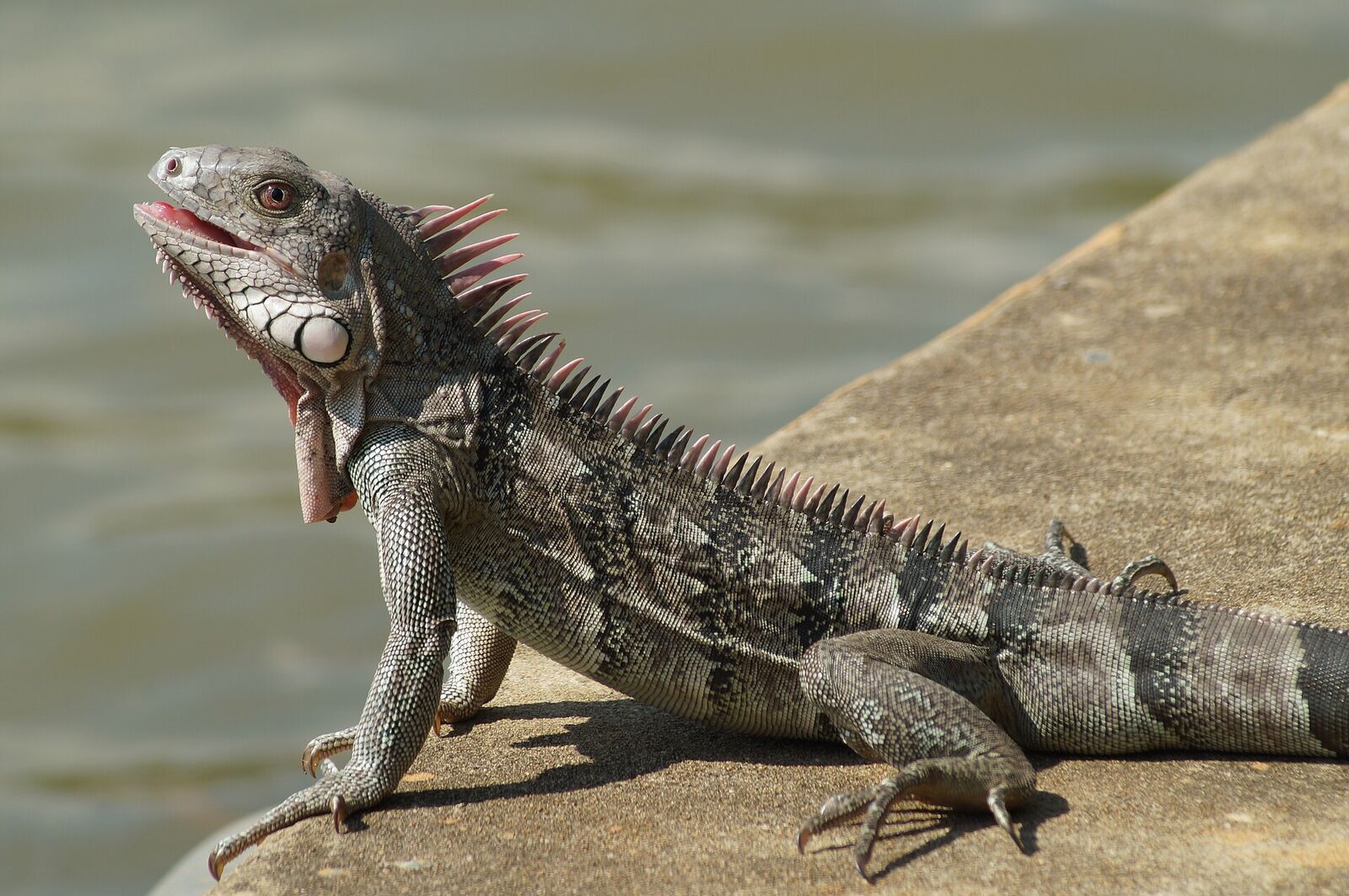
Green iguana
Iguana iguana
A 6-foot vegetarian with a whip of a tail.
Pet trade

Black spiny-tailed iguana
Ctenosaura similis
Pet trade

Common chuckwalla
Sauromalus ater
Pet trade

Cuban rock iguana
Cyclura nubila
Pet trade

Desert iguana
Dipsosaurus dorsalis
Pet trade

Mexican spiny-tailed iguana
Ctenosaura pectinata
Pet trade