
Home / Reptiles / Lizards / Iguanidae / Cuban rock iguana
Federal restrictions applyCuban rock iguana
Cyclura nubila
Reptiles › Lizards (Lacertilia) › Iguanidae (Iguanas)
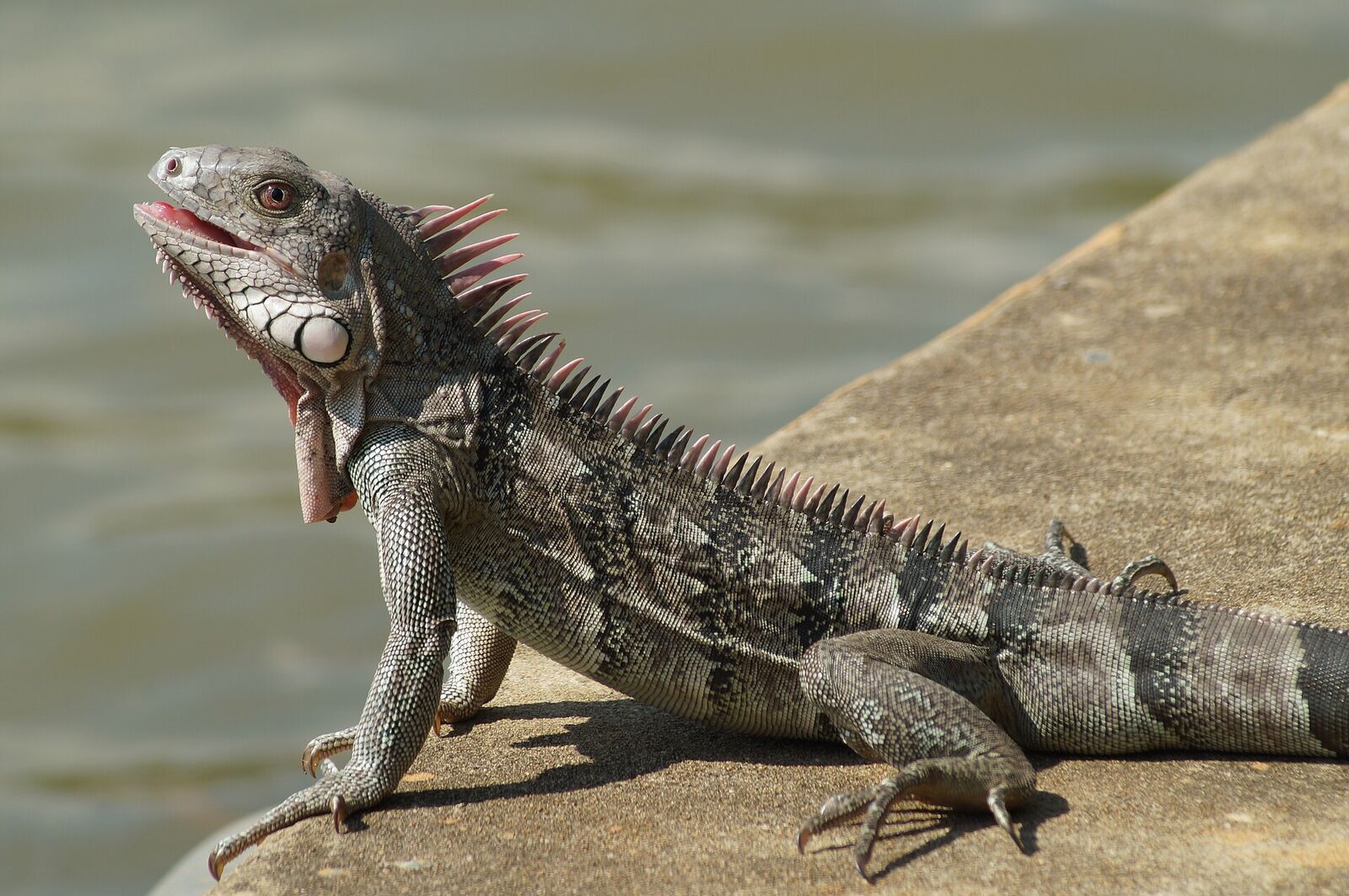
The Cuban rock iguana (Cyclura nubila), also known as the Cuban ground iguana or Cuban iguana, is a species of lizard of the iguana family.
From Wikipedia: Cyclura nubila, CC BY-SA 4.0 (excerpt)

Care at a glance
Species-specific values
Values researched for this exact species. Air, surface and water temperatures are listed separately, and each source is kept as published rather than averaged.
| Minimum enclosure | Adults need an enclosure 8 to 12 feet long, 4 feet wide, and 5 to 6 feet high. Source: reptilesmagazine.com | |
| Basking surface temperature | at least 120 °F Source: reptilesmagazine.com | |
| Cool side air temperature | up to 80 °F Source: reptilesmagazine.com | |
| Diet | Feed a varied diet of green and yellow vegetables and Mazuri Iguana Diet; rodents and insects may be given occasionally. Source: reptilesmagazine.com | |
| Diet | The author feeds Cyclura vegetables and Mazuri Iguana Diet, with occasional rodents or insects. Source: reptilesmagazine.com | |
| Feeding frequency | The author finds feeding all they can eat every other day works best, though daily feeding is also possible. Source: reptilesmagazine.com | |
| Social housing | The article describes social expressions but does not state a housing recommendation. Source: reptilesmagazine.com | |
| Substrate | For hatchlings, the author uses alfalfa pellets. Source: reptilesmagazine.com |
Warnings
Understanding the animal
About this animal
About this animal
It is the second largest of the West Indian rock iguanas (genus Cyclura), one of the most endangered groups of lizards. A herbivorous species with a thick tail and spiked jowls, it is one of the largest lizards in the Caribbean.
From Wikipedia: Cyclura nubila, CC BY-SA 4.0 (excerpt)
In the wild
In the wild
| Overview | The Cuban rock iguana (Cyclura nubila), also known as the Cuban ground iguana or Cuban iguana, is a species of lizard of the iguana family. It is the second largest of the West Indian rock iguanas (genus Cyclura), one of the most endangered groups of lizards. A herbivorous species with a thick tail and spiked jowls, it is one of the largest lizards in the Caribbean. The Cuban iguana is distributed throughout the mainland of Cuba and its surrounding islets with a feral population thriving on Isla Magueyes, Puerto Rico. — From Wikipedia: Cyclura nubila, CC BY-SA 4.0 (excerpt) |
| Appearance and size | The Cuban iguana is a large lizard, only surpassed in size by the blue iguana among the Cyclura; it has an average body length of 40 cm from snout to vent (the base of the tail). — From Wikipedia: Cyclura nubila, CC BY-SA 4.0 (excerpt) |
Read about this species in the wild at The Reptile Database.
Profile
Profile
Researched for this exact species. Sources are listed under In the wild above.
Data and studies
The numbers
The numbers
Each bar is what one source reports. Where several sources weigh in, the dashed gold band marks their average.
Maximum recorded lifespan
Longest recorded lifespan reported by each database; typical lifespans are usually shorter. The AnAge record comes from an animal in human care.
Typical adult weight
Average adult body mass in each database (FishBase gives the maximum recorded weight).
Adult snout-to-vent length
Body length without the tail.
Incubation
Female maturity
Care articles for this species
Care articles for this species
- Cuban Rock Iguana Care Tips (Reptiles Magazine)
- Cuban Rock Iguana Breeding Basics (Reptiles Magazine)
Written by keepers, breeders and vets Reptiles MagazineReptiFiles
Veterinary & husbandry research
Veterinary & husbandry research
- Histopathology, Molecular Identification and Antifungal Susceptibility Testing of Nannizziopsis arthrosporioides from a Captive Cuban Rock Iguana (Cyclura nubila) Chen YH et al., Mycopathologia 2020
Peer-reviewed papers that mention this species alongside captivity, zoos, veterinary care or aquaculture. Some cover several species or mention it only in passing, so check the abstract. PubMed
Sources for this sheet
- AnAge: The Animal Ageing and Longevity Database (Human Ageing Genomic Resources) (CC BY 3.0) Peer-reviewed researchCurated, referenced longevity and life-history records for thousands of species; maximum lifespans are often from zoo animals.
- Myhrvold et al. (2015). An amniote life-history database. Ecology 96: 3109 Peer-reviewed researchPeer-reviewed compilation of life-history data for over 21,000 birds, mammals and reptiles.
- Species+ (UNEP-WCMC and the CITES Secretariat) Zoo, university or veterinaryThe official database of species listed under CITES. UNEP (2026). The Species+ Website. Nairobi, Kenya. Compiled by UNEP-WCMC, Cambridge, UK. Available at: www.speciesplus.net. [Accessed 04/10/2026].
- USFWS International Affairs: CITES Zoo, university or veterinaryFederal agency that issues CITES permits.
- 50 CFR 17.11: Endangered and threatened wildlife Zoo, university or veterinaryCurrent federal Endangered Species Act list.
- The Reptile Database Peer-reviewed researchScientist-curated catalog of every reptile species, with taxonomy and literature.
- GBIF Backbone Taxonomy (Global Biodiversity Information Facility) (CC BY 4.0) Peer-reviewed researchInternational scientific taxonomy used here for classification. GBIF Secretariat (2023). GBIF Backbone Taxonomy. Checklist dataset https://doi.org/10.15468/39omei, accessed via GBIF.org.
- Wikipedia (species article) (CC BY-SA 4.0) Community referenceFree encyclopedia; useful overviews with their own citations. Short excerpts are quoted under CC BY-SA 4.0, each credited with a link to its article.
- PubMed (U.S. National Library of Medicine) Peer-reviewed researchIndex of peer-reviewed veterinary, zoo and husbandry research.
- iNaturalist (captive observations) Community referenceCommunity observation platform run by the California Academy of Sciences and National Geographic; observations marked captive show animals living in homes, zoos and aquariums.
- Reptiles Magazine (care articles) Experienced keeper or breederEstablished reptile and amphibian hobby magazine; care articles are written by breeders, keepers and veterinarians.
More iguanas
Green iguana
Iguana iguana
A 6-foot vegetarian with a whip of a tail.
Pet trade

Black spiny-tailed iguana
Ctenosaura similis
Pet trade

Common chuckwalla
Sauromalus ater
Pet trade

Desert iguana
Dipsosaurus dorsalis
Pet trade

Fiji banded iguana
Brachylophus fasciatus
Pet trade

Mexican spiny-tailed iguana
Ctenosaura pectinata
Pet trade