
Home / Reptiles / Lizards / Iguanidae / Mexican spiny-tailed iguana
Some federal rules applyMexican spiny-tailed iguana
Ctenosaura pectinata
Reptiles › Lizards (Lacertilia) › Iguanidae (Iguanas)
Ctenosaura pectinata is a species of moderately large lizard in the family Iguanidae.
From Wikipedia: Ctenosaura pectinata, CC BY-SA 4.0 (excerpt)

Care at a glance
Species-specific values
Values researched for this exact species. Air, surface and water temperatures are listed separately, and each source is kept as published rather than averaged.
| Minimum enclosure | Starter enclosure about 48 × 30 × 36 inches or larger. Source: floridaiguana.com | |
| Basking surface temperature | 105–110 °F Source: floridaiguana.com | |
| Warm side air temperature | 85–90 °F | floridaiguana.com |
| Cool side air temperature | 75–80 °F | floridaiguana.com |
| Night temperature | 70–75 °F | floridaiguana.com |
| Humidity | 30–50 % Source: floridaiguana.com | |
| Uvb lighting | Use high-output desert-strength UVB indoors or natural unfiltered sunlight outdoors; measure exposure at basking height. Source: floridaiguana.com | |
| Diet | Juveniles receive plant foods and insects; adults eat varied plant foods, with insects as an occasional treat. Source: floridaiguana.com | |
| Feeding frequency | Fresh plant foods daily; growing juveniles receive appropriately sized insects about every other day. Source: floridaiguana.com | |
| Social housing | Pairs or breeding groups may sometimes be kept with experience, space, and constant observation. Source: floridaiguana.com | |
| Substrate | Secured carpet, textured tile, rock, or slate; experienced keepers may use managed sandy-soil mixtures. Source: floridaiguana.com | |
| Note: more detail at floridaiguana.com. | ||
Understanding the animal
About this animal
About this animal
The species is native to western Mexico. The standardized English name is the western spiny-tailed iguana.
From Wikipedia: Ctenosaura pectinata, CC BY-SA 4.0 (excerpt)
In the wild
In the wild
| Overview | Ctenosaura pectinata is a species of moderately large lizard in the family Iguanidae. The species is native to western Mexico. The standardized English name is the western spiny-tailed iguana. However, an earlier edition of standardized names applied the name to Ctenosaura pectinata. — From Wikipedia: Ctenosaura pectinata, CC BY-SA 4.0 (excerpt) |
| Where it lives | C. pectinata is native to the coastal lowlands of Western Mexico from Sinaloa to extreme western Chiapas. It follows many valleys and canyons into lower elevations of the Sierra Madre Occidental and Sierra Madre del Sur, including extensive areas of the Rio Balsas Basin. This iguana has been introduced to Brownsville, Texas and South Florida and reproduces in the wild in several feral populations. — From Wikipedia: Ctenosaura pectinata, CC BY-SA 4.0 (excerpt) |
| Behavior | C. pectinata is a social lizard, which has adapted to living in groups as opposed to other species of Ctenosaura which tend to be solitary animals. These iguanas are excellent climbers, and prefer a rocky habitat with plenty of crevices to hide in, rocks to bask on, and nearby trees to climb. — From Wikipedia: Ctenosaura pectinata, CC BY-SA 4.0 (excerpt) |
| Reproduction | Mating of C. pectinata occurs in the spring. Males show dominance and interest by head bobbing, eventually chasing the female until he can catch her and subdue her. Within eight to ten weeks, the female will dig a nest and lay clutches of up to 50 eggs in a burrow of loose soil. — From Wikipedia: Ctenosaura pectinata, CC BY-SA 4.0 (excerpt) |
| Appearance and size | C. pectinata has distinctive keeled scales on its long tail, to which its common name refers. It is one of the larger members of the genus Ctenosaura, capable of growing to 1.3 m (4.3 feet) in total length (including tail), with females being slightly smaller than males at 1.0 m. It is usually brown or grey-brown in coloration dorsally, with a yellowish ventral surface. — From Wikipedia: Ctenosaura pectinata, CC BY-SA 4.0 (excerpt) |
Read about this species in the wild at The Reptile Database.
Native climate (measured)
Native climate (measured)
| Warm-season highs | about 92°F (up to 95°F in the hottest sampled areas) |
| Cool-season lows | about 56°F (down to 45°F in the coldest sampled areas) |
| Average temperature | 69–80°F across sampled records |
| Relative humidity | 62–74% on average (driest month about 67%) |
| Rainfall | about 1103 mm a year, with strong wet and dry seasons |
Measured at 125 wild occurrence records sampled against WorldClim 2.1 climate data (1970–2000 averages). Air conditions in the range are ecological context, not enclosure settings: microhabitats such as burrows, leaf litter or basking rocks can be cooler, warmer or more humid.
Profile
Profile
Researched for this exact species. Sources are listed under In the wild above.
Data and studies
The numbers
The numbers
Each bar is what one source reports. Where several sources weigh in, the dashed gold band marks their average.
Maximum recorded lifespan
Longest recorded lifespan reported by each database; typical lifespans are usually shorter. The AnAge record comes from an animal in human care.
Typical adult weight
Average adult body mass in each database (FishBase gives the maximum recorded weight).
Adult snout-to-vent length
Body length without the tail.
Veterinary & husbandry research
Veterinary & husbandry research
- Effect of feed type and sex on digestibility and feed efficiency utilization in black spiny-tailed iguana (Ctenosaura pectinata) Rueda-Zozaya P et al., Zoo biology 2011
- Effect of lysine addition on growth of black iguana (Ctenosaura pectinata) Guzmán JJ et al., Zoo biology 2013
Peer-reviewed papers that mention this species alongside captivity, zoos, veterinary care or aquaculture. Some cover several species or mention it only in passing, so check the abstract. See all 3 on PubMed → PubMed
Sources for this sheet
- AnAge: The Animal Ageing and Longevity Database (Human Ageing Genomic Resources) (CC BY 3.0) Peer-reviewed researchCurated, referenced longevity and life-history records for thousands of species; maximum lifespans are often from zoo animals.
- Myhrvold et al. (2015). An amniote life-history database. Ecology 96: 3109 Peer-reviewed researchPeer-reviewed compilation of life-history data for over 21,000 birds, mammals and reptiles.
- Species+ (UNEP-WCMC and the CITES Secretariat) Zoo, university or veterinaryThe official database of species listed under CITES. UNEP (2026). The Species+ Website. Nairobi, Kenya. Compiled by UNEP-WCMC, Cambridge, UK. Available at: www.speciesplus.net. [Accessed 04/10/2026].
- USFWS International Affairs: CITES Zoo, university or veterinaryFederal agency that issues CITES permits.
- The Reptile Database Peer-reviewed researchScientist-curated catalog of every reptile species, with taxonomy and literature.
- GBIF Backbone Taxonomy (Global Biodiversity Information Facility) (CC BY 4.0) Peer-reviewed researchInternational scientific taxonomy used here for classification. GBIF Secretariat (2023). GBIF Backbone Taxonomy. Checklist dataset https://doi.org/10.15468/39omei, accessed via GBIF.org.
- Wikipedia (species article) (CC BY-SA 4.0) Community referenceFree encyclopedia; useful overviews with their own citations. Short excerpts are quoted under CC BY-SA 4.0, each credited with a link to its article.
- PubMed (U.S. National Library of Medicine) Peer-reviewed researchIndex of peer-reviewed veterinary, zoo and husbandry research.
- iNaturalist (captive observations) Community referenceCommunity observation platform run by the California Academy of Sciences and National Geographic; observations marked captive show animals living in homes, zoos and aquariums.
More iguanas
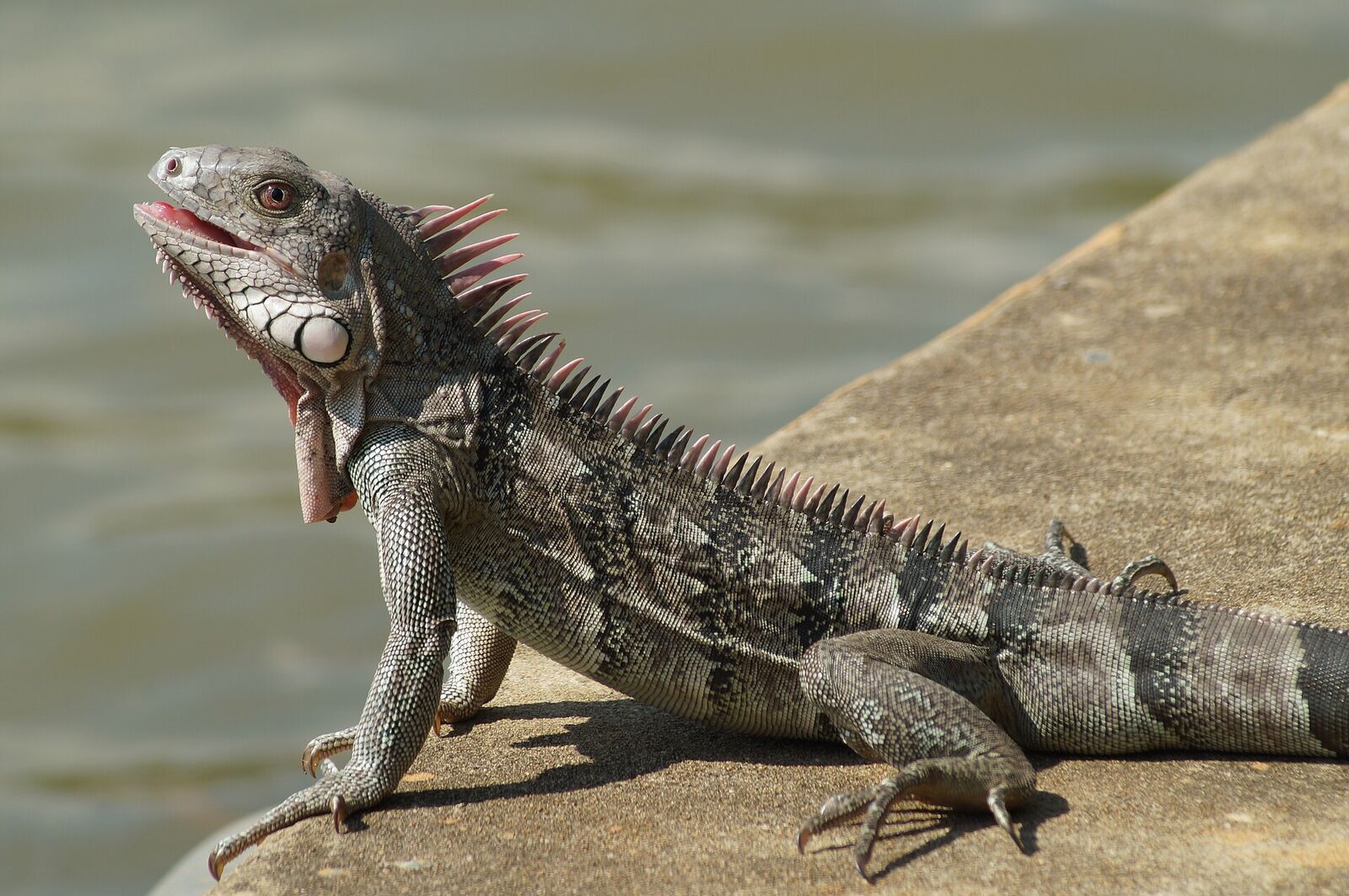
Green iguana
Iguana iguana
A 6-foot vegetarian with a whip of a tail.
Pet trade

Black spiny-tailed iguana
Ctenosaura similis
Pet trade

Common chuckwalla
Sauromalus ater
Pet trade

Cuban rock iguana
Cyclura nubila
Pet trade

Desert iguana
Dipsosaurus dorsalis
Pet trade

Fiji banded iguana
Brachylophus fasciatus
Pet trade