
Home / Reptiles / Lizards / Iguanidae / Rhinoceros iguana
Federal restrictions applyRhinoceros iguana
Cyclura cornuta
Reptiles › Lizards (Lacertilia) › Iguanidae (Iguanas)
The rhinoceros iguana (Cyclura cornuta) is an endangered species of iguana that is (habituated) endemic to the Caribbean island of Hispaniola (shared by Haiti and the Dominican Republic) and its surrounding islands.

Care at a glance
Species-specific values
Values researched for this exact species. Air, surface and water temperatures are listed separately, and each source is kept as published rather than averaged.
| Basking surface temperature | 106 °F Source: reptilesmagazine.com | |
| Warm side air temperature | 75–88 °F Source: reptilesmagazine.com | |
| Cool side air temperature | The cool-zone temperature is about 10 degrees less than the daytime ambient temperature. Source: reptilesmagazine.com | |
| Night temperature | 68–73 °F Source: reptilesmagazine.com | |
| Uvb lighting | Provide UVB lighting; the author uses a lamp producing 290 to 305 nanometers of UVB. Source: reptilesmagazine.com | |
| Substrate | Use newspaper, artificial turf, or outdoor carpeting indoors; soil- or bark-based substrates are discouraged indoors and near feeding areas. Source: reptilesmagazine.com | |
| Diet | The diet is almost exclusively herbivorous; avoid animal matter and use plant foods. Source: reptilesmagazine.com | |
| Feeding frequency | Dust food with calcium one to two times weekly for adults and vitamins every two weeks. Source: reptilesmagazine.com |
Warnings
Understanding the animal
About this animal
About this animal
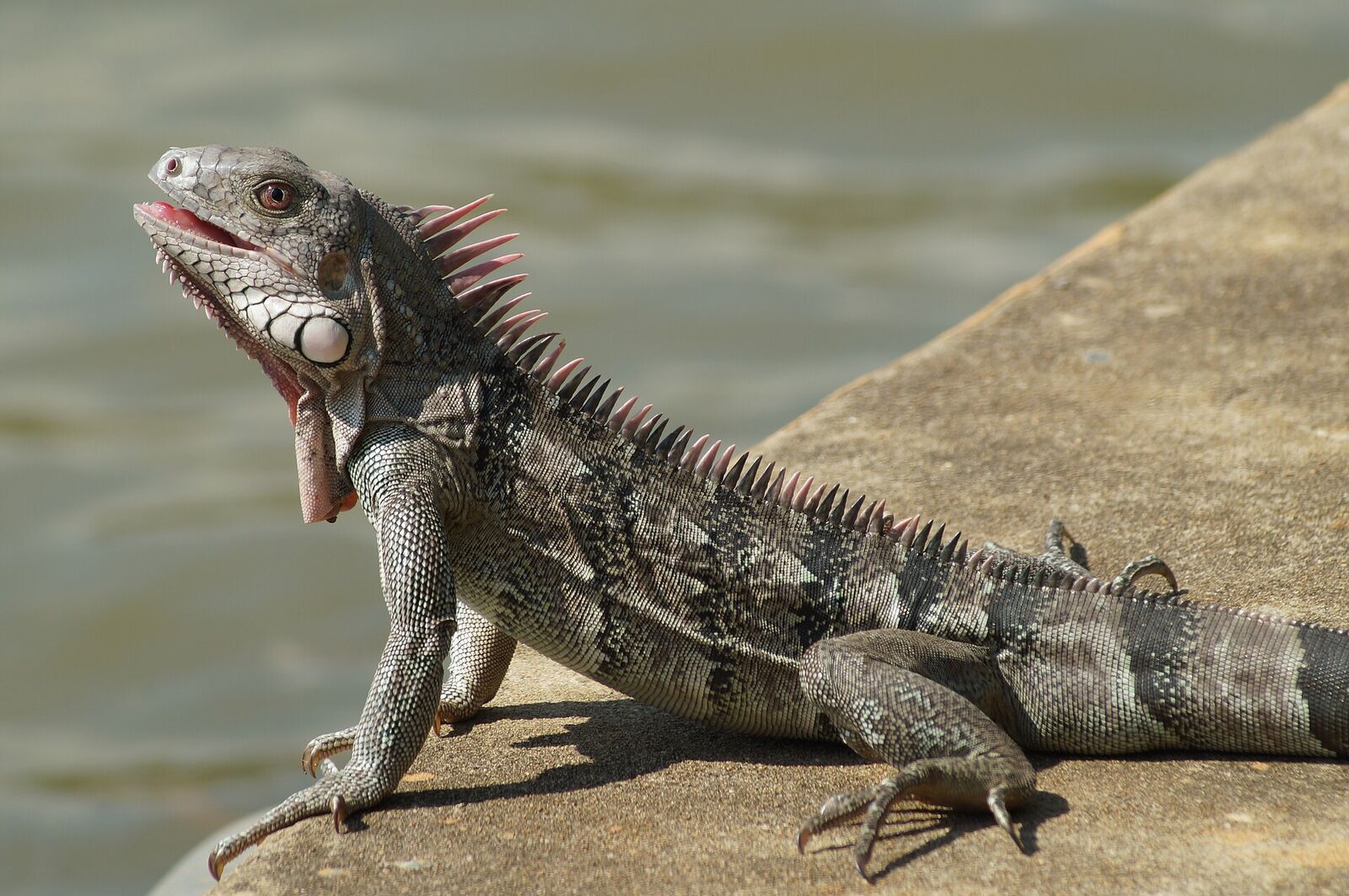
A large lizard, they vary in length from 60 to 136 centimetres (24 to 54 in), and skin colours range from a steely grey to a dark green and even brown. Their name derives from the bony-plated pseudo-horn or outgrowth which resembles the horn of a rhinoceros on the iguana's snout.
From Wikipedia: Rhinoceros iguana, CC BY-SA 4.0 (excerpt)
In the wild
In the wild
Researched for this exact species, not its family. Wild conditions are context, not enclosure settings.12345
| Where it lives | Hispaniolan lowland dry forest and thorn scrub, especially rocky limestone coastal terraces. Shelters in crevices, caves and soil or sand burrows. |
| Ground it lives on | Rocky limestone with soil or sand pockets and burrows. |
| Climate | Hot, sunny tropical habitat; occupied regions have reported annual mean temperatures of at least 80.6°F. Full wild temperature and humidity ranges were not established. |
| Active | Diurnal; nights spent in retreats. |
| Social life | Mostly solitary and territorial; food and mates may be defended. |
| Wild diet | Leaves, flowers, fruits and seeds; occasional insects, land crabs and carrion. |
| Behavior to plan for | Primarily terrestrial, with occasional climbing for fruit or basking. Digs nests and defends itself with bites and tail blows. |
Profile
Profile
Researched for this exact species. Sources are listed under In the wild above.
History
Cyclura cornuta was first identified by Pierre Joseph Bonnaterre in 1789. The extinct Navassa Island iguana was treated as a subspecies, while the Mona ground iguana has also historically been treated by some taxonomists as a subspecies of C. cornuta.
Data and studies
The numbers
The numbers
Each bar is what one source reports. Where several sources weigh in, the dashed gold band marks their average.
Maximum recorded lifespan
Longest recorded lifespan reported by each database; typical lifespans are usually shorter. The AnAge record comes from an animal in human care.
Adult snout-to-vent length
Body length without the tail.
Incubation
Female maturity
Care articles for this species
Care articles for this species
- Rhinoceros Iguana Care Info (Reptiles Magazine)
Written by keepers, breeders and vets Reptiles MagazineReptiFiles
Veterinary & husbandry research
Veterinary & husbandry research
- Vitamin D status of wild Ricord's iguanas (Cyclura ricordii) and captive and wild rhinoceros iguanas (Cyclura cornuta) in the Dominican Republic Ramer JC et al., Journal of zoo and wildlife medicine: official publication of the American Association of Zoo Veterinarians 2005
Peer-reviewed papers that mention this species alongside captivity, zoos, veterinary care or aquaculture. Some cover several species or mention it only in passing, so check the abstract. PubMed
Sources for this sheet
- AnAge: The Animal Ageing and Longevity Database (Human Ageing Genomic Resources) (CC BY 3.0) Peer-reviewed researchCurated, referenced longevity and life-history records for thousands of species; maximum lifespans are often from zoo animals.
- Myhrvold et al. (2015). An amniote life-history database. Ecology 96: 3109 Peer-reviewed researchPeer-reviewed compilation of life-history data for over 21,000 birds, mammals and reptiles.
- Species+ (UNEP-WCMC and the CITES Secretariat) Zoo, university or veterinaryThe official database of species listed under CITES. UNEP (2026). The Species+ Website. Nairobi, Kenya. Compiled by UNEP-WCMC, Cambridge, UK. Available at: www.speciesplus.net. [Accessed 04/10/2026].
- USFWS International Affairs: CITES Zoo, university or veterinaryFederal agency that issues CITES permits.
- Clint's Reptiles (YouTube): Rhinoceros Iguana, The Best Pet Lizard? Expert educator & keeperClint Laidlaw, PhD in Biology Education and MS in Evolutionary Ecology; owner of Clint's Reptile Room and a longtime keeper. His "Best Pet?" series reviews each species' care in depth.
- The Reptile Database Peer-reviewed researchScientist-curated catalog of every reptile species, with taxonomy and literature.
- GBIF Backbone Taxonomy (Global Biodiversity Information Facility) (CC BY 4.0) Peer-reviewed researchInternational scientific taxonomy used here for classification. GBIF Secretariat (2023). GBIF Backbone Taxonomy. Checklist dataset https://doi.org/10.15468/39omei, accessed via GBIF.org.
- Wikipedia (species article) (CC BY-SA 4.0) Community referenceFree encyclopedia; useful overviews with their own citations. Short excerpts are quoted under CC BY-SA 4.0, each credited with a link to its article.
- PubMed (U.S. National Library of Medicine) Peer-reviewed researchIndex of peer-reviewed veterinary, zoo and husbandry research.
- iNaturalist (captive observations) Community referenceCommunity observation platform run by the California Academy of Sciences and National Geographic; observations marked captive show animals living in homes, zoos and aquariums.
- Reptiles Magazine (care articles) Experienced keeper or breederEstablished reptile and amphibian hobby magazine; care articles are written by breeders, keepers and veterinarians.
More iguanas
Green iguana
Iguana iguana
A 6-foot vegetarian with a whip of a tail.
Pet trade

Black spiny-tailed iguana
Ctenosaura similis
Pet trade

Common chuckwalla
Sauromalus ater
Pet trade

Cuban rock iguana
Cyclura nubila
Pet trade

Desert iguana
Dipsosaurus dorsalis
Pet trade

Fiji banded iguana
Brachylophus fasciatus
Pet trade