
Home / Reptiles / Lizards / Iguanidae / San Esteban chuckwalla
Federal restrictions applySan Esteban chuckwalla
Sauromalus varius
Reptiles › Lizards (Lacertilia) › Iguanidae (Iguanas)
The San Esteban chuckwalla (Sauromalus varius), also known as the piebald chuckwalla or pinto chuckwalla, is a species of chuckwalla belonging to the family Iguanidae endemic to San Esteban Island in the Gulf of California.
From Wikipedia: San Esteban chuckwalla, CC BY-SA 4.0 (excerpt)

Care at a glance
Species-specific values
Values researched for this exact species. Air, surface and water temperatures are listed separately, and each source is kept as published rather than averaged.
| Basking surface temperature | 108–115 °F (42–46 °C) Source: animalstart.com | |
| Cool side air temperature | 86 °F (up to 30 °C) Source: animalstart.com | |
| Uvb lighting | Use full-spectrum UVB lighting for roughly 12–14 hours daily, replacing lamps according to manufacturer guidance. Source: animalstart.com | |
| Diet | Offer varied leafy greens, flowers, and cactus pads; juveniles may also receive occasional insects, while adults typically need no supplemental protein. Source: animalstart.com | |
| Feeding frequency | Juveniles may receive appropriately sized insects once or twice weekly; adults typically do not require supplemental protein. Source: animalstart.com | |
| Substrate | Use dry, non-abrasive substrate that is easy to inspect; avoid sand if ingestion is a risk, and use paper or tile in quarantine or for impaction-prone animals. Source: animalstart.com |
Warnings
Understanding the animal
About this animal
About this animal
It is the largest of the five species of chuckwallas, and the most threatened.
From Wikipedia: San Esteban chuckwalla, CC BY-SA 4.0 (excerpt)
In the wild
In the wild
| Overview | The San Esteban chuckwalla (Sauromalus varius), also known as the piebald chuckwalla or pinto chuckwalla, is a species of chuckwalla belonging to the family Iguanidae endemic to San Esteban Island in the Gulf of California. It is the largest of the five species of chuckwallas, and the most threatened. — From Wikipedia: San Esteban chuckwalla, CC BY-SA 4.0 (excerpt) |
| Where it lives | The San Esteban chuckwalla is endemic to San Esteban Island in the Gulf of California. While it is abundant on this small island, it occurs naturally nowhere else and is protected under the Endangered Species Act. — From Wikipedia: San Esteban chuckwalla, CC BY-SA 4.0 (excerpt) |
| Wild diet | Chuckwallas prefer dwelling in lava flows and rocky areas with nooks and crannies available for a retreat when threatened. These areas are typically vegetated by creosote bush and cholla cacti which form the staple of their diet, as the chuckwalla is primarily herbivorous. — From Wikipedia: San Esteban chuckwalla, CC BY-SA 4.0 (excerpt) |
| Behavior | Harmless to humans, these large lizards are known to run from potential threats. When disturbed, the chuckwalla wedges itself into a tight rock crevice, gulps air, and inflates its body to entrench itself. Males are seasonally and conditionally territorial; an abundance of resources tends to create a hierarchy based on size, with one large male dominating the area's smaller males. — From Wikipedia: San Esteban chuckwalla, CC BY-SA 4.0 (excerpt) |
| Appearance and size | The San Esteban chuckwalla is the largest species of chuckwalla, reaching 61 cm in body length and 76 cm overall length, and weighing up to 1.4 kg. It is considered a textbook example of island gigantism, as it is three to four times the size of its mainland counterparts. The male's skin is gray with tan to yellow patches over its entire body, and its face is gray to black. — From Wikipedia: San Esteban chuckwalla, CC BY-SA 4.0 (excerpt) |
Read about this species in the wild at The Reptile Database.
Native climate (measured)
Native climate (measured)
| Warm-season highs | about 92°F (up to 92°F in the hottest sampled areas) |
| Cool-season lows | about 48°F (down to 47°F in the coldest sampled areas) |
| Average temperature | 70°F across sampled records |
| Relative humidity | 63% on average (driest month about 59%) |
| Rainfall | about 116 mm a year, with strong wet and dry seasons |
Measured at 28 wild occurrence records sampled against WorldClim 2.1 climate data (1970–2000 averages). Air conditions in the range are ecological context, not enclosure settings: microhabitats such as burrows, leaf litter or basking rocks can be cooler, warmer or more humid.
Profile
Profile
Researched for this exact species. Sources are listed under In the wild above.
Data and studies
The numbers
The numbers
Each bar is what one source reports. Where several sources weigh in, the dashed gold band marks their average.
Maximum recorded lifespan
Longest recorded lifespan reported by each database; typical lifespans are usually shorter. The AnAge record comes from an animal in human care.
Typical adult weight
Average adult body mass in each database (FishBase gives the maximum recorded weight).
Adult snout-to-vent length
Body length without the tail.
Sources for this sheet
- AnAge: The Animal Ageing and Longevity Database (Human Ageing Genomic Resources) (CC BY 3.0) Peer-reviewed researchCurated, referenced longevity and life-history records for thousands of species; maximum lifespans are often from zoo animals.
- Myhrvold et al. (2015). An amniote life-history database. Ecology 96: 3109 Peer-reviewed researchPeer-reviewed compilation of life-history data for over 21,000 birds, mammals and reptiles.
- 50 CFR 17.11: Endangered and threatened wildlife Zoo, university or veterinaryCurrent federal Endangered Species Act list.
- Species+ (UNEP-WCMC and the CITES Secretariat) Zoo, university or veterinaryThe official database of species listed under CITES. UNEP (2026). The Species+ Website. Nairobi, Kenya. Compiled by UNEP-WCMC, Cambridge, UK. Available at: www.speciesplus.net. [Accessed 04/10/2026].
- USFWS International Affairs: CITES Zoo, university or veterinaryFederal agency that issues CITES permits.
- The Reptile Database Peer-reviewed researchScientist-curated catalog of every reptile species, with taxonomy and literature.
- Wikipedia (species article) (CC BY-SA 4.0) Community referenceFree encyclopedia; useful overviews with their own citations. Short excerpts are quoted under CC BY-SA 4.0, each credited with a link to its article.
- iNaturalist (captive observations) Community referenceCommunity observation platform run by the California Academy of Sciences and National Geographic; observations marked captive show animals living in homes, zoos and aquariums.
More iguanas
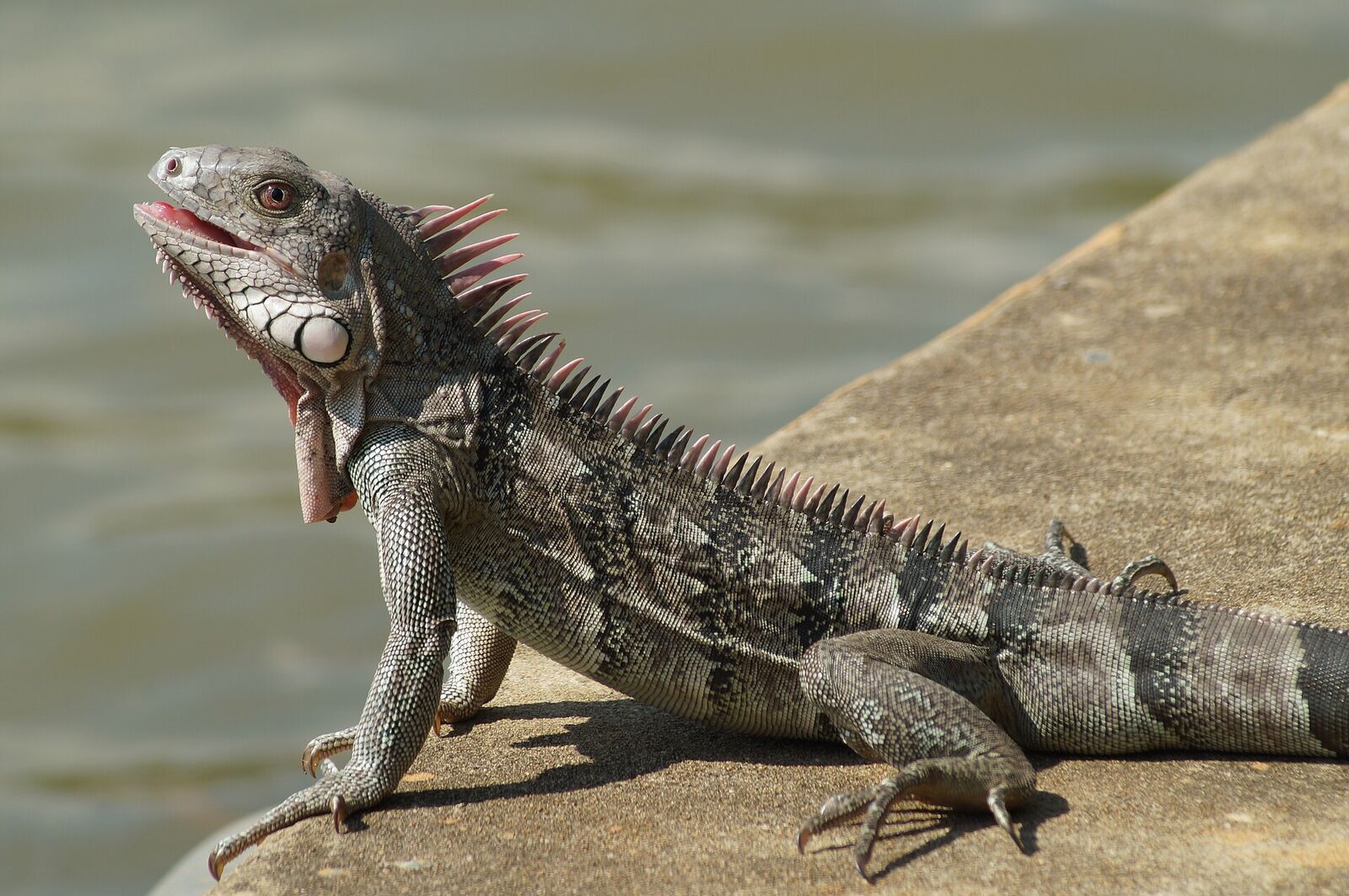
Green iguana
Iguana iguana
A 6-foot vegetarian with a whip of a tail.
Pet trade

Black spiny-tailed iguana
Ctenosaura similis
Pet trade

Common chuckwalla
Sauromalus ater
Pet trade

Cuban rock iguana
Cyclura nubila
Pet trade

Desert iguana
Dipsosaurus dorsalis
Pet trade

Fiji banded iguana
Brachylophus fasciatus
Pet trade