
Home / Birds / Songbirds and perching birds / European goldfinch
Some federal rules applyEuropean goldfinch
Carduelis carduelis
Birds › Songbirds and perching birds (Passeriformes) › Fringillidae (Finches and canaries)
The European goldfinch, or simply goldfinch (Carduelis carduelis), is a small passerine bird in the finch family that is native to the Palearctic zone in Europe, northern Africa, and western Asia.
From Wikipedia: European goldfinch, CC BY-SA 4.0 (excerpt)

Care at a glance
Species-specific values
Values researched for this exact species. Air, surface and water temperatures are listed separately, and each source is kept as published rather than averaged.
| Night temperature | 59–64 °F (15–18 °C) Source: johnnysfinches.com | |
| Diet | A species-appropriate finch seed mix, fresh or sprouted seeds, millet sprays, greens, fruit, seasonal grass seed heads, egg or soft food during breeding, live food during chick-rearing, and cuttlebone and mineral grit. Source: johnnysfinches.com | |
| Social housing | During breeding season, house one pair per enclosure. Source: johnnysfinches.com |
Understanding the animal
About this animal
About this animal
It has been introduced to other areas, including Australia, New Zealand, Uruguay and the United States. The breeding male has a red face with black markings around the eyes, and a black-and-white head.
From Wikipedia: European goldfinch, CC BY-SA 4.0 (excerpt)
In the wild
In the wild
| Overview | The European goldfinch, or simply goldfinch (Carduelis carduelis), is a small passerine bird in the finch family that is native to the Palearctic zone in Europe, northern Africa, and western Asia. It has been introduced to other areas, including Australia, New Zealand, Uruguay and the United States. The breeding male has a red face with black markings around the eyes, and a black-and-white head. Its back and flanks are buff or chestnut brown. — From Wikipedia: European goldfinch, CC BY-SA 4.0 (excerpt) |
| Where it lives | The European goldfinch is native to Europe, North Africa, and western and central Asia. It inhabits open, partially wooded lowlands and is resident in the milder western regions of its habitat, but migrates from colder areas. Even in the west, it will make local movements to escape bad weather. — From Wikipedia: European goldfinch, CC BY-SA 4.0 (excerpt) |
| Wild diet | The European goldfinch's preferred food is small seeds such as beige-coloured sunflower hearts and those from thistles (the Latin name is from Carduus, a genus of thistles), cornflowers, and teasels, but it also eats insects when it feeds its young. They also regularly visit bird feeders in winter. During this time, European goldfinches group together to form flocks of up to 40, and occasionally more. — From Wikipedia: European goldfinch, CC BY-SA 4.0 (excerpt) |
| Reproduction | The female builds the nest entirely herself, generally completing it within a week. The male accompanies her, but does not contribute. The neat, compact nest is usually located several metres above the ground and hidden by leaves and twigs at the end of a swaying branch. — From Wikipedia: European goldfinch, CC BY-SA 4.0 (excerpt) |
| Appearance and size | The average European goldfinch is 12–13 cm long, has a wingspan of 21–25 cm and weighs 14 to 19 g. There is little difference between the sexes, both having a red face, black and white head, warm brown upperparts, white underparts with buff flanks and breast patches, and black and yellow wings. — From Wikipedia: European goldfinch, CC BY-SA 4.0 (excerpt) |
| History and naming | The European goldfinch was one of the birds described and illustrated by Swiss naturalist Conrad Gessner in his Historiae animalium of 1555. The first formal description was by Carl Linnaeus in the 10th edition of his Systema Naturae published in 1758. He introduced the binomial name, Fringilla carduelis. — From Wikipedia: European goldfinch, CC BY-SA 4.0 (excerpt) |
Native climate (measured)
Native climate (measured)
| Warm-season highs | about 73°F (up to 77°F in the hottest sampled areas) |
| Cool-season lows | about 27°F (down to 9°F in the coldest sampled areas) |
| Average temperature | 39–51°F across sampled records |
| Relative humidity | 75–80% on average (driest month about 68%) |
| Rainfall | about 713 mm a year, spread fairly evenly |
| Winters | Cool to cold winters (lows around 27°F) in much of its native range. Seasonal slowdown may be relevant, but species-specific biology determines whether brumation or hibernation occurs. |
Measured at 120 wild occurrence records sampled against WorldClim 2.1 climate data (1970–2000 averages). Air conditions in the range are ecological context, not enclosure settings: microhabitats such as burrows, leaf litter or basking rocks can be cooler, warmer or more humid.
Profile
Profile
Researched for this exact species. Sources are listed under In the wild above.
History
The European goldfinch was one of the birds described and illustrated by Swiss naturalist Conrad Gessner in his Historiae animalium of 1555. The first formal description was by Carl Linnaeus in the 10th edition of his Systema Naturae published in 1758. He introduced the binomial name, Fringilla carduelis.
From Wikipedia: European goldfinch, CC BY-SA 4.0 (excerpt)
Data and studies
The numbers
The numbers
Each bar is what one source reports. Where several sources weigh in, the dashed gold band marks their average.
Maximum recorded lifespan
Longest recorded lifespan reported by each database; typical lifespans are usually shorter.
Typical adult weight
Average adult body mass in each database (FishBase gives the maximum recorded weight).
Incubation
Female maturity
Veterinary & husbandry research
Veterinary & husbandry research
- Mycobacterium genavense and avian polyomavirus co-infection in a European goldfinch (Carduelis carduelis) Manarolla G et al., Avian pathology: journal of the W.V.P.A 2007
- Pathological Findings of Nestling European Goldfinches (Carduelis carduelis) Co-Infected with Klebsiella pneumoniae and Pseudomonas aeruginosa Abbate JM et al., Veterinary sciences 2025
- Investigation of systemic isosporosis outbreaks in an aviary of greenfinch (Carduelis chloris) and goldfinch (Carduelis carduelis) and a possible link with local wild sparrows (Passer domesticus) Gosbell MC et al., Australian veterinary journal 2020
Peer-reviewed papers that mention this species alongside captivity, zoos, veterinary care or aquaculture. Some cover several species or mention it only in passing, so check the abstract. See all 6 on PubMed → PubMed
Sources for this sheet
- AnAge: The Animal Ageing and Longevity Database (Human Ageing Genomic Resources) (CC BY 3.0) Peer-reviewed researchCurated, referenced longevity and life-history records for thousands of species; maximum lifespans are often from zoo animals.
- Myhrvold et al. (2015). An amniote life-history database. Ecology 96: 3109 Peer-reviewed researchPeer-reviewed compilation of life-history data for over 21,000 birds, mammals and reptiles.
- Species+ (UNEP-WCMC and the CITES Secretariat) Zoo, university or veterinaryThe official database of species listed under CITES. UNEP (2026). The Species+ Website. Nairobi, Kenya. Compiled by UNEP-WCMC, Cambridge, UK. Available at: www.speciesplus.net. [Accessed 04/10/2026].
- USFWS International Affairs: CITES Zoo, university or veterinaryFederal agency that issues CITES permits.
- 9 CFR 2.1: Animal Welfare Act licensing (USDA) Zoo, university or veterinaryWho needs a USDA license to breed, sell or exhibit animals.
- GBIF Backbone Taxonomy (Global Biodiversity Information Facility) (CC BY 4.0) Peer-reviewed researchInternational scientific taxonomy used here for classification. GBIF Secretariat (2023). GBIF Backbone Taxonomy. Checklist dataset https://doi.org/10.15468/39omei, accessed via GBIF.org.
- Wikipedia (species article) (CC BY-SA 4.0) Community referenceFree encyclopedia; useful overviews with their own citations. Short excerpts are quoted under CC BY-SA 4.0, each credited with a link to its article.
- PubMed (U.S. National Library of Medicine) Peer-reviewed researchIndex of peer-reviewed veterinary, zoo and husbandry research.
- iNaturalist (captive observations) Community referenceCommunity observation platform run by the California Academy of Sciences and National Geographic; observations marked captive show animals living in homes, zoos and aquariums.
More finches and canaries
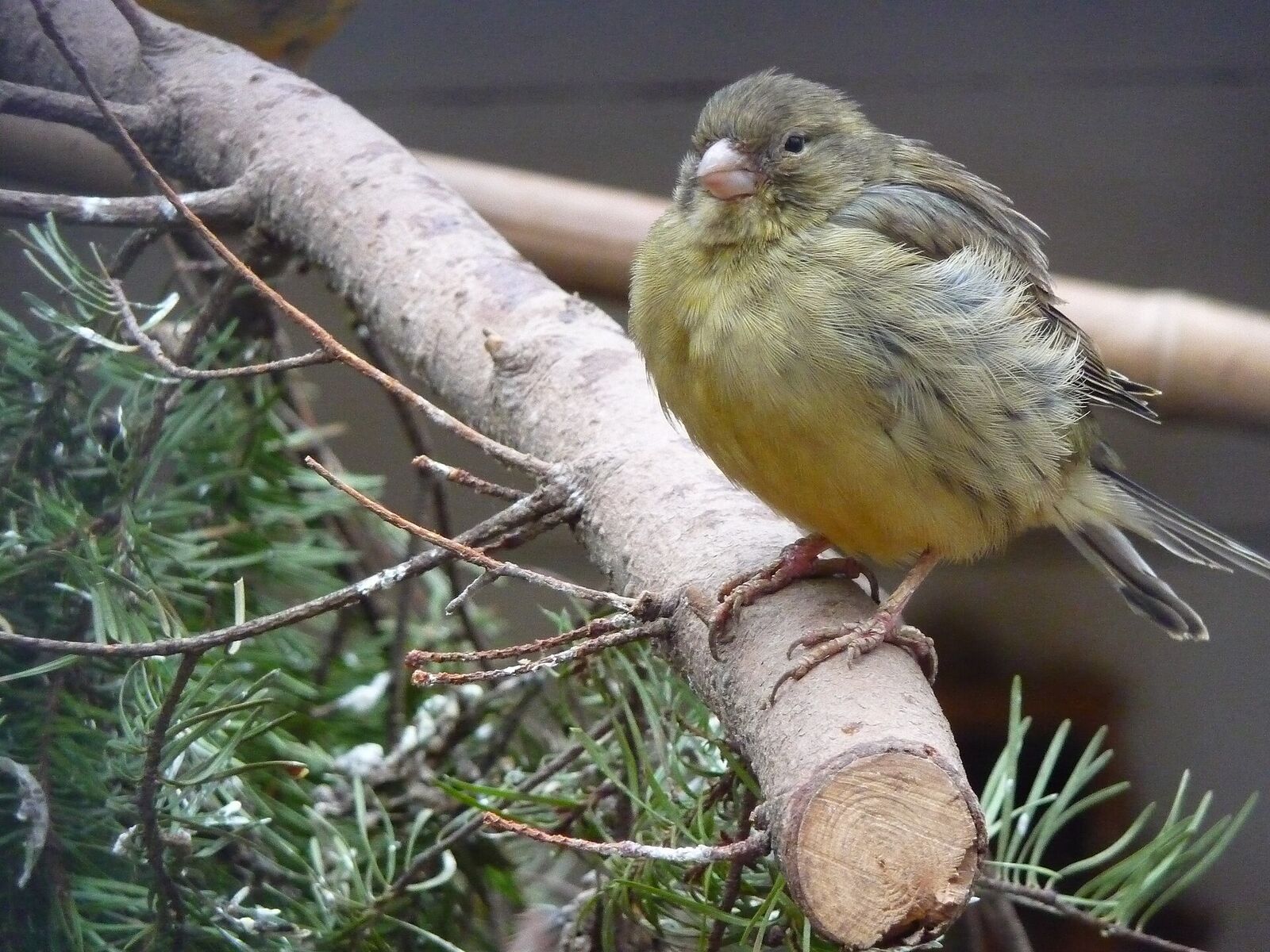
Domestic canary
Serinus canaria
Centuries of song in a small bird.
Pet trade

Black siskin
Spinus atratus
Aviary

Black-chinned siskin
Spinus barbatus
Aviary

Black-headed siskin
Spinus notatus
Aviary

Eurasian chaffinch
Fringilla coelebs
Zoos & aquariums

European greenfinch
Chloris chloris
Pet trade