
Home / Reptiles / Lizards / Chamaeleonidae / Fork-nosed Chameleon
Some federal rules applyFork-nosed Chameleon
Furcifer bifidus
Reptiles › Lizards (Lacertilia) › Chamaeleonidae (Chameleons)
Furcifer bifidus, also known as the fork-nosed chameleon, is a species of chameleon that is endemic to Madagascar.
From Wikipedia: Furcifer bifidus, CC BY-SA 4.0 (excerpt)

Care at a glance
Species-specific values
Values researched for this exact species. Air, surface and water temperatures are listed separately, and each source is kept as published rather than averaged.
| Minimum enclosure | Minimum cage size is 2′ x 2′ x 4′ tall for both sexes. Source: chameleonacademy.com | |
| Basking surface temperature | 80 °F Source: chameleonacademy.com | |
| Warm side air temperature | The article recommends cage temperatures around 75F to create gradients, with a basking branch at 80F. Source: chameleonacademy.com | |
| Humidity | 40–50 % Source: chameleonacademy.com | |
| Humidity | 80–100 % Source: chameleonacademy.com | |
| Uvb lighting | Target UV Index 3 at the basking branch, with maximum UVI 6. Source: chameleonacademy.com | |
| Diet | Feed insects about one feeder unit, defined relative to the chameleon's eye spacing. Source: chameleonacademy.com | |
| Feeding frequency | Adults: Feed 3–4 units every two days. Source: chameleonacademy.com | |
| Social housing | House one chameleon per cage; bring them together only for mating. Source: chameleonacademy.com | |
| Substrate | For the egg-laying bin, use a 50/50 sand and soil mixture. Source: chameleonacademy.com | |
| Seasonal cooling | During dry-season months, temperatures can be lowered a bit. Source: chameleonacademy.com |
Understanding the animal
About this animal
About this animal
It was described by Alexandre Brongniart in 1800. The International Union for Conservation of Nature have ranked this species of chameleon as Least Concern.
From Wikipedia: Furcifer bifidus, CC BY-SA 4.0 (excerpt)
In the wild
In the wild
| Overview | Furcifer bifidus, also known as the fork-nosed chameleon, is a species of chameleon that is endemic to Madagascar. It was described by Alexandre Brongniart in 1800. The International Union for Conservation of Nature have ranked this species of chameleon as Least Concern. — From Wikipedia: Furcifer bifidus, CC BY-SA 4.0 (excerpt) |
| Where it lives | Furcifer bifidus is found in east Madagascar, and there is no known type locality. According to the International Union for Conservation of Nature (IUCN), it can be found over an area of 35368 sqkm, and is therefore ranked as a Least Concern species of animal, although it is exposed to many threats. — From Wikipedia: Furcifer bifidus, CC BY-SA 4.0 (excerpt) |
Read about this species in the wild at The Reptile Database.
Native climate (measured)
Native climate (measured)
| Warm-season highs | about 82°F (up to 86°F in the hottest sampled areas) |
| Cool-season lows | about 52°F (down to 48°F in the coldest sampled areas) |
| Average temperature | 66–73°F across sampled records |
| Relative humidity | 81–83% on average (driest month about 76%) |
| Rainfall | about 1697 mm a year |
Measured at 10 wild occurrence records sampled against WorldClim 2.1 climate data (1970–2000 averages). Air conditions in the range are ecological context, not enclosure settings: microhabitats such as burrows, leaf litter or basking rocks can be cooler, warmer or more humid.
Profile
Profile
Researched for this exact species. Sources are listed under In the wild above.
History
Named after Latin bifidus = forked, with a cleft.
Sources for this sheet
- Species+ (UNEP-WCMC and the CITES Secretariat) Zoo, university or veterinaryThe official database of species listed under CITES. UNEP (2026). The Species+ Website. Nairobi, Kenya. Compiled by UNEP-WCMC, Cambridge, UK. Available at: www.speciesplus.net. [Accessed 04/10/2026].
- USFWS International Affairs: CITES Zoo, university or veterinaryFederal agency that issues CITES permits.
- Myhrvold et al. (2015). An amniote life-history database. Ecology 96: 3109 Peer-reviewed researchPeer-reviewed compilation of life-history data for over 21,000 birds, mammals and reptiles.
- The Reptile Database Peer-reviewed researchScientist-curated catalog of every reptile species, with taxonomy and literature.
- GBIF Backbone Taxonomy (Global Biodiversity Information Facility) (CC BY 4.0) Peer-reviewed researchInternational scientific taxonomy used here for classification. GBIF Secretariat (2023). GBIF Backbone Taxonomy. Checklist dataset https://doi.org/10.15468/39omei, accessed via GBIF.org.
- Wikipedia (species article) (CC BY-SA 4.0) Community referenceFree encyclopedia; useful overviews with their own citations. Short excerpts are quoted under CC BY-SA 4.0, each credited with a link to its article.
- iNaturalist (captive observations) Community referenceCommunity observation platform run by the California Academy of Sciences and National Geographic; observations marked captive show animals living in homes, zoos and aquariums.
More chameleons
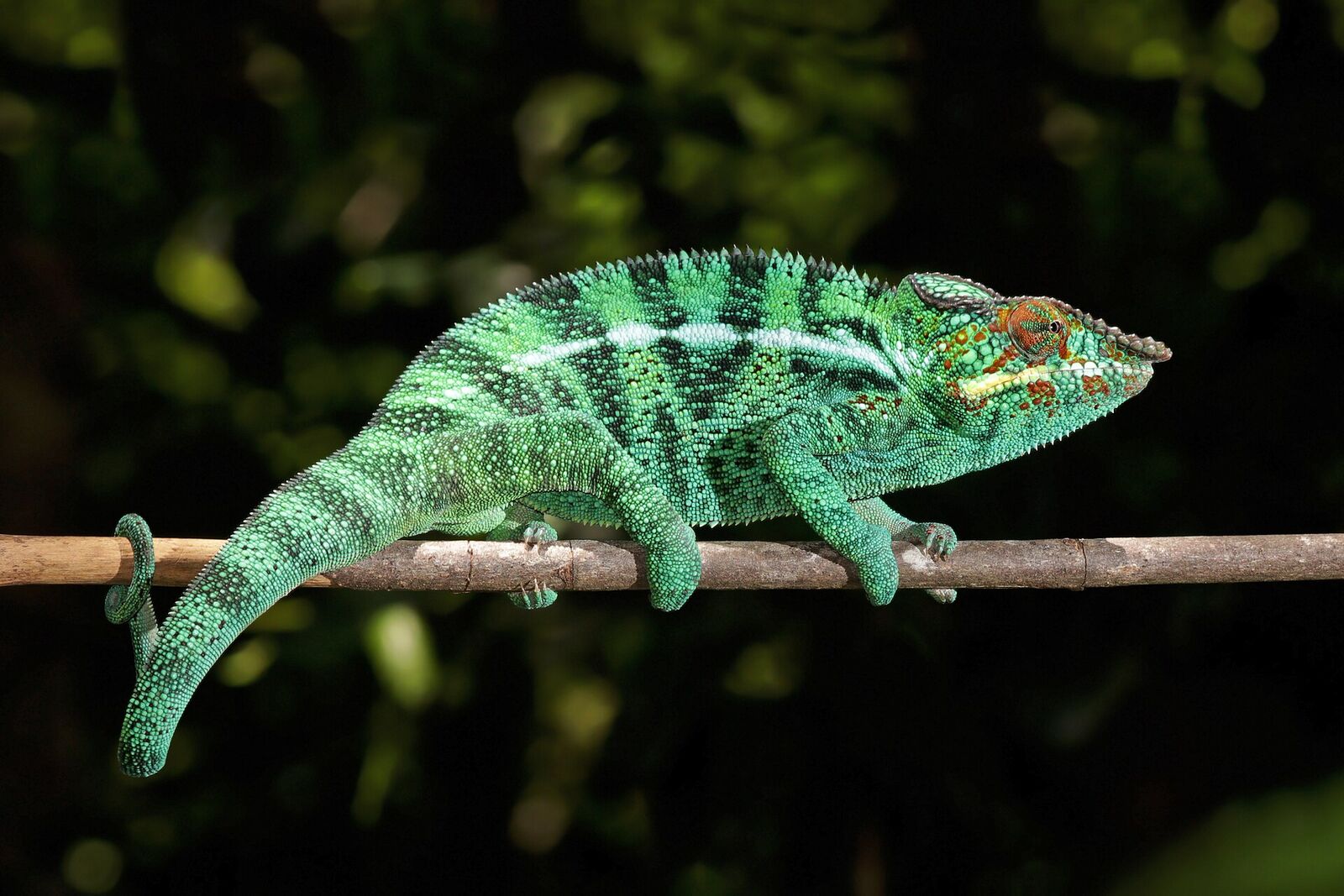
Panther chameleon
Furcifer pardalis
The most colorful chameleon of all.
Pet trade
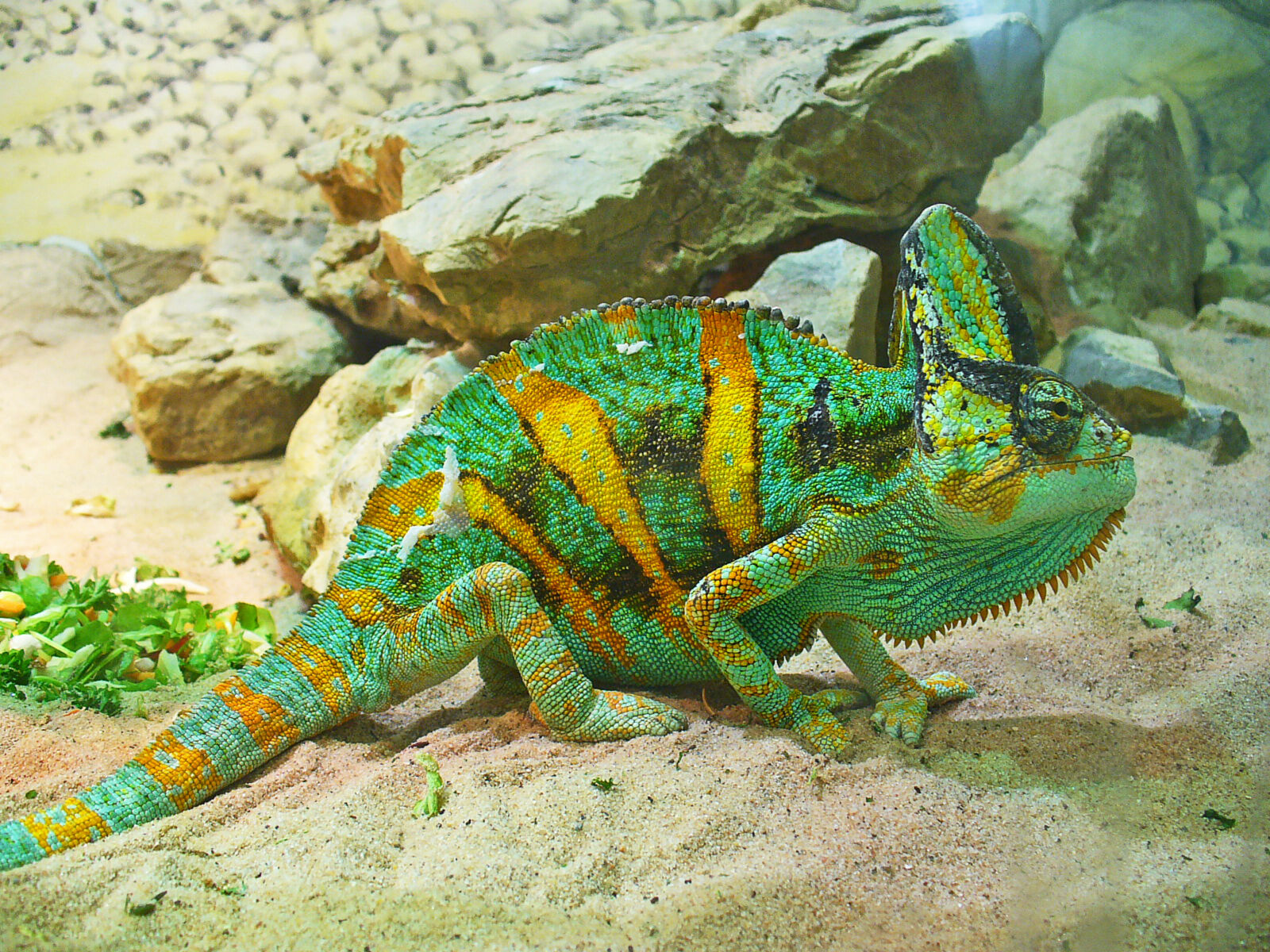
Veiled chameleon
Chamaeleo calyptratus
Color-shifting, independent, look-don't-touch.
Pet trade

Bearded pygmy chameleon
Rieppeleon brevicaudatus
Pet trade

Cape dwarf chameleon
Bradypodion pumilum
Pet trade

Carpet chameleon
Furcifer lateralis
Pet trade

Common chameleon
Chamaeleo chamaeleon
Zoos & aquariums