
Home / Reptiles / Lizards / Chamaeleonidae / Lesser chameleon
Some federal rules applyLesser chameleon
Furcifer minor
Reptiles › Lizards (Lacertilia) › Chamaeleonidae (Chameleons)
The lesser chameleon (Furcifer minor) or minor chameleon is a species of lizards in the family Chamaeleonidae.
From Wikipedia: Lesser chameleon, CC BY-SA 4.0 (excerpt)

Care at a glance
Species-specific values
Values researched for this exact species. Air, surface and water temperatures are listed separately, and each source is kept as published rather than averaged.
| Minimum enclosure | Adults should be kept in enclosures at least 18 by 18 by 24 inches. Source: reptilesmagazine.com | |
| Basking surface temperature | 90–100 °F Source: reptilesmagazine.com | |
| Warm side air temperature | Ambient daytime temperatures should be in the 70s. Source: reptilesmagazine.com | |
| Uvb lighting | Use UV-producing fluorescent lighting; the author recommends Reptisun 10.0 or Arcadia 6.0 bulbs. Source: reptilesmagazine.com | |
| Diet | Feed gut-loaded and supplemented insects, primarily crickets; other feeders include Turkistan roaches, bean beetles, and fruit flies. Source: reptilesmagazine.com | |
| Feeding frequency | Juveniles are fed daily; adults are fed every other day. Source: reptilesmagazine.com | |
| Social housing | Keep chameleons singly except when together for breeding. Source: reptilesmagazine.com | |
| Substrate | For eggs, place a 6 to 8-inch mixture of 50/50 organic potting soil and sand. Source: reptilesmagazine.com | |
| Minimum enclosure | At least 18″L x 18″W x 24″H; the article also recommends a 24″ cube or larger. Source: happydragons.com | |
| Basking surface temperature | 85–90 °F Source: happydragons.com | |
| Warm side air temperature | 80–85 °F Source: happydragons.com | |
| Cool side air temperature | 70–75 °F Source: happydragons.com | |
| Humidity | 40–70 % Source: happydragons.com | |
| Humidity | 80–95 % Source: happydragons.com | |
| Uvb lighting | Provide a 5–7% UVB T5 lamp or a 10% UVB T8 lamp. Source: happydragons.com | |
| Diet | Feed insects only; offer varied, live insects and gut-load them before feeding. Source: happydragons.com | |
| Social housing | House singly; the article does not recommend cohabitation. Source: happydragons.com | |
| Substrate | Use 3–5 inches total substrate with drainage, soil, and a leaf litter or moss moisture layer. Source: happydragons.com | |
| Seasonal cooling | Reduce light and temperature in winter; the article gives the seasonal schedule in its Lighting section. Source: happydragons.com |
Understanding the animal
About this animal
About this animal
It is endemic to Madagascar.
From Wikipedia: Lesser chameleon, CC BY-SA 4.0 (excerpt)
In the wild
In the wild
| Overview | The lesser chameleon (Furcifer minor) or minor chameleon is a species of lizards in the family Chamaeleonidae. It is endemic to Madagascar. — From Wikipedia: Lesser chameleon, CC BY-SA 4.0 (excerpt) |
| Where it lives | The lesser chameleon mainly inhabits the arboreal habitat of tapia forest, dominated by the Uapaca bojeri tree, as well as other endemic habitats such as humid montane habitats between the ranges of 1,000 and 1,650 metres above sea level in the region of Madagascar. They have also been known to colonise pastureland as well as coffee and cocoa plantations, and as a result may be more abundant in these locations. — From Wikipedia: Lesser chameleon, CC BY-SA 4.0 (excerpt) |
| Reproduction | The lesser chameleon is oviparous, with 4 to 16 eggs laid in a single clutch and in recorded captivity as many as 3 clutches have been known to be laid per year although this number is typically closer to 1 clutch per year. A dissected female contained 12 eggs measuring 12 by 7 mm. The eggs require an incubation time of 8 to 9 months at a constant temperature of 23 degrees Celsius. — From Wikipedia: Lesser chameleon, CC BY-SA 4.0 (excerpt) |
| Conservation | It is threatened by habitat loss as a result of quartz and tourmaline mining, logging as well as the clearing of its habitat through slash-and-burn techniques for subsistence agriculture. There are signs that it appears to tolerate habitat loss, although there is a lack of basic information on its ecology to support whether these new habitats can be suitable for breeding. — From Wikipedia: Lesser chameleon, CC BY-SA 4.0 (excerpt) |
Read about this species in the wild at The Reptile Database.
Native climate (measured)
Native climate (measured)
| Warm-season highs | about 77°F (up to 82°F in the hottest sampled areas) |
| Cool-season lows | about 45°F (down to 44°F in the coldest sampled areas) |
| Average temperature | 62–66°F across sampled records |
| Relative humidity | 83–87% on average (driest month about 77%) |
| Rainfall | about 1382 mm a year, with strong wet and dry seasons |
Measured at 7 wild occurrence records sampled against WorldClim 2.1 climate data (1970–2000 averages). Air conditions in the range are ecological context, not enclosure settings: microhabitats such as burrows, leaf litter or basking rocks can be cooler, warmer or more humid.
Profile
Profile
Researched for this exact species. Sources are listed under In the wild above.
Data and studies
The numbers
The numbers
Each bar is what one source reports. Where several sources weigh in, the dashed gold band marks their average.
Basking spot
Species-specific values from keeper care sheets. Basking figures are often surface readings taken with an infrared thermometer, which run hotter than air.
Sources for this sheet
- Reptiles Magazine (care articles) Experienced keeper or breederEstablished reptile and amphibian hobby magazine; care articles are written by breeders, keepers and veterinarians.
- Species+ (UNEP-WCMC and the CITES Secretariat) Zoo, university or veterinaryThe official database of species listed under CITES. UNEP (2026). The Species+ Website. Nairobi, Kenya. Compiled by UNEP-WCMC, Cambridge, UK. Available at: www.speciesplus.net. [Accessed 04/10/2026].
- USFWS International Affairs: CITES Zoo, university or veterinaryFederal agency that issues CITES permits.
- Myhrvold et al. (2015). An amniote life-history database. Ecology 96: 3109 Peer-reviewed researchPeer-reviewed compilation of life-history data for over 21,000 birds, mammals and reptiles.
- The Reptile Database Peer-reviewed researchScientist-curated catalog of every reptile species, with taxonomy and literature.
- GBIF Backbone Taxonomy (Global Biodiversity Information Facility) (CC BY 4.0) Peer-reviewed researchInternational scientific taxonomy used here for classification. GBIF Secretariat (2023). GBIF Backbone Taxonomy. Checklist dataset https://doi.org/10.15468/39omei, accessed via GBIF.org.
- Wikipedia (species article) (CC BY-SA 4.0) Community referenceFree encyclopedia; useful overviews with their own citations. Short excerpts are quoted under CC BY-SA 4.0, each credited with a link to its article.
- iNaturalist (captive observations) Community referenceCommunity observation platform run by the California Academy of Sciences and National Geographic; observations marked captive show animals living in homes, zoos and aquariums.
More chameleons
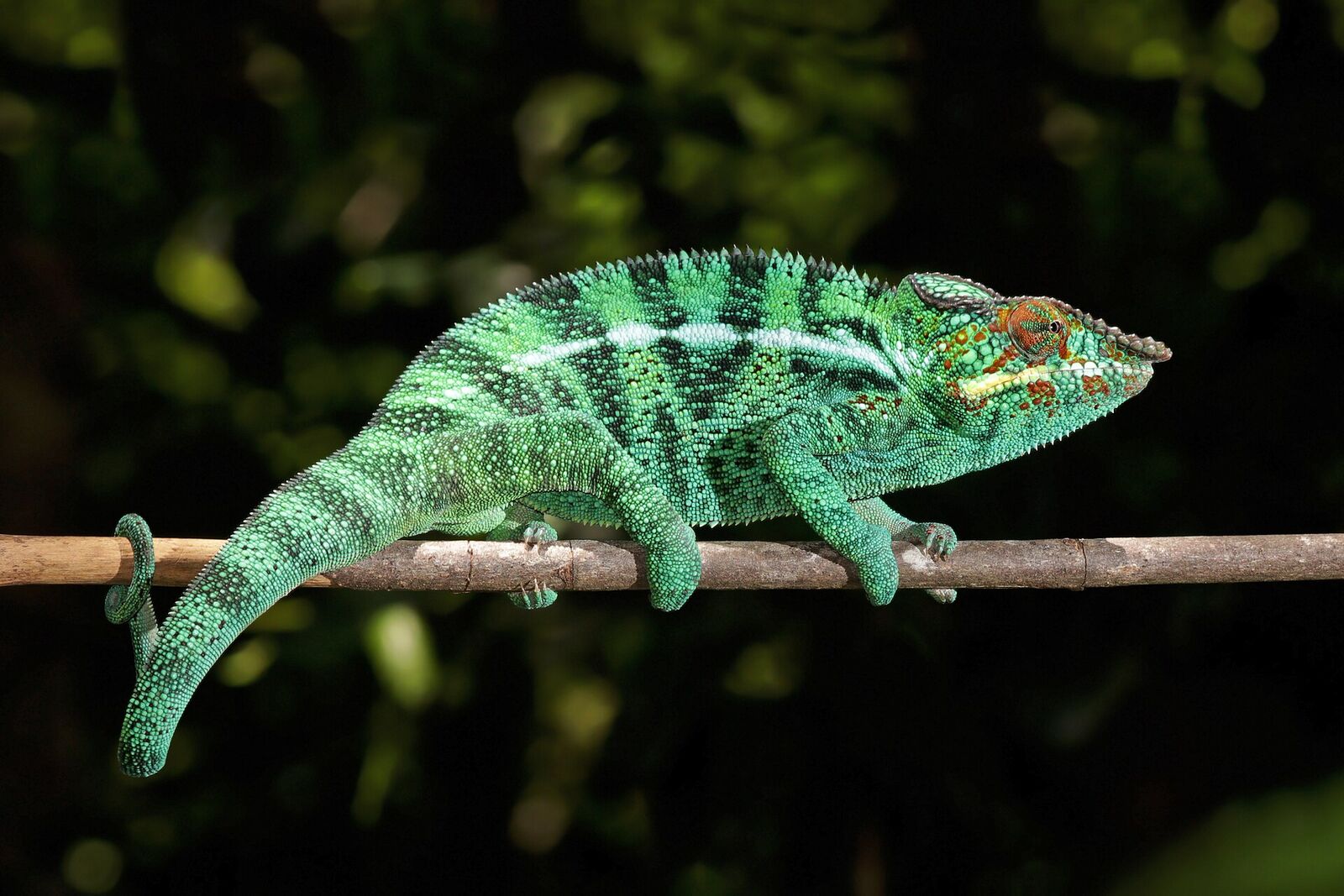
Panther chameleon
Furcifer pardalis
The most colorful chameleon of all.
Pet trade
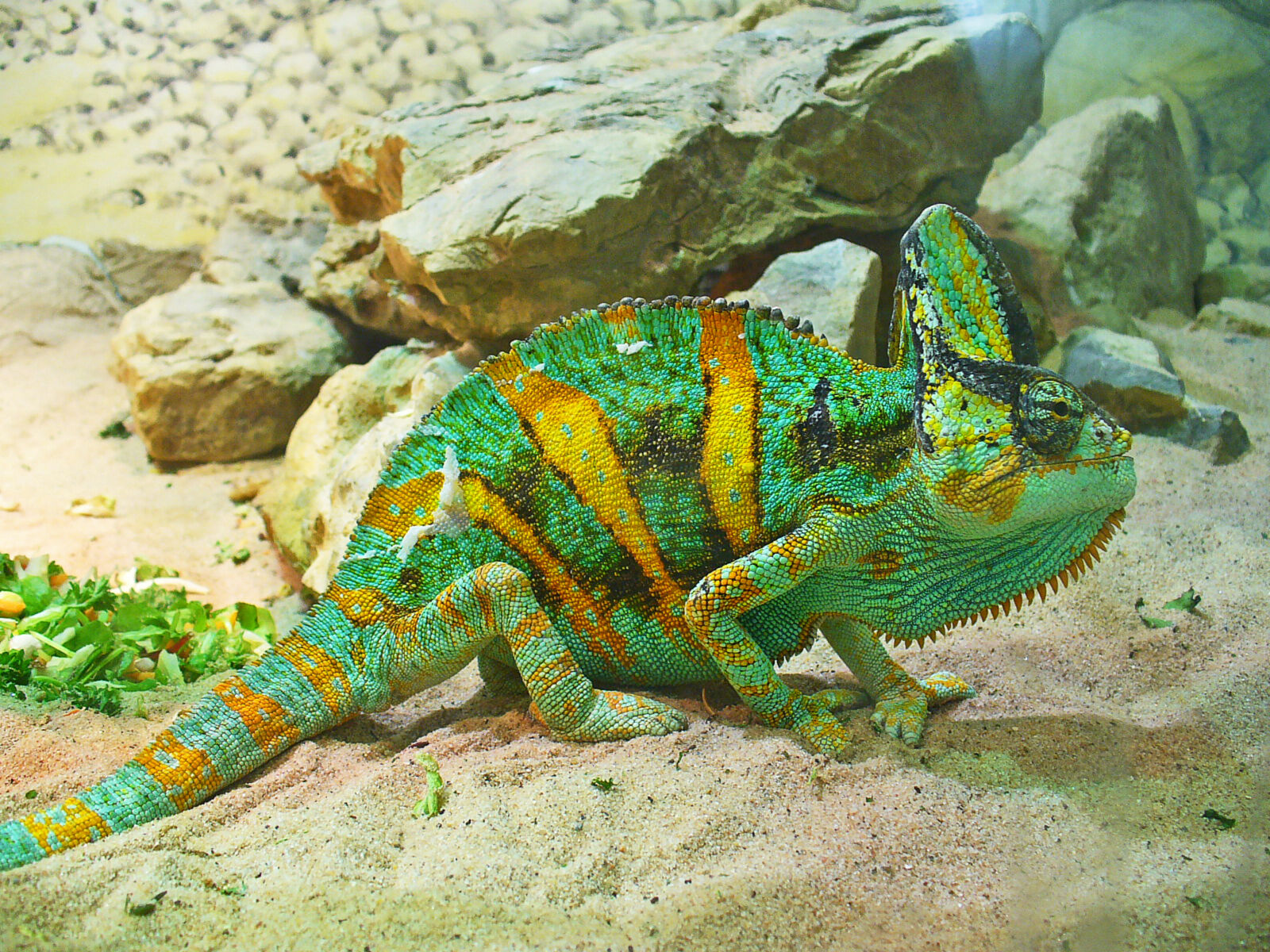
Veiled chameleon
Chamaeleo calyptratus
Color-shifting, independent, look-don't-touch.
Pet trade

Bearded pygmy chameleon
Rieppeleon brevicaudatus
Pet trade

Cape dwarf chameleon
Bradypodion pumilum
Pet trade

Carpet chameleon
Furcifer lateralis
Pet trade

Common chameleon
Chamaeleo chamaeleon
Zoos & aquariums