
Home / Reptiles / Lizards / Scincidae / Gidgee spiny-tailed skink
Some federal rules applyGidgee spiny-tailed skink
Egernia stokesii
Reptiles › Lizards (Lacertilia) › Scincidae (Skinks)
Egernia stokesii is a gregarious species of lizard of the Scincidae family.
From Wikipedia: Stokes's skink, CC BY-SA 4.0 (excerpt)

Care at a glance
Species-specific values
Values researched for this exact species. Air, surface and water temperatures are listed separately, and each source is kept as published rather than averaged.
| Minimum enclosure | Adult terrarium size is 180×60×50 cm. Source: bion.com.ua | |
| Basking surface temperature | 113 °F (up to 45 °C) Source: bion.com.ua | |
| Warm side air temperature | 79–90 °F (26–32 °C) Source: bion.com.ua | |
| Night temperature | 77–79 °F (25–26 °C) Source: bion.com.ua | |
| Humidity | 50–60 % Source: bion.com.ua | |
| Humidity | 60–70 % Source: bion.com.ua | |
| Diet | Adults eat insects and salad; babies eat insects, with salad offered daily. Source: bion.com.ua | |
| Feeding frequency | Adults are fed every other day; babies daily. Source: bion.com.ua | |
| Seasonal cooling | 64 °F (18 °C) Source: bion.com.ua |
Understanding the animal
About this animal
About this animal
This diurnal species is endemic to Australia, and is also known as the Gidgee skink, spiny-tailed skink, Stokes's skink and Stokes's egernia. The species forms stable, long-term social aggregations, much like the social groups seen in mammalian and avian species.
From Wikipedia: Stokes's skink, CC BY-SA 4.0 (excerpt)
In the wild
In the wild
| Overview | Egernia stokesii is a gregarious species of lizard of the Scincidae family. This diurnal species is endemic to Australia, and is also known as the Gidgee skink, spiny-tailed skink, Stokes's skink and Stokes's egernia. The species forms stable, long-term social aggregations, much like the social groups seen in mammalian and avian species. This characteristic is rarely found in the Squamata order, but is widespread within the Australian subfamily of Egerniinae skinks. — From Wikipedia: Stokes's skink, CC BY-SA 4.0 (excerpt) |
| Where it lives | E. stokesii may be saxicolous, occupying rocky outcrops, or semi-arboreal, and found in grassland, woodland or shrubland habitats. They are diurnal and non-burrowing, instead sheltering in rock crevices, under logs, or in tree hollows. E. stokesii is found in New South Wales, Northern Territory, Queensland, South Australia, and Western Australia. — From Wikipedia: Stokes's skink, CC BY-SA 4.0 (excerpt) |
| Conservation | Egernia stokesii is categorised by the International Union for the Conservation of Nature Red List as Least Concern. However, the current population has been assessed as decreasing; affected by severely fragmented populations and processes that alter or degrade habitats, such as agricultural activities, mining and altered fire regimes. — From Wikipedia: Stokes's skink, CC BY-SA 4.0 (excerpt) |
Read about this species in the wild at The Reptile Database.
Native climate (measured)
Native climate (measured)
| Warm-season highs | about 96°F (up to 98°F in the hottest sampled areas) |
| Cool-season lows | about 42°F (down to 40°F in the coldest sampled areas) |
| Average temperature | 63–70°F across sampled records |
| Relative humidity | 40–43% on average (driest month about 28%) |
| Rainfall | about 243 mm a year, spread fairly evenly |
Measured at 86 wild occurrence records sampled against WorldClim 2.1 climate data (1970–2000 averages). Air conditions in the range are ecological context, not enclosure settings: microhabitats such as burrows, leaf litter or basking rocks can be cooler, warmer or more humid.
Profile
Profile
Researched for this exact species. Sources are listed under In the wild above.
Data and studies
The numbers
The numbers
Each bar is what one source reports. Where several sources weigh in, the dashed gold band marks their average.
Maximum recorded lifespan
Longest recorded lifespan reported by each database; typical lifespans are usually shorter. The AnAge record comes from an animal in human care.
Typical adult weight
Average adult body mass in each database (FishBase gives the maximum recorded weight).
Adult snout-to-vent length
Body length without the tail.
Veterinary & husbandry research
Veterinary & husbandry research
- Sex identification in Australian skinks (Egernia stokesii, E. hosmeri, E. striolata) using cloacoscopy Knotek Z et al., Veterinarni medicina 2023
Peer-reviewed papers that mention this species alongside captivity, zoos, veterinary care or aquaculture. Some cover several species or mention it only in passing, so check the abstract. PubMed
Sources for this sheet
- AnAge: The Animal Ageing and Longevity Database (Human Ageing Genomic Resources) (CC BY 3.0) Peer-reviewed researchCurated, referenced longevity and life-history records for thousands of species; maximum lifespans are often from zoo animals.
- Myhrvold et al. (2015). An amniote life-history database. Ecology 96: 3109 Peer-reviewed researchPeer-reviewed compilation of life-history data for over 21,000 birds, mammals and reptiles.
- Species+ (UNEP-WCMC and the CITES Secretariat) Zoo, university or veterinaryThe official database of species listed under CITES. UNEP (2026). The Species+ Website. Nairobi, Kenya. Compiled by UNEP-WCMC, Cambridge, UK. Available at: www.speciesplus.net. [Accessed 04/10/2026].
- USFWS International Affairs: CITES Zoo, university or veterinaryFederal agency that issues CITES permits.
- The Reptile Database Peer-reviewed researchScientist-curated catalog of every reptile species, with taxonomy and literature.
- GBIF Backbone Taxonomy (Global Biodiversity Information Facility) (CC BY 4.0) Peer-reviewed researchInternational scientific taxonomy used here for classification. GBIF Secretariat (2023). GBIF Backbone Taxonomy. Checklist dataset https://doi.org/10.15468/39omei, accessed via GBIF.org.
- Wikipedia (species article) (CC BY-SA 4.0) Community referenceFree encyclopedia; useful overviews with their own citations. Short excerpts are quoted under CC BY-SA 4.0, each credited with a link to its article.
- PubMed (U.S. National Library of Medicine) Peer-reviewed researchIndex of peer-reviewed veterinary, zoo and husbandry research.
- iNaturalist (captive observations) Community referenceCommunity observation platform run by the California Academy of Sciences and National Geographic; observations marked captive show animals living in homes, zoos and aquariums.
More skinks
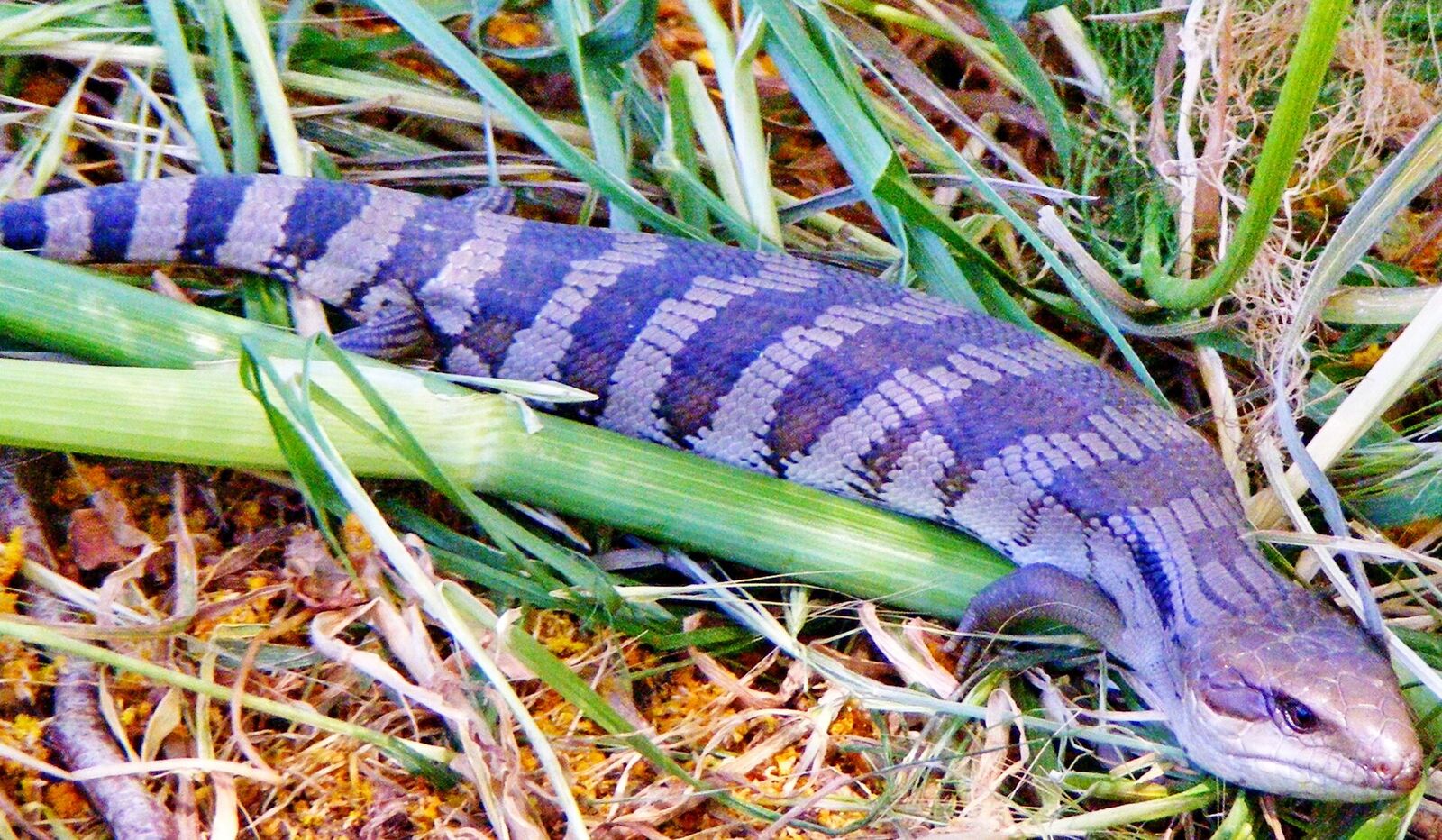
Common blue-tongued skink
Tiliqua scincoides
Docile, chunky and flashes a blue tongue.
Pet trade

Blotched blue-tongued skink
Tiliqua nigrolutea
Pet trade

Centralian blue-tongued skink
Tiliqua multifasciata
Pet trade

Cunningham's skink
Egernia cunninghami
Pet trade

East Indian brown mabuya
Eutropis multifasciata
Pet trade

Eastern Pilbara spiny-tailed skink
Egernia epsisolus
Pet trade