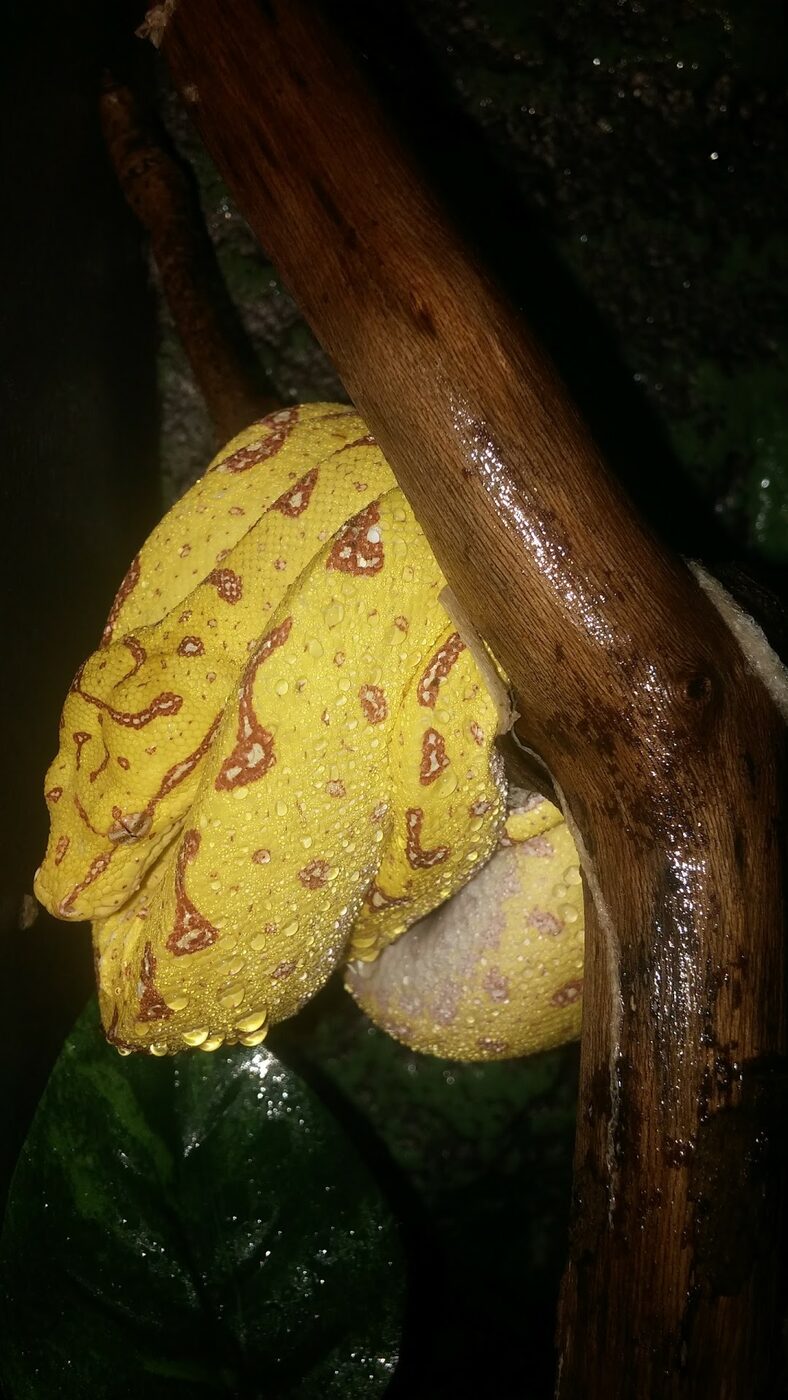
Care at a glance
Species-specific values
Values researched for this exact species. Where they differ from the group guide below, follow these. Air, surface and water temperatures are listed separately, and each source is kept as published rather than averaged.
| Basking surface temperature | 80–86 °F Probe on branch. | 239 |
| Cool air temperature | 70–80 °F Shaded mid-enclosure probe. | 239 |
| Night air temperature | 68–72 °F RF night regime. | 239 |
| Relative humidity | 40–70 % Allow drying between misting events. | 239 |
| Enclosure starting dimensions | length: 3 ft; width: 2 ft; height: 2 ft RF starting point; same source requires full-length stretching, so enlarge for snakes longer than 3 ft. | 239 |
| Perch height air temperature | 78–88 °F Walder horizontal-gradient regime; not averaged with RF. | 240 |
| Enclosure dimensions recommendation | length: 36–48 in; width: 18–24 in; height: 24 in Walder older breeder recommendation, not the RF full-length standard. | 240 |
Care guide
Arboreal pythons and tree boas
Applies to most species in this group. Habitat: Tropical rainforest canopy. Individual species can differ, so compare with the species numbers above and the linked sources.
Housing & setup
- For Morelia viridis, provide usable climbing perches and enough horizontal space for stretching and thermoregulation at perch height; a tall cage alone does not meet these needs.
- Higher humidity with good ventilation; mist in the evening and let it dry somewhat during the day.
- These snakes coil on perches for most of their lives, so perch diameter should roughly match body thickness.
Climate & lighting
Starting point only: RF and Walder recommendations differ; do not apply one humid-hot recipe to all tree boas and pythons. Check the species-specific values for this animal where shown.
| Warm side / daytime | 85–90°F |
| Cool side | 75–80°F |
| Night | 72–78°F |
| Humidity | 60–80% |
Diet
- Appropriately sized rodents; many arboreal species do best on smaller, less frequent meals.
- Offer food with long tongs at perch level.
Social life
- Solitary.
Handling
- Handle from the perch; many keepers move the whole perch rather than unwrapping the snake.
Health watch
- Dehydration and stuck sheds if kept too dry; respiratory problems if stuffy and wet.
- Often defensive; captive-bred adults usually calm with steady routine.
Understanding the animal
About this animal
About this animal
The species is native to New Guinea, some islands in Indonesia, and the Cape York Peninsula in Australia. First described by Hermann Schlegel in 1872, it was known for many years as Chondropython viridis.
Quoted from the Wikipedia article “Green tree python” (CC BY-SA 4.0) 174
In the wild
In the wild
Quoted from the matching sections of reputable sources for this exact species. Specialist databases are used first; Wikipedia (community-edited, CC BY-SA 4.0) only fills gaps. Other sources are short credited quotes.
| Overview | The green tree python (Morelia viridis), is a species of snake in the family Pythonidae. The species is native to New Guinea, some islands in Indonesia, and the Cape York Peninsula in Australia. First described by Hermann Schlegel in 1872, it was known for many years as Chondropython viridis. As its common name suggests, it is a bright green snake that can reach a total length (including tail) of 2 m and a weight of 1.6 kg, with females slightly larger and heavier than males. — Wikipedia (community-edited) |
| Where it lives | arboreal, although categories as “not arboreal” by Harrington et al. 2018. — The Reptile Database |
| Wild diet | The diet of green tree pythons consists mostly of small mammals, such as murid rodents (Melomys capensis, M. cervinipes, Mus domesticus, Rattus leucopus, other Rattus spp.), and sometimes reptiles, such as geckos and skinks (Carlia longipes), and insects. This snake, like the emerald tree boa, was previously thought to eat birds; however, Switak conducted field work on this issue. — Wikipedia (community-edited) |
| Behavior | Morelia viridis is the most arboreal python species, though it may be found on the ground occasionally. — Animal Diversity Web |
| Reproduction | Reproduction in the wild has never been reported for Morelia viridis and the mating system is unknown. — Animal Diversity Web |
| Lifespan | Information on actual ages in the wild is limited for Morelia viridis. — Animal Diversity Web |
| Appearance and size | Morelia viridis reaches an average length of 1.5 meters; with the largest recorded specimen being 2.2 meters in length. — Animal Diversity Web |
| History and naming | German naturalist Hermann Schlegel described the green tree python in 1872 as Python viridis, from two specimens collected in the Aru Islands of Indonesia. His countryman Adolf Bernhard Meyer erected the genus Chondropython (though recognised similarity to Morelia) and described the green tree python as Chondropython azureus in 1874, from a specimen collected in "Kordo", later determined to be Korido on Biak Island. — Wikipedia (community-edited) |
| Conservation | In 2010, the green tree python was rated as least concern on the IUCN Red List of endangered species on the basis of its large range and isolated declines in population from smuggling. However, the threat from smuggling for the pet trade was recognised and requires monitoring. — Wikipedia (community-edited) |
Native climate (measured)
Native climate (measured)
| Warm-season highs | about 89°F (up to 89°F in the hottest sampled areas) |
| Cool-season lows | about 65°F (down to 65°F in the coldest sampled areas) |
| Average temperature | 77–78°F across sampled records |
| Relative humidity | 77–77% on average (driest month about 70%) |
| Rainfall | about 1996 mm a year, with strong wet and dry seasons |
Measured at 80 wild occurrence records sampled against WorldClim 2.1 climate data (1970–2000 averages). Air conditions in the range are ecological context, not enclosure settings: microhabitats such as burrows, leaf litter or basking rocks can be cooler, warmer or more humid.
Profile
Profile
Researched for this exact species. Sources are listed under In the wild above.
History
German naturalist Hermann Schlegel described the green tree python in 1872 as Python viridis, from two specimens collected in the Aru Islands of Indonesia. His countryman Adolf Bernhard Meyer erected the genus Chondropython (though recognised similarity to Morelia) and described the green tree python as Chondropython azureus in 1874, from a specimen collected in "Kordo", later determined to be Korido on Biak Island.
Data and studies
The numbers
The numbers
Each bar is what one source reports. Where several sources weigh in, the dashed gold band marks their average.
Maximum recorded lifespan
Longest recorded lifespan reported by each database; typical lifespans are usually shorter. The AnAge record comes from an animal in human care.
Typical adult weight
Average adult body mass in each database (FishBase gives the maximum recorded weight).
Cool side
Species-specific values from keeper care sheets. Basking figures are often surface readings taken with an infrared thermometer, which run hotter than air.
Night temperature
Species-specific values from keeper care sheets. Basking figures are often surface readings taken with an infrared thermometer, which run hotter than air.
Humidity
Species-specific values from keeper care sheets. Basking figures are often surface readings taken with an infrared thermometer, which run hotter than air.
Basking spot
Species-specific values from keeper care sheets. Basking figures are often surface readings taken with an infrared thermometer, which run hotter than air.
Care articles for this species
Care articles for this species
- Green Tree Python Care Sheet (ReptiFiles)
- Green Tree Python Care Sheet (Reptiles Magazine)
- Green Tree Python Care Info (Reptiles Magazine)
- Green Tree Python Enclosure (Reptiles Magazine)
- Breeding Green Tree Pythons (Morelia Viridis) (Reptiles Magazine)
- Green Tree Python Information And Care (Reptiles Magazine)
Veterinary & husbandry research
Veterinary & husbandry research
- Serpentoviruses: More than Respiratory Pathogens Dervas E et al., Journal of virology 2020
- Detection and prevalence of boid inclusion body disease in collections of boas and pythons using immunological assays Chang L et al., Veterinary journal (London, England: 1997) 2016
- Identification of snake arenaviruses in live boas and pythons in a zoo in Germany Aqrawi T et al., Tierarztliche Praxis. Ausgabe K, Kleintiere/Heimtiere 2015
- Molecular identification of Sarcocystis spp. helped to define the origin of green pythons (Morelia viridis) confiscated in Germany Moré G et al., Parasitology 2014
Peer-reviewed papers that mention this species alongside captivity, zoos, veterinary care or aquaculture. Some cover several species or mention it only in passing, so check the abstract. See all 8 on PubMed → 170
Sources for this sheet
- AnAge: The Animal Ageing and Longevity Database (Human Ageing Genomic Resources) Peer-reviewed researchCurated, referenced longevity and life-history records for thousands of species; maximum lifespans are often from zoo animals.
- Myhrvold et al. (2015). An amniote life-history database. Ecology 96: 3109 Peer-reviewed researchPeer-reviewed compilation of life-history data for over 21,000 birds, mammals and reptiles.
- ReptiFiles (care guides) Experienced keeper or breederWell-researched reptile care guides that cite herpetological literature and experienced keepers.
- Reptiles Magazine (care articles) Experienced keeper or breederEstablished reptile and amphibian hobby magazine; care articles are written by breeders, keepers and veterinarians.
- Species+ (UNEP-WCMC and the CITES Secretariat) Zoo, university or veterinaryThe official database of species listed under CITES.
- USFWS International Affairs: CITES Zoo, university or veterinaryFederal agency that issues CITES permits.
- Merck Veterinary Manual: Management and husbandry of reptiles Zoo, university or veterinaryThe Merck Veterinary Manual: a standard veterinary reference written and reviewed by veterinary specialists.
- Merck Veterinary Manual: Nutritional, metabolic and endocrine diseases of reptiles Zoo, university or veterinaryThe Merck Veterinary Manual: a standard veterinary reference written and reviewed by veterinary specialists.
- ReptiFiles: Green tree python care sheet Zoo, university or veterinaryAdded in the 2026 source-checked care-guide review.
- Reptiles Magazine: Green tree python care — Rico Walder Experienced keeper or breederAdded in the 2026 source-checked care-guide review.
- The Reptile Database Peer-reviewed researchScientist-curated catalog of every reptile species, with taxonomy and literature.
- GBIF Backbone Taxonomy (Global Biodiversity Information Facility) Peer-reviewed researchInternational scientific taxonomy used here for classification.
- Wikipedia (species article) Community referenceFree encyclopedia; useful overviews with their own citations. Intro text is quoted under CC BY-SA 4.0.
- PubMed (U.S. National Library of Medicine) Peer-reviewed researchIndex of peer-reviewed veterinary, zoo and husbandry research.
More pythons
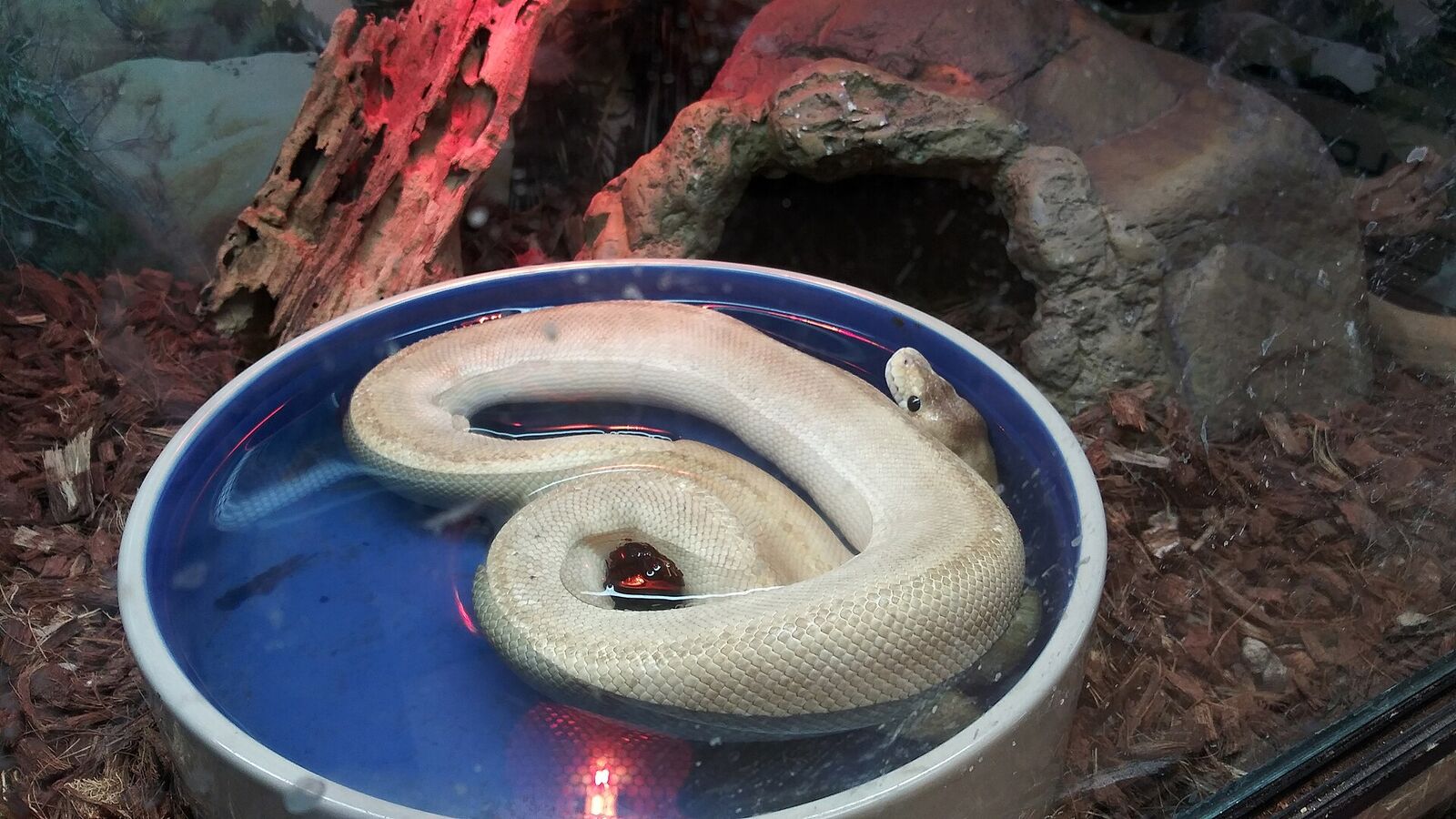 In-depth
Ball python
Python regius
The calm, curl-up classic of pet snakes.
Pet trade
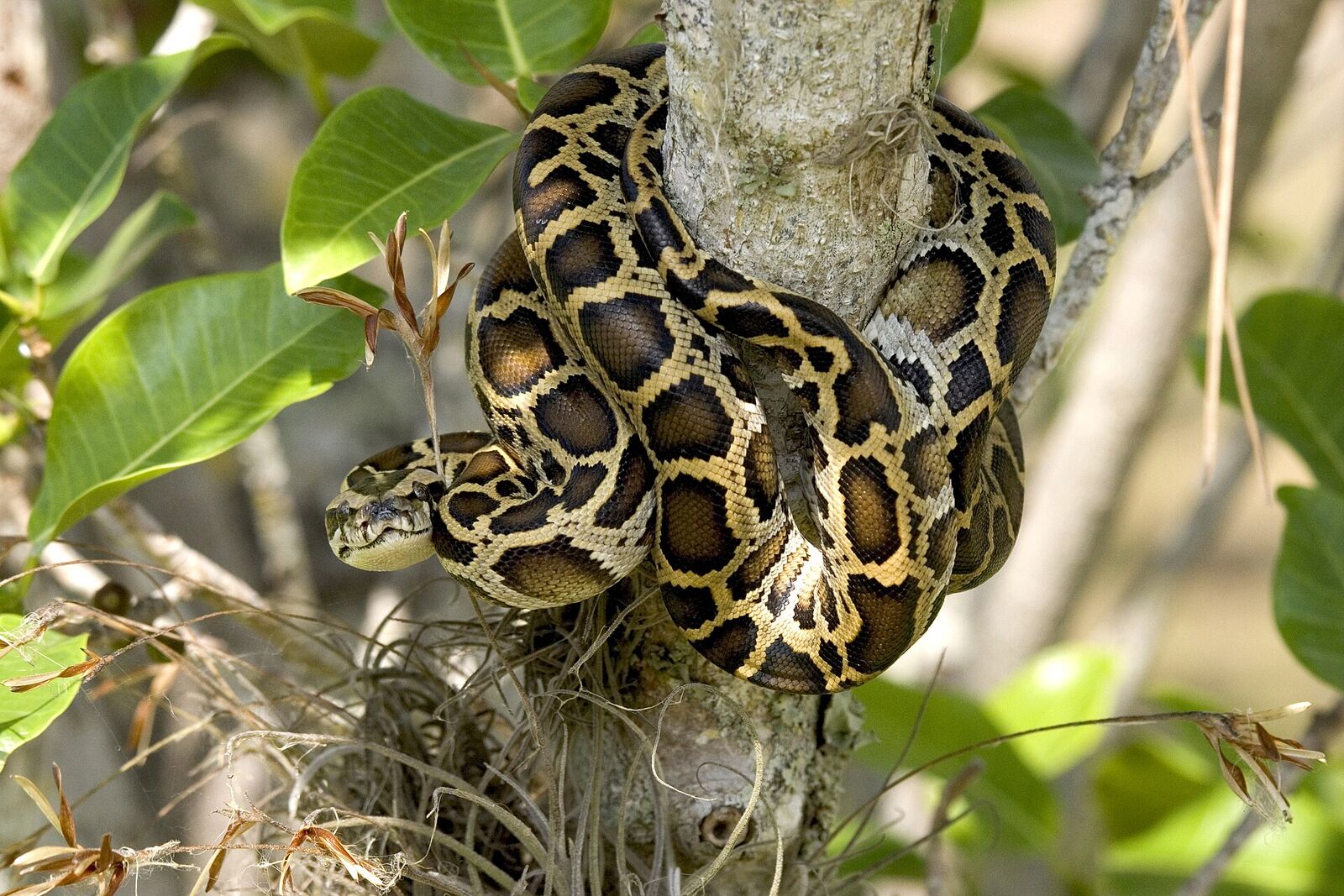 In-depth
Burmese python
Python bivittatus
A heavy-bodied giant with a famously calm reputation.
Pet trade
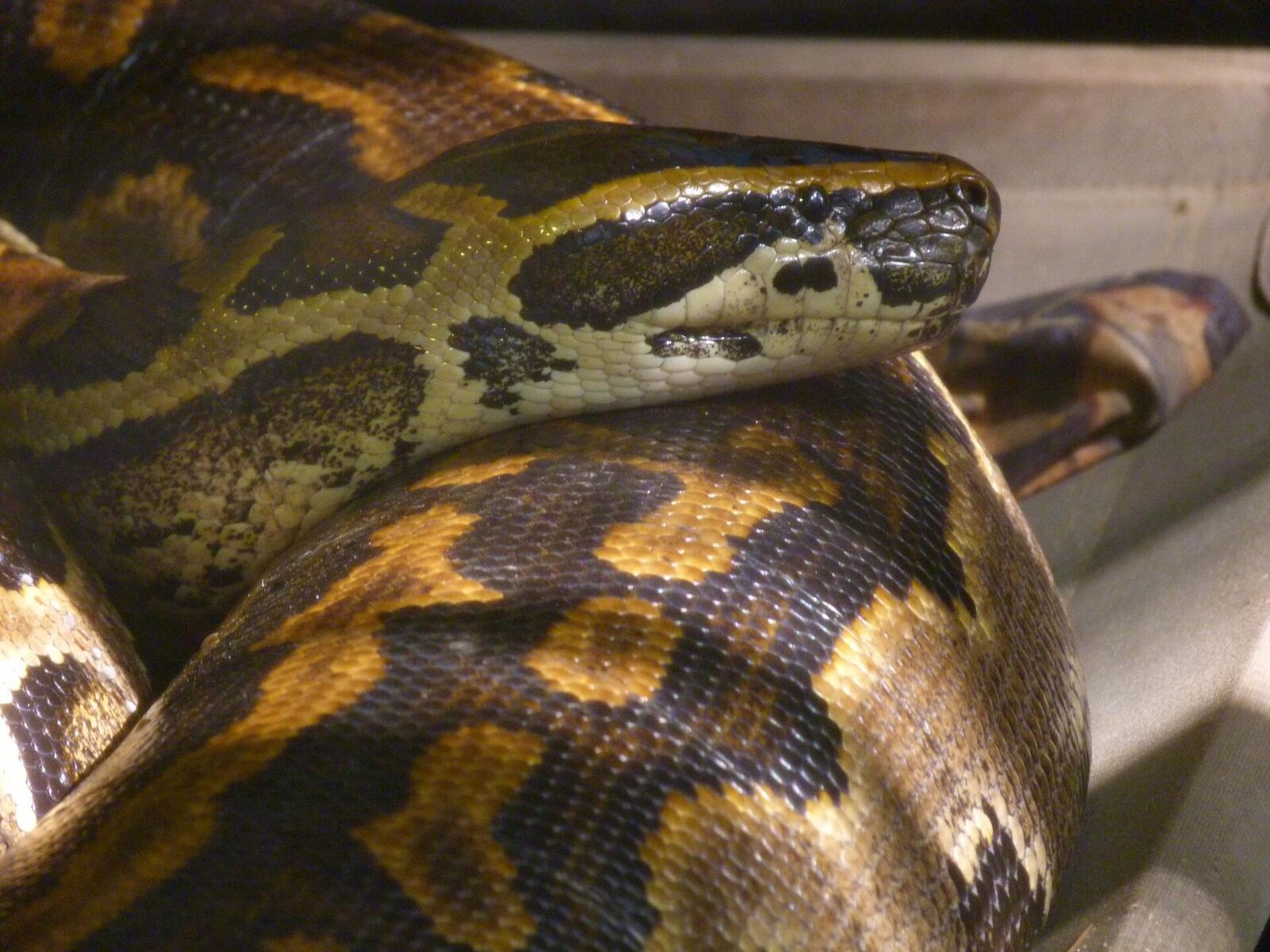 In-depth
Central African rock python
Python sebae
Africa's largest snake, powerful and spirited.
Pet trade
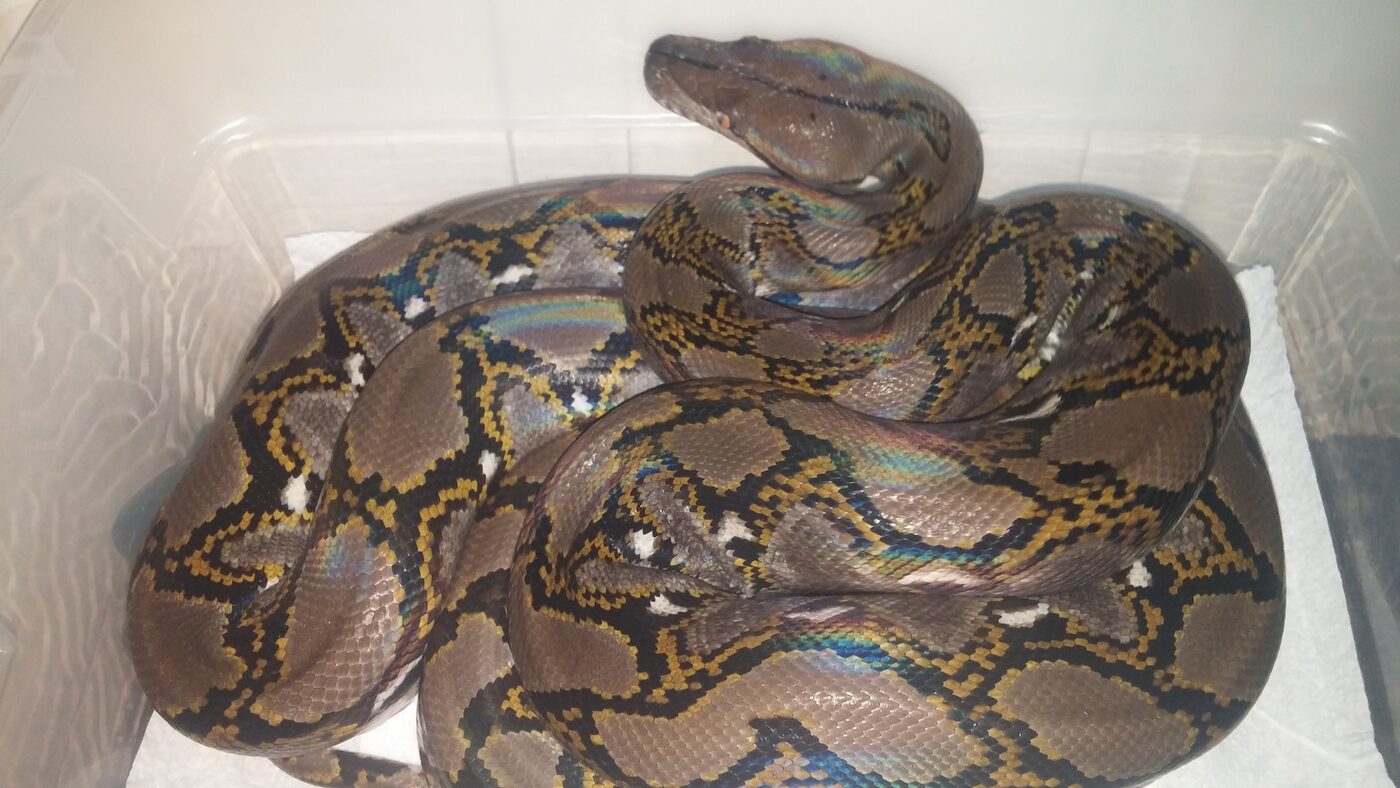 In-depth
Reticulated python
Malayopython reticulatus
The world's longest snake, and a brilliant, active giant.
Pet trade