
Home / Reptiles / Lizards / Diplodactylidae / Leachianus gecko
No federal permit to keepLeachianus gecko
Rhacodactylus leachianus
Reptiles › Lizards (Lacertilia) › Diplodactylidae (Crested and related geckos)
Rhacodactylus leachianus, commonly known as the New Caledonian giant gecko, Leach's giant gecko, leachianus gecko, or Leachie, is the largest living species of gecko and a member of the family Diplodactylidae.

Care at a glance
Species-specific values
Values researched for this exact species. Air, surface and water temperatures are listed separately, and each source is kept as published rather than averaged.
| Minimum enclosure | At least 18 by 18 by 24 inches tall for one adult; a 40-gallon enclosure is also given as an option. Source: reptilesmagazine.com | |
| Warm side air temperature | Daytime ambient temperatures should range from the upper 70s to the lower 80s Fahrenheit. Source: reptilesmagazine.com | |
| Night temperature | Nighttime temperatures can drop into the low 70s Fahrenheit. Source: reptilesmagazine.com | |
| Uvb lighting | UVB lights can be used to simulate day and nighttime rhythms, though lighting is not required. Source: reptilesmagazine.com | |
| Diet | Adults can eat commercial crested gecko diet; fruit puree, crickets, waxworms, Dubia roaches, and occasional pinky mice are also mentioned. Source: reptilesmagazine.com | |
| Feeding frequency | Offer the main diet two to three times a week; insects several times a week. Source: reptilesmagazine.com | |
| Social housing | House individually unless they are a breeding pair; separate immediately if aggression occurs. Source: reptilesmagazine.com | |
| Substrate | Use high-grade mulch or peat-based potting soil; hatchlings are recommended paper towel. Source: reptilesmagazine.com | |
| Humidity | 50–75 % Source: reptilesmagazine.com |
Understanding the animal
About this animal
About this animal
It is native to most of New Caledonia.
From Wikipedia: Rhacodactylus leachianus, CC BY-SA 4.0 (excerpt)
In the wild
In the wild
Researched for this exact species, not its family. Wild conditions are context, not enclosure settings.123
| Where it lives | Forests of New Caledonia's Grande Terre and neighboring islands, including the Isle of Pines area. It primarily uses large trees, canopy branches and tree hollows. |
| Ground it lives on | Arboreal; nesting females in an island study also used coastal dune soil. |
| Climate | An Île de Bayonnaise field study recorded body temperatures of about 64–90°F, with averages near 74–75°F; these are body temperatures, not enclosure air targets. Numerical wild humidity ranges were not established. |
| Active | Primarily nocturnal. |
| Social life | Males vocalize in territorial marking; one island field study found no strict territory borders and no female territorial behavior. |
| Wild diet | Fruit, insects, small animals and flowers. |
| Behavior to plan for | It shelters in tree hollows and moves through trees at night. Island fieldwork found occasional long movements and females leaving usual ranges to nest in coastal dunes. |
Native climate (measured)
Native climate (measured)
| Warm-season highs | about 83°F (up to 86°F in the hottest sampled areas) |
| Cool-season lows | about 60°F (down to 57°F in the coldest sampled areas) |
| Average temperature | 70–73°F across sampled records |
| Relative humidity | 77–79% on average (driest month about 72%) |
| Rainfall | about 1468 mm a year |
Measured at 30 wild occurrence records sampled against WorldClim 2.1 climate data (1970–2000 averages). Air conditions in the range are ecological context, not enclosure settings: microhabitats such as burrows, leaf litter or basking rocks can be cooler, warmer or more humid.
Data and studies
The numbers
The numbers
Each bar is what one source reports. Where several sources weigh in, the dashed gold band marks their average.
Maximum recorded lifespan
Longest recorded lifespan reported by each database; typical lifespans are usually shorter. The AnAge record comes from an animal in human care.
Incubation
Humidity
Species-specific values from keeper care sheets. Basking figures are often surface readings taken with an infrared thermometer, which run hotter than air.
Care articles for this species
Care articles for this species
- New Caledonian Giant Gecko Care Sheet (Reptiles Magazine)
- The Care And Breeding of Rhacodactylus leachianus (Reptiles Magazine)
- Breeding New Caledonian Giant Geckos (Reptiles Magazine)
Written by keepers, breeders and vets Reptiles MagazineReptiFiles
Sources for this sheet
- AnAge: The Animal Ageing and Longevity Database (Human Ageing Genomic Resources) (CC BY 3.0) Peer-reviewed researchCurated, referenced longevity and life-history records for thousands of species; maximum lifespans are often from zoo animals.
- Myhrvold et al. (2015). An amniote life-history database. Ecology 96: 3109 Peer-reviewed researchPeer-reviewed compilation of life-history data for over 21,000 birds, mammals and reptiles.
- Reptiles Magazine (care articles) Experienced keeper or breederEstablished reptile and amphibian hobby magazine; care articles are written by breeders, keepers and veterinarians.
- Clint's Reptiles (YouTube): Leachianus Gecko (Leachie), The Best Pet Lizard? Expert educator & keeperClint Laidlaw, PhD in Biology Education and MS in Evolutionary Ecology; owner of Clint's Reptile Room and a longtime keeper. His "Best Pet?" series reviews each species' care in depth.
- The Reptile Database Peer-reviewed researchScientist-curated catalog of every reptile species, with taxonomy and literature.
- GBIF Backbone Taxonomy (Global Biodiversity Information Facility) (CC BY 4.0) Peer-reviewed researchInternational scientific taxonomy used here for classification. GBIF Secretariat (2023). GBIF Backbone Taxonomy. Checklist dataset https://doi.org/10.15468/39omei, accessed via GBIF.org.
- Species+ (UNEP-WCMC and the CITES Secretariat) Zoo, university or veterinaryThe official database of species listed under CITES. UNEP (2026). The Species+ Website. Nairobi, Kenya. Compiled by UNEP-WCMC, Cambridge, UK. Available at: www.speciesplus.net. [Accessed 04/10/2026].
- Wikipedia (species article) (CC BY-SA 4.0) Community referenceFree encyclopedia; useful overviews with their own citations. Short excerpts are quoted under CC BY-SA 4.0, each credited with a link to its article.
- iNaturalist (captive observations) Community referenceCommunity observation platform run by the California Academy of Sciences and National Geographic; observations marked captive show animals living in homes, zoos and aquariums.
More crested and related geckos
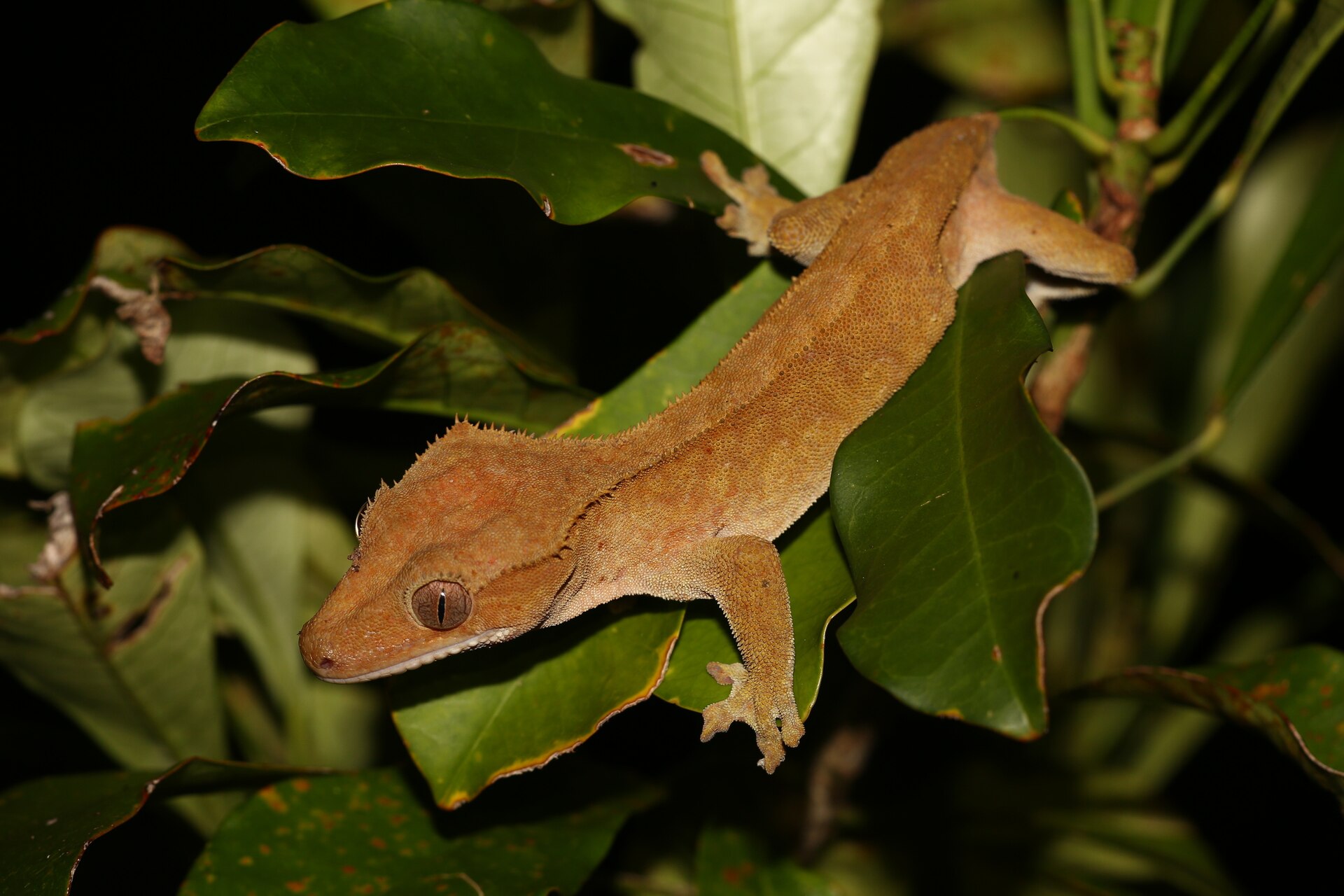
Crested gecko
Correlophus ciliatus
A sticky-toed fruit-lover that hates heat.
Pet trade

Bauer's chameleon gecko
Eurydactylodes agricolae
Pet trade

Chahoua gecko
Mniarogekko chahoua
Pet trade
Dotted Velvet Gecko
Oedura gemmata
Pet trade

Gargoyle gecko
Rhacodactylus auriculatus
Pet trade

Golden-tailed gecko
Strophurus taenicauda
Pet trade