
Home / Reptiles / Lizards / Chamaeleonidae / Meller's chameleon
Some federal rules applyMeller's chameleon
Trioceros melleri
Reptiles › Lizards (Lacertilia) › Chamaeleonidae (Chameleons)
Meller's chameleon (Trioceros melleri), also known commonly as the giant one-horned chameleon, is a species of lizard in the family Chamaeleonidae.
From Wikipedia: Meller's chameleon, CC BY-SA 4.0 (excerpt)

Care at a glance
Species-specific values
Values researched for this exact species. Air, surface and water temperatures are listed separately, and each source is kept as published rather than averaged.
| Minimum enclosure | Lowest allowable dimensions: 48 x 24 x 48 in (120 x 60 x 120 cm). Source: chameleons.info | |
| Basking surface temperature | 81–86 °F (27–30 °C) Source: chameleons.info | |
| Night temperature | 68–72 °F (20–22 °C) Source: chameleons.info | |
| Humidity | up to 50 % Source: chameleons.info | |
| Humidity | 100 % Source: chameleons.info | |
| Uvb lighting | Use T5 HO UVB for 8–12 hours daily, at 5–12% according to cage height. Source: chameleons.info | |
| Diet | Feed crickets, soldier flies, and roaches; no vegetables or fruits. Source: chameleons.info | |
| Feeding frequency | Juveniles may eat without limit; adults get at most one cricket daily. Source: chameleons.info | |
| Social housing | Do not cohouse. Source: chameleons.info | |
| Substrate | Use no substrate or a bioactive setup. Source: chameleons.info |
Understanding the animal
About this animal
About this animal
Meller's chameleon is the largest species of chameleon from the African mainland, i.e., the largest of the chameleons not native to Madagascar.
From Wikipedia: Meller's chameleon, CC BY-SA 4.0 (excerpt)
In the wild
In the wild
| Overview | Meller's chameleon (Trioceros melleri), also known commonly as the giant one-horned chameleon, is a species of lizard in the family Chamaeleonidae. Meller's chameleon is the largest species of chameleon from the African mainland, i.e., the largest of the chameleons not native to Madagascar. — From Wikipedia: Meller's chameleon, CC BY-SA 4.0 (excerpt) |
| Where it lives | Trioceros melleri is relatively common in the bushy savannas and woodlands of East Africa where it can be found in Malawi, northern Mozambique, and Tanzania. — From Wikipedia: Meller's chameleon, CC BY-SA 4.0 (excerpt) |
| Wild diet | Like most chameleons, Meller's chameleon is a strict carnivore, eating insects, smaller lizards, spiders, crickets, worms, and caterpillars. Large specimens have been known to eat small birds. Females annually produce a single clutch of up to 80 eggs. — From Wikipedia: Meller's chameleon, CC BY-SA 4.0 (excerpt) |
Read about this species in the wild at The Reptile Database.
Native climate (measured)
Native climate (measured)
| Warm-season highs | about 87°F (up to 89°F in the hottest sampled areas) |
| Cool-season lows | about 54°F (down to 51°F in the coldest sampled areas) |
| Average temperature | 68–77°F across sampled records |
| Relative humidity | 71–76% on average (driest month about 60%) |
| Rainfall | about 1111 mm a year, with strong wet and dry seasons |
Measured at 92 wild occurrence records sampled against WorldClim 2.1 climate data (1970–2000 averages). Air conditions in the range are ecological context, not enclosure settings: microhabitats such as burrows, leaf litter or basking rocks can be cooler, warmer or more humid.
Profile
Profile
Researched for this exact species. Sources are listed under In the wild above.
Data and studies
The numbers
The numbers
Each bar is what one source reports. Where several sources weigh in, the dashed gold band marks their average.
Typical adult weight
Average adult body mass in each database (FishBase gives the maximum recorded weight).
Adult snout-to-vent length
Body length without the tail.
Gestation
Veterinary & husbandry research
Veterinary & husbandry research
- FATAL RANAVIRUS INFECTION IN A GROUP OF ZOO-HOUSED MELLER'S CHAMELEONS (TRIOCEROS MELLERI) Peiffer LB et al., Journal of zoo and wildlife medicine: official publication of the American Association of Zoo Veterinarians 2019
- A new species of Choleoeimeria (Apicomplexa: Eimeriidae) from Meller's chameleon, Trioceros melleri (Sauria: Chamaeleonidae) McAllister CT et al., The Journal of parasitology 2012
- First identification of a patent pentastomid pulmonary (Raillietiella orientalis) infection in a captive Meller's chameleon (Trioceros melleri) in Germany Sapion-Miranda P et al., International journal for parasitology. Parasites and wildlife 2025
- Ganglioneuroma in a Meller's chameleon (Triocerosmelleri) Mitchell F et al., Journal of comparative pathology 2026
Peer-reviewed papers that mention this species alongside captivity, zoos, veterinary care or aquaculture. Some cover several species or mention it only in passing, so check the abstract. PubMed
Sources for this sheet
- Myhrvold et al. (2015). An amniote life-history database. Ecology 96: 3109 Peer-reviewed researchPeer-reviewed compilation of life-history data for over 21,000 birds, mammals and reptiles.
- Species+ (UNEP-WCMC and the CITES Secretariat) Zoo, university or veterinaryThe official database of species listed under CITES. UNEP (2026). The Species+ Website. Nairobi, Kenya. Compiled by UNEP-WCMC, Cambridge, UK. Available at: www.speciesplus.net. [Accessed 04/10/2026].
- USFWS International Affairs: CITES Zoo, university or veterinaryFederal agency that issues CITES permits.
- The Reptile Database Peer-reviewed researchScientist-curated catalog of every reptile species, with taxonomy and literature.
- GBIF Backbone Taxonomy (Global Biodiversity Information Facility) (CC BY 4.0) Peer-reviewed researchInternational scientific taxonomy used here for classification. GBIF Secretariat (2023). GBIF Backbone Taxonomy. Checklist dataset https://doi.org/10.15468/39omei, accessed via GBIF.org.
- Wikipedia (species article) (CC BY-SA 4.0) Community referenceFree encyclopedia; useful overviews with their own citations. Short excerpts are quoted under CC BY-SA 4.0, each credited with a link to its article.
- PubMed (U.S. National Library of Medicine) Peer-reviewed researchIndex of peer-reviewed veterinary, zoo and husbandry research.
- iNaturalist (captive observations) Community referenceCommunity observation platform run by the California Academy of Sciences and National Geographic; observations marked captive show animals living in homes, zoos and aquariums.
More chameleons
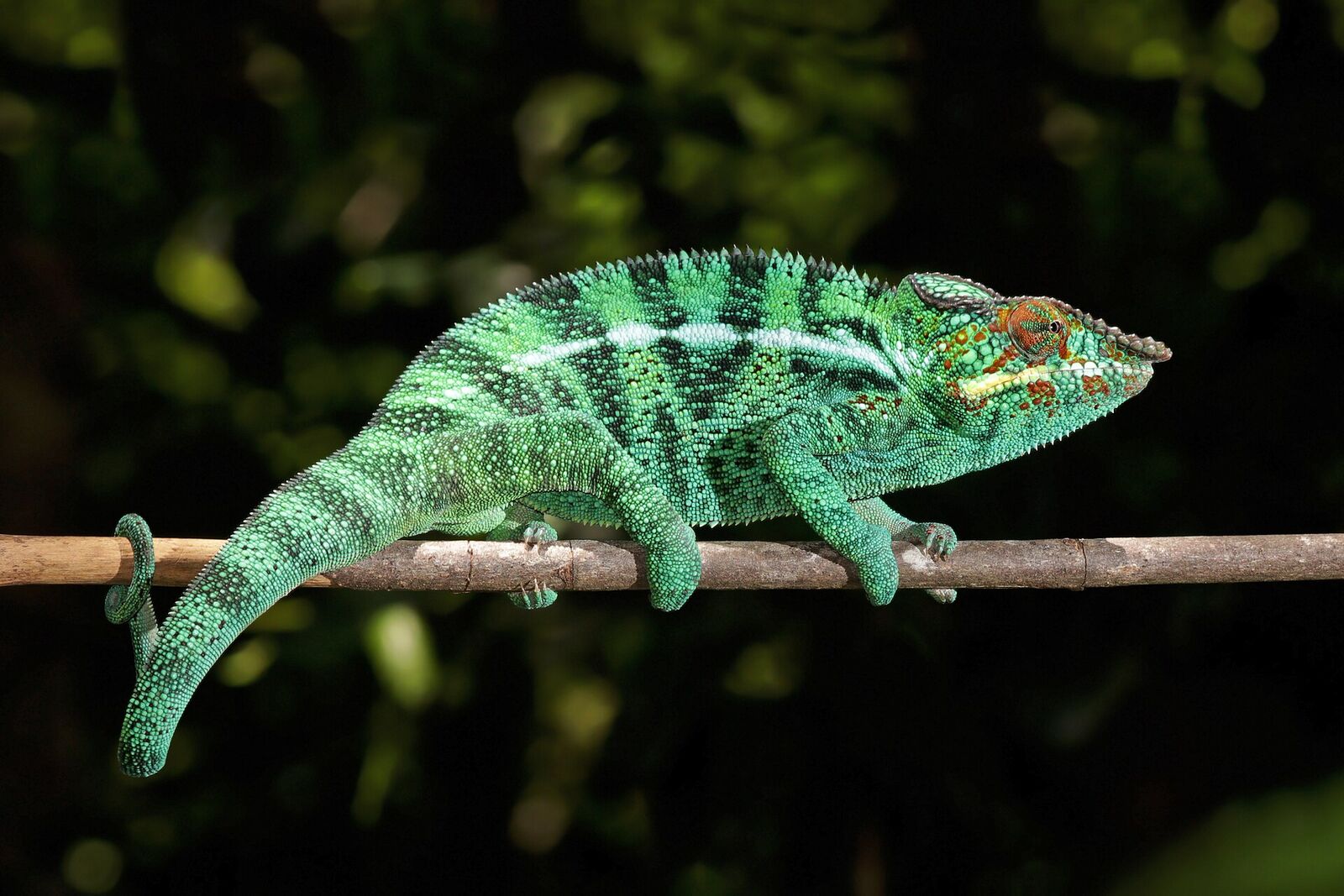
Panther chameleon
Furcifer pardalis
The most colorful chameleon of all.
Pet trade
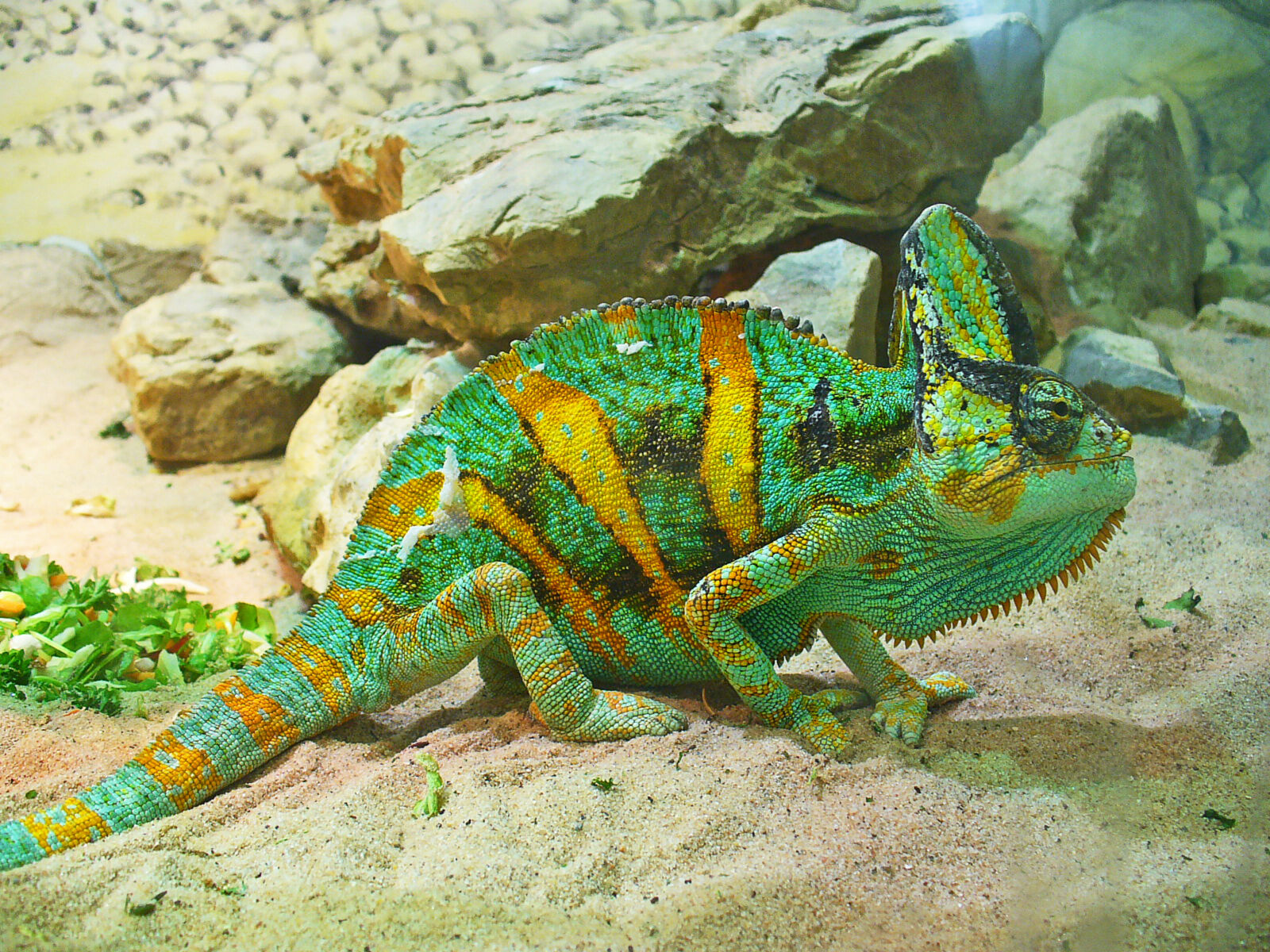
Veiled chameleon
Chamaeleo calyptratus
Color-shifting, independent, look-don't-touch.
Pet trade

Bearded pygmy chameleon
Rieppeleon brevicaudatus
Pet trade

Cape dwarf chameleon
Bradypodion pumilum
Pet trade

Carpet chameleon
Furcifer lateralis
Pet trade

Common chameleon
Chamaeleo chamaeleon
Zoos & aquariums