
Home / Birds / Parrots / Moluccan king parrot
Some federal rules applyMoluccan king parrot
Alisterus amboinensis
Birds › Parrots (Psittaciformes) › Psittaculidae (Old World parrots, lorikeets and lovebirds)
The Moluccan king parrot (Alisterus amboinensis) is a parrot endemic to Peleng Island, Maluku, and West Papua in Indonesia.
From Wikipedia: Moluccan king parrot, CC BY-SA 4.0 (excerpt)

Care at a glance
Species-specific values
Values researched for this exact species. Air, surface and water temperatures are listed separately, and each source is kept as published rather than averaged.
| Diet | Offer plenty of fruits and vegetables, quality supplementary food, sprouted seeds, and some dry seeds. Source: wwbirds.co.za | |
| Social housing | Pair birds at a young age before sexual maturity so they mature together and become compatible. Source: wwbirds.co.za | |
| Minimum enclosure | One successful breeder had an aviary 5 m long x 1.2 m x 2 m high; the article does not call this a minimum. Source: wwbirds.co.za | |
| Substrate | Provide a selection of nests at about 750 mm, 1.2 m, and 1.8–2.0 m deep, with the deepest type based just off the floor. Source: wwbirds.co.za |
Understanding the animal
About this animal
About this animal
It is sometimes referred to as the Ambon king parrot or Amboina king parrot, but this is potentially misleading, as it is found on numerous other islands than Ambon. The male and female are similar in appearance, with a predominantly red head and underparts, green wings (blue in one subspecies), and blue back and tail.
From Wikipedia: Moluccan king parrot, CC BY-SA 4.0 (excerpt)
In the wild
In the wild
| Overview | The Moluccan king parrot (Alisterus amboinensis) is a parrot endemic to Peleng Island, Maluku, and West Papua in Indonesia. It is sometimes referred to as the Ambon king parrot or Amboina king parrot, but this is potentially misleading, as it is found on numerous other islands than Ambon. The male and female are similar in appearance, with a predominantly red head and underparts, green wings (blue in one subspecies), and blue back and tail. Six subspecies are recognised, but only a few of these are regular in aviculture. — From Wikipedia: Moluccan king parrot, CC BY-SA 4.0 (excerpt) |
| Where it lives | The Moluccan king parrot inhabits rainforests, but sometimes enters nearby plantations and gardens. Exceptionally, it occurs at altitude up to 2100 m, but more commonly below 1200 m (New Guinea) or 1600 m (Maluku). It is generally uncommon due to habitat loss and capture for the parrot trade, but remains locally common at least on the Sula Islands, Halmahera, and Buru. — From Wikipedia: Moluccan king parrot, CC BY-SA 4.0 (excerpt) |
| Behavior | Encountered alone or in pairs, occasionally in small groups, it mainly frequents dense cover in the lower and mid-levels of forests. It is inconspicuous and rather quiet, except in flight. It consumes fruit, berries, seeds and buds. — From Wikipedia: Moluccan king parrot, CC BY-SA 4.0 (excerpt) |
| Appearance and size | An adult Moluccan king parrot measures 35–40 cm (14 in) in length and has a red head and chest, outer wings dull green (except in subspecies A. a. hypophonius, which are blue), mantle, lesser wing coverts and tail-coverts dark purple-blue. Tail darker blackish blue, irises orange, and the legs are dark grey. — From Wikipedia: Moluccan king parrot, CC BY-SA 4.0 (excerpt) |
| History and naming | In 1760 the French zoologist Mathurin Jacques Brisson included a description of the Moluccan king parrot in his Ornithologie based on a specimen collected on the island of Ambon in Indonesia. He used the French name La perruche rouge d'Amboine and the Latin name Psittaca amboinensis coccinea. — From Wikipedia: Moluccan king parrot, CC BY-SA 4.0 (excerpt) |
Native climate (measured)
Native climate (measured)
| Warm-season highs | about 86°F (up to 89°F in the hottest sampled areas) |
| Cool-season lows | about 70°F (down to 62°F in the coldest sampled areas) |
| Average temperature | 71–81°F across sampled records |
| Relative humidity | 83–88% on average (driest month about 83%) |
| Rainfall | about 2800 mm a year, spread fairly evenly |
Measured at 38 wild occurrence records sampled against WorldClim 2.1 climate data (1970–2000 averages). Air conditions in the range are ecological context, not enclosure settings: microhabitats such as burrows, leaf litter or basking rocks can be cooler, warmer or more humid.
Profile
Profile
Researched for this exact species. Sources are listed under In the wild above.
History
In 1760 the French zoologist Mathurin Jacques Brisson included a description of the Moluccan king parrot in his Ornithologie based on a specimen collected on the island of Ambon in Indonesia. He used the French name La perruche rouge d'Amboine and the Latin name Psittaca amboinensis coccinea.
From Wikipedia: Moluccan king parrot, CC BY-SA 4.0 (excerpt)
Data and studies
The numbers
The numbers
Each bar is what one source reports. Where several sources weigh in, the dashed gold band marks their average.
Typical adult weight
Average adult body mass in each database (FishBase gives the maximum recorded weight).
Sources for this sheet
- Myhrvold et al. (2015). An amniote life-history database. Ecology 96: 3109 Peer-reviewed researchPeer-reviewed compilation of life-history data for over 21,000 birds, mammals and reptiles.
- Species+ (UNEP-WCMC and the CITES Secretariat) Zoo, university or veterinaryThe official database of species listed under CITES. UNEP (2026). The Species+ Website. Nairobi, Kenya. Compiled by UNEP-WCMC, Cambridge, UK. Available at: www.speciesplus.net. [Accessed 04/10/2026].
- USFWS International Affairs: CITES Zoo, university or veterinaryFederal agency that issues CITES permits.
- 9 CFR 2.1: Animal Welfare Act licensing (USDA) Zoo, university or veterinaryWho needs a USDA license to breed, sell or exhibit animals.
- GBIF Backbone Taxonomy (Global Biodiversity Information Facility) (CC BY 4.0) Peer-reviewed researchInternational scientific taxonomy used here for classification. GBIF Secretariat (2023). GBIF Backbone Taxonomy. Checklist dataset https://doi.org/10.15468/39omei, accessed via GBIF.org.
- Wikipedia (species article) (CC BY-SA 4.0) Community referenceFree encyclopedia; useful overviews with their own citations. Short excerpts are quoted under CC BY-SA 4.0, each credited with a link to its article.
- The eBird/Clements Checklist of Birds of the World (Cornell Lab of Ornithology) Peer-reviewed researchThe standard global bird checklist maintained by the Cornell Lab of Ornithology; used here for complete species lists of widely kept bird families.
- iNaturalist (captive observations) Community referenceCommunity observation platform run by the California Academy of Sciences and National Geographic; observations marked captive show animals living in homes, zoos and aquariums.
More old world parrots, lorikeets and lovebirds
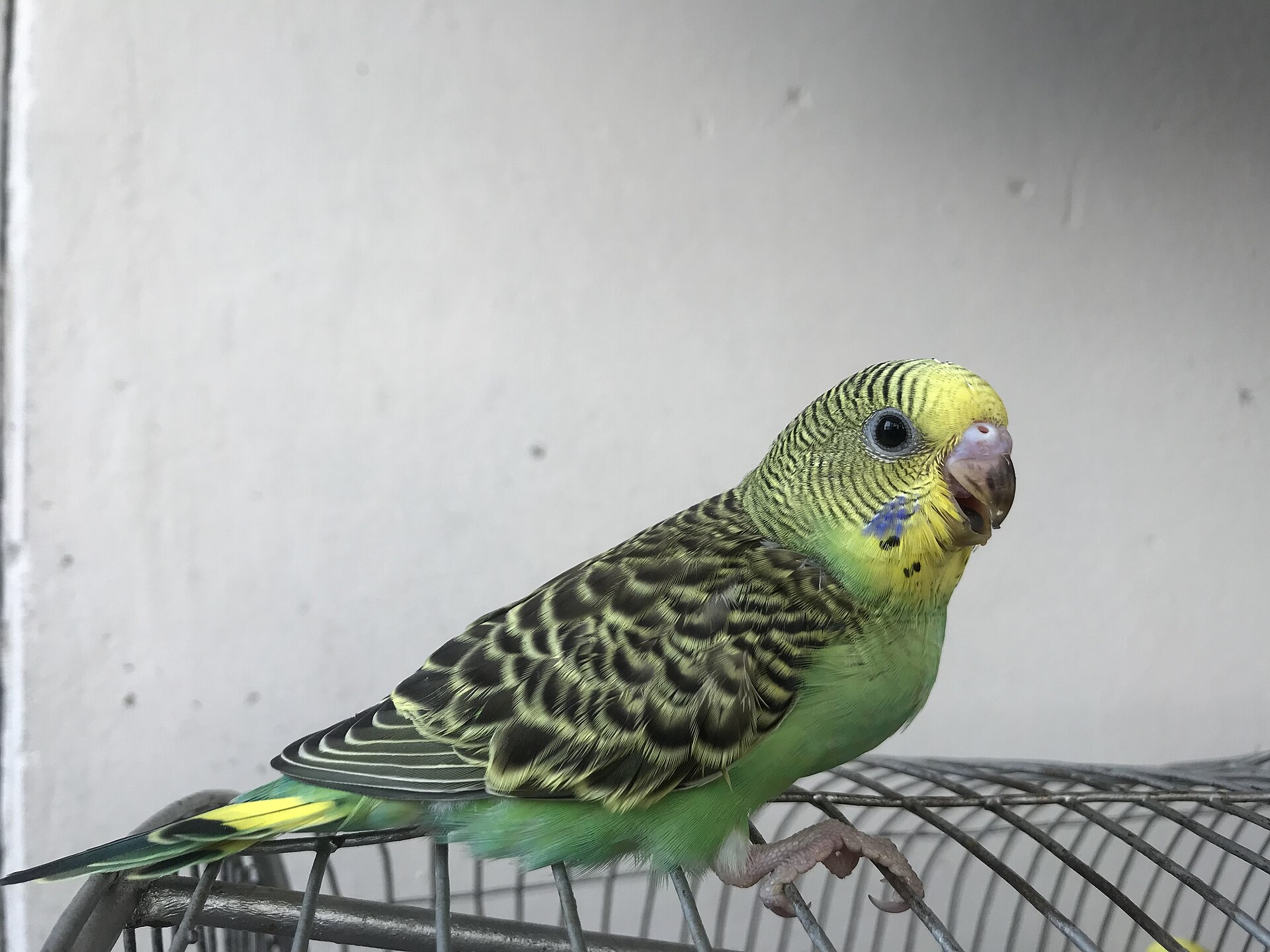
Budgerigar
Melopsittacus undulatus
A small parrot with a big vocabulary.
Pet trade

Alexandrine parakeet
Psittacula eupatria
Pet trade

Black-capped lory
Lorius lory
Pet trade

Black-cheeked lovebird
Agapornis nigrigenis
Pet trade

Blue lorikeet
Vini peruviana
Zoos & aquariums

Blue-crowned hanging parrot
Loriculus galgulus
Zoos & aquariums