
Home / Amphibians / Frogs and toads / Red-spotted toad
No federal permit to keepRed-spotted toad
Anaxyrus punctatus
Amphibians › Frogs and toads (Anura) › Bufonidae (Toads)
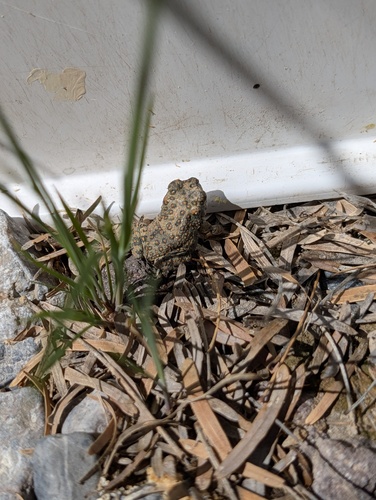
The red-spotted toad (Anaxyrus punctatus), formerly Bufo punctatus, is a toad in the family Bufonidae found in the southwestern United States and northwestern Mexico.
From Wikipedia: Red-spotted toad, CC BY-SA 4.0 (excerpt)
Care at a glance
Species-specific values
Values researched for this exact species. Air, surface and water temperatures are listed separately, and each source is kept as published rather than averaged.
| Minimum enclosure | A single adult needs an 18 × 18 × 18 inch enclosure. Source: tailsandscales.ca | |
| Warm side air temperature | 75–84 °F Source: tailsandscales.ca | |
| Basking surface temperature | 86–90 °F Source: tailsandscales.ca | |
| Night temperature | 65–72 °F Source: tailsandscales.ca | |
| Humidity | 40–60 % Source: tailsandscales.ca | |
| Uvb lighting | Install a light cycle for day/night plus diffused illumination and low-level UVB (2 to 5%). Source: tailsandscales.ca | |
| Diet | Feed invertebrates of proper size plus multivitamins and calcium. Source: tailsandscales.ca | |
| Feeding frequency | Juveniles feed more frequently than adults, which thrive on a moderate schedule. Source: tailsandscales.ca | |
| Social housing | For multiple individuals, upgrade to a 24 × 18 × 18 inch enclosure. Source: tailsandscales.ca | |
| Substrate | Use deep, slightly moist soil or a soil–sand mix with abundant leaf litter. Source: tailsandscales.ca |
Warnings
Understanding the animal
In the wild
In the wild
| Overview | The red-spotted toad (Anaxyrus punctatus), formerly Bufo punctatus, is a toad in the family Bufonidae found in the southwestern United States and northwestern Mexico. — From Wikipedia: Red-spotted toad, CC BY-SA 4.0 (excerpt) |
| Where it lives | This toad is native to the southwestern United States and northwestern Mexico, especially Baja California. It occurs primarily along rocky streams and riverbeds, often in arid or semi-arid regions. It is very localized on the coastal slope, but widespread in the deserts. — From Wikipedia: Red-spotted toad, CC BY-SA 4.0 (excerpt) |
| Appearance and size | It is a small toad species growing to 3.7 to 7.5 cm in length. It has a flattened head and body, and a light grey, olive or reddish brown dorsum with reddish or orange skin glands. It has a whitish or buff venter with or without faint dark spotting, and round parotoid glands. — From Wikipedia: Red-spotted toad, CC BY-SA 4.0 (excerpt) |
Native climate (measured)
Native climate (measured)
| Warm-season highs | about 99°F (up to 105°F in the hottest sampled areas) |
| Cool-season lows | about 38°F (down to 32°F in the coldest sampled areas) |
| Average temperature | 62–73°F across sampled records |
| Relative humidity | 33–40% on average (driest month about 23%) |
| Rainfall | about 328 mm a year |
| Winters | Cool to cold winters (lows around 38°F) in much of its native range. Seasonal slowdown may be relevant, but species-specific biology determines whether brumation or hibernation occurs. |
Measured at 72 wild occurrence records sampled against WorldClim 2.1 climate data (1970–2000 averages). Air conditions in the range are ecological context, not enclosure settings: microhabitats such as burrows, leaf litter or basking rocks can be cooler, warmer or more humid.
Data and studies
The numbers
The numbers
Each bar is what one source reports. Where several sources weigh in, the dashed gold band marks their average.
Maximum recorded lifespan
Longest recorded lifespan reported by each database; typical lifespans are usually shorter. The AnAge record comes from an animal in human care.
Female maturity
Sources for this sheet
- AnAge: The Animal Ageing and Longevity Database (Human Ageing Genomic Resources) (CC BY 3.0) Peer-reviewed researchCurated, referenced longevity and life-history records for thousands of species; maximum lifespans are often from zoo animals.
- AmphibiaWeb (University of California, Berkeley) (CC BY-NC) Peer-reviewed researchUniversity-hosted database of amphibian biology and conservation.
- Wikipedia (species article) (CC BY-SA 4.0) Community referenceFree encyclopedia; useful overviews with their own citations. Short excerpts are quoted under CC BY-SA 4.0, each credited with a link to its article.
- iNaturalist (captive observations) Community referenceCommunity observation platform run by the California Academy of Sciences and National Geographic; observations marked captive show animals living in homes, zoos and aquariums.
More toads
American toad
Anaxyrus americanus
Pet trade

Asian common toad
Duttaphrynus melanostictus
Pet trade
Cane toad
Rhinella marina
Pet trade

Colorado river toad
Incilius alvarius
Pet trade

Common European toad
Bufo bufo
Pet trade

Cuban toad
Peltophryne peltocephala
Zoos & aquariums