
Home / Birds / Parrots / Scaly-breasted lorikeet
Some federal rules applyScaly-breasted lorikeet
Trichoglossus chlorolepidotus
Birds › Parrots (Psittaciformes) › Psittaculidae (Old World parrots, lorikeets and lovebirds)
The scaly-breasted lorikeet (Trichoglossus chlorolepidotus) is an Australian lorikeet found in woodland in eastern Australia.
From Wikipedia: Scaly-breasted lorikeet, CC BY-SA 4.0 (excerpt)

Care at a glance
Species-specific values
Values researched for this exact species. Air, surface and water temperatures are listed separately, and each source is kept as published rather than averaged.
| Social housing | Keep only a single pair in an aviary. Source: aviculturehub.com.au | |
| Substrate | Traditional aviaries need replaceable or pressure-cleanable sand or gravel; keep substrate dry and ensure good drainage. Source: aviculturehub.com.au | |
| Diet | Offer commercial lorikeet mix and varied fruit and vegetables; do not allow seed. Source: aviculturehub.com.au | |
| Feeding frequency | Keep dry food and fresh water available at all times; replace wet food several times daily, especially in hot weather. Source: aviculturehub.com.au |
Understanding the animal
About this animal
About this animal
The common name aptly describes this bird, which has yellow breast feathers broadly edged with green that look like scales.
From Wikipedia: Scaly-breasted lorikeet, CC BY-SA 4.0 (excerpt)
In the wild
In the wild
| Overview | The scaly-breasted lorikeet (Trichoglossus chlorolepidotus) is an Australian lorikeet found in woodland in eastern Australia. The common name aptly describes this bird, which has yellow breast feathers broadly edged with green that look like scales. — From Wikipedia: Scaly-breasted lorikeet, CC BY-SA 4.0 (excerpt) |
| Where it lives | This lorikeet is common in most timbered areas of Eastern Australia from Bamaga, the tip of North Queensland, south to Illawarra district on the New South Wales south coast; also on some offshore islands. They are generally confined to coastal plains and adjacent tablelands; occasionally found along watercourses west of the Great Dividing Range. — From Wikipedia: Scaly-breasted lorikeet, CC BY-SA 4.0 (excerpt) |
| Wild diet | Scaly-breasted lorikeets have similar habits to the related rainbow lorikeet, and the two species often group together in mixed flocks. Both species feed mainly on nectar, such as that from the broad-leaved paperbark (Melaleuca quinquenervia), and pollen, but they also eat blossoms, berries, other fruit, and insects and their larvae. — From Wikipedia: Scaly-breasted lorikeet, CC BY-SA 4.0 (excerpt) |
| Behavior | The lorikeet's predominantly green plumage blends so well with foliage that the bird is hard to detect. An observer beneath a tree where scaly-breasted lorikeets are feeding may take some time to spot the birds. Their dark coral beak is often the first indications to their whereabouts. — From Wikipedia: Scaly-breasted lorikeet, CC BY-SA 4.0 (excerpt) |
| Reproduction | Breeding occurs in all months except March and April though usually August–January in the southern part of its range. These birds nest in hollow trees, usually high above the ground, with a layer of wood dust serving as a mattress at the bottom. They usually lay two eggs, rarely three; they are white, oval, and about 26 X 20 mm. — From Wikipedia: Scaly-breasted lorikeet, CC BY-SA 4.0 (excerpt) |
| Appearance and size | The scaly-breasted lorikeet is about 23 cm long. The crown and sides of head are emerald-green slightly tinged with blue, while the feathers of the back of the neck and throat and breast are yellow, broadly edged with green, giving scaly appearance. The tail is green with the base of the outer tail-feathers marked with orange-red. — From Wikipedia: Scaly-breasted lorikeet, CC BY-SA 4.0 (excerpt) |
| History and naming | The scaly-breasted lorikeet was first described by German zoologist Heinrich Kuhl in 1820. Other names this bird is known by include the gold and green lorikeet, greenie, green lorikeet, green and yellow lorikeet, green keet, green parrot, green leek, and green leaf. It is often colloquially referred to as a "scaly". — From Wikipedia: Scaly-breasted lorikeet, CC BY-SA 4.0 (excerpt) |
Native climate (measured)
Native climate (measured)
| Warm-season highs | about 89°F (up to 94°F in the hottest sampled areas) |
| Cool-season lows | about 44°F (down to 37°F in the coldest sampled areas) |
| Average temperature | 58–77°F across sampled records |
| Relative humidity | 57–70% on average (driest month about 57%) |
| Rainfall | about 809 mm a year |
Measured at 605 wild occurrence records sampled against WorldClim 2.1 climate data (1970–2000 averages). Air conditions in the range are ecological context, not enclosure settings: microhabitats such as burrows, leaf litter or basking rocks can be cooler, warmer or more humid.
Profile
Profile
Researched for this exact species. Sources are listed under In the wild above.
History
The scaly-breasted lorikeet was first described by German zoologist Heinrich Kuhl in 1820. Other names this bird is known by include the gold and green lorikeet, greenie, green lorikeet, green and yellow lorikeet, green keet, green parrot, green leek, and green leaf. It is often colloquially referred to as a "scaly".
From Wikipedia: Scaly-breasted lorikeet, CC BY-SA 4.0 (excerpt)
Data and studies
Researched care notes
Researched care notes
Findings checked against veterinary, zoo, welfare, keeper and peer-reviewed sources. Air, basking-surface and water temperatures are kept separate, and where sources disagree both are shown. “Study” notes report what a paper measured, not a universal rule.
Lories And Lorikeets (feeding group)
Researched for this genus; applies to its species unless a species note says otherwise.
- Use a suitable high-quality formulated nectar food as the staple with appropriate fresh foods.1
- Seeds are a minor occasional component for most discussed species, not the principal ration.1
- Provide fresh liquid nectar daily and position food and toys to avoid droppings contamination.1
- Provide activity space and sturdy, varied chewing and foraging toys.1
The numbers
The numbers
Each bar is what one source reports. Where several sources weigh in, the dashed gold band marks their average.
Maximum recorded lifespan
Longest recorded lifespan reported by each database; typical lifespans are usually shorter.
Typical adult weight
Average adult body mass in each database (FishBase gives the maximum recorded weight).
Sources for this sheet
- AnAge: The Animal Ageing and Longevity Database (Human Ageing Genomic Resources) (CC BY 3.0) Peer-reviewed researchCurated, referenced longevity and life-history records for thousands of species; maximum lifespans are often from zoo animals.
- Myhrvold et al. (2015). An amniote life-history database. Ecology 96: 3109 Peer-reviewed researchPeer-reviewed compilation of life-history data for over 21,000 birds, mammals and reptiles.
- Species+ (UNEP-WCMC and the CITES Secretariat) Zoo, university or veterinaryThe official database of species listed under CITES. UNEP (2026). The Species+ Website. Nairobi, Kenya. Compiled by UNEP-WCMC, Cambridge, UK. Available at: www.speciesplus.net. [Accessed 04/10/2026].
- USFWS International Affairs: CITES Zoo, university or veterinaryFederal agency that issues CITES permits.
- 9 CFR 2.1: Animal Welfare Act licensing (USDA) Zoo, university or veterinaryWho needs a USDA license to breed, sell or exhibit animals.
- GBIF Backbone Taxonomy (Global Biodiversity Information Facility) (CC BY 4.0) Peer-reviewed researchInternational scientific taxonomy used here for classification. GBIF Secretariat (2023). GBIF Backbone Taxonomy. Checklist dataset https://doi.org/10.15468/39omei, accessed via GBIF.org.
- Wikipedia (species article) (CC BY-SA 4.0) Community referenceFree encyclopedia; useful overviews with their own citations. Short excerpts are quoted under CC BY-SA 4.0, each credited with a link to its article.
- The eBird/Clements Checklist of Birds of the World (Cornell Lab of Ornithology) Peer-reviewed researchThe standard global bird checklist maintained by the Cornell Lab of Ornithology; used here for complete species lists of widely kept bird families.
- iNaturalist (captive observations) Community referenceCommunity observation platform run by the California Academy of Sciences and National Geographic; observations marked captive show animals living in homes, zoos and aquariums.
More old world parrots, lorikeets and lovebirds
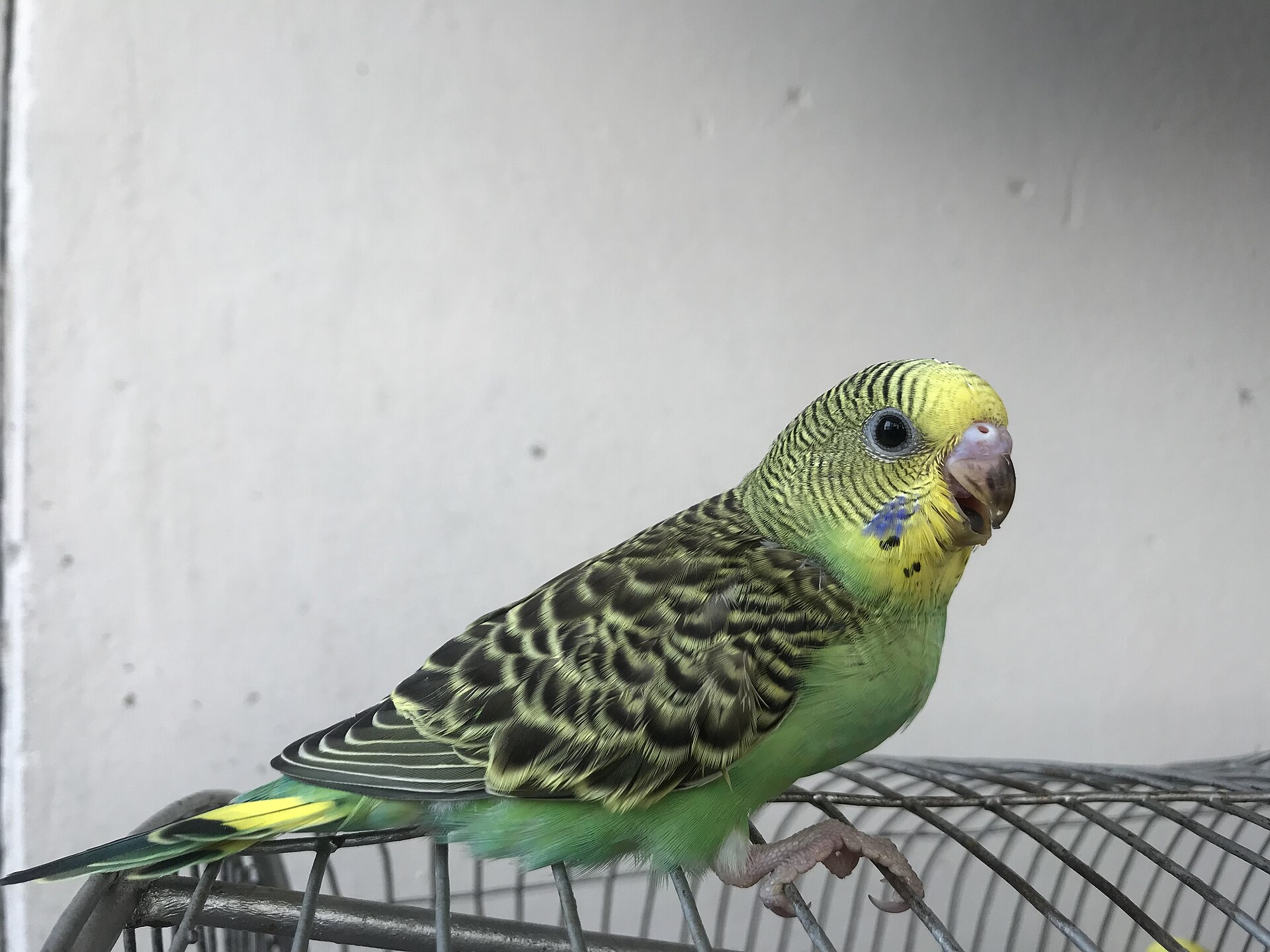
Budgerigar
Melopsittacus undulatus
A small parrot with a big vocabulary.
Pet trade

Alexandrine parakeet
Psittacula eupatria
Pet trade

Black-capped lory
Lorius lory
Pet trade

Black-cheeked lovebird
Agapornis nigrigenis
Pet trade

Blue lorikeet
Vini peruviana
Zoos & aquariums

Blue-crowned hanging parrot
Loriculus galgulus
Zoos & aquariums