
Home / Amphibians / Frogs and toads / Smooth-sided toad
No federal permit to keepSmooth-sided toad
Rhaebo guttatus
Amphibians › Frogs and toads (Anura) › Bufonidae (Toads)
The smooth-sided toad (Rhaebo guttatus), also known commonly as the spotted toad, is a species of amphibian in the family Bufonidae.
From Wikipedia: Smooth-sided toad, CC BY-SA 4.0 (excerpt)

Care at a glance
Species-specific values
Values researched for this exact species. Air, surface and water temperatures are listed separately, and each source is kept as published rather than averaged.
| Minimum enclosure | Adult housing: a front-opening 36x18x18 minimum or 40 breeder for multiple animals, while one toad fits a 24x18x18 or 20 long tank. Source: joshsfrogs.com | |
| Basking surface temperature | A basking spot in the 80s is advisable. Source: joshsfrogs.com | |
| Warm side air temperature | 75–85 °F Source: joshsfrogs.com | |
| Humidity | 50–70 % Source: joshsfrogs.com | |
| Social housing | Outside breeding, they are fairly docile toward each other and can be kept in groups. Source: joshsfrogs.com | |
| Substrate | They can be kept on coco fiber or biobedding. Source: joshsfrogs.com | |
| Diet | Tadpoles consume fish foods, including Tree Frog Tadpole Food and Meat Pie. Source: joshsfrogs.com | |
| Minimum enclosure | Vivarium around a metre long with a minimum height around 45 cm. Source: coasttocoast.co.uk | |
| Uvb lighting | If lighting is used, the article recommends a lower output T5 UVB tube, such as Arcadia ShadeDweller. Source: coasttocoast.co.uk | |
| Diet | Feed a mix of commercially available live insects, including crickets, locusts, earthworms, cockroaches, waxworms, and Pachnoda grubs. Source: coasttocoast.co.uk | |
| Feeding frequency | Feed every other day. Source: coasttocoast.co.uk | |
| Substrate | Use a substrate such as Forest Floor and coir, perhaps mixed. Source: coasttocoast.co.uk |
Understanding the animal
About this animal
About this animal
It is native to the Amazon basin of South America.
From Wikipedia: Smooth-sided toad, CC BY-SA 4.0 (excerpt)
In the wild
In the wild
| Overview | The smooth-sided toad (Rhaebo guttatus), also known commonly as the spotted toad, is a species of amphibian in the family Bufonidae. It is native to the Amazon basin of South America. — From Wikipedia: Smooth-sided toad, CC BY-SA 4.0 (excerpt) |
| Where it lives | The species is found in the Amazon basin of South America, in Bolivia, Brazil Colombia, Ecuador, French Guiana, Guyana, Peru, Suriname and Venezuela. Its natural habitats are tropical moist lowland forests, in particular mature gallery forests. It occurs on the ground or in deep leaf-litter on the forest floor, at elevations of 50–860 m. — From Wikipedia: Smooth-sided toad, CC BY-SA 4.0 (excerpt) |
| Appearance and size | Males growth to about 15 cm snout–vent length. Females are larger, at up to 17.4 cm, possibly even 10 in, in snout–vent length. The dorsal color is cream colored or very light brown to reddish brown. — From Wikipedia: Smooth-sided toad, CC BY-SA 4.0 (excerpt) |
| History and naming | The first description of the species was published in 1799 by Johann Gottlob Schneider, who placed it in the genus Bufo. Edward Drinker Cope moved the species to the genus Rhaebo in 1865. The species taxonomic status is unclear, as it is likely that Rhaebo guttatus as currently defined actually encompasses several distinct species of toad. — From Wikipedia: Smooth-sided toad, CC BY-SA 4.0 (excerpt) |
Native climate (measured)
Native climate (measured)
| Warm-season highs | about 89°F (up to 95°F in the hottest sampled areas) |
| Cool-season lows | about 69°F (down to 64°F in the coldest sampled areas) |
| Average temperature | 77–80°F across sampled records |
| Relative humidity | 79–85% on average (driest month about 77%) |
| Rainfall | about 2700 mm a year |
Measured at 124 wild occurrence records sampled against WorldClim 2.1 climate data (1970–2000 averages). Air conditions in the range are ecological context, not enclosure settings: microhabitats such as burrows, leaf litter or basking rocks can be cooler, warmer or more humid.
Profile
Profile
Researched for this exact species. Sources are listed under In the wild above.
History
The first description of the species was published in 1799 by Johann Gottlob Schneider, who placed it in the genus Bufo. Edward Drinker Cope moved the species to the genus Rhaebo in 1865. The species taxonomic status is unclear, as it is likely that Rhaebo guttatus as currently defined actually encompasses several distinct species of toad.
From Wikipedia: Smooth-sided toad, CC BY-SA 4.0 (excerpt)
Sources for this sheet
- AmphibiaWeb (University of California, Berkeley) (CC BY-NC) Peer-reviewed researchUniversity-hosted database of amphibian biology and conservation.
- GBIF Backbone Taxonomy (Global Biodiversity Information Facility) (CC BY 4.0) Peer-reviewed researchInternational scientific taxonomy used here for classification. GBIF Secretariat (2023). GBIF Backbone Taxonomy. Checklist dataset https://doi.org/10.15468/39omei, accessed via GBIF.org.
- Wikipedia (species article) (CC BY-SA 4.0) Community referenceFree encyclopedia; useful overviews with their own citations. Short excerpts are quoted under CC BY-SA 4.0, each credited with a link to its article.
- iNaturalist (captive observations) Community referenceCommunity observation platform run by the California Academy of Sciences and National Geographic; observations marked captive show animals living in homes, zoos and aquariums.
More toads
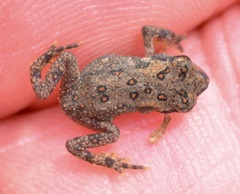
American toad
Anaxyrus americanus
Pet trade

Asian common toad
Duttaphrynus melanostictus
Pet trade
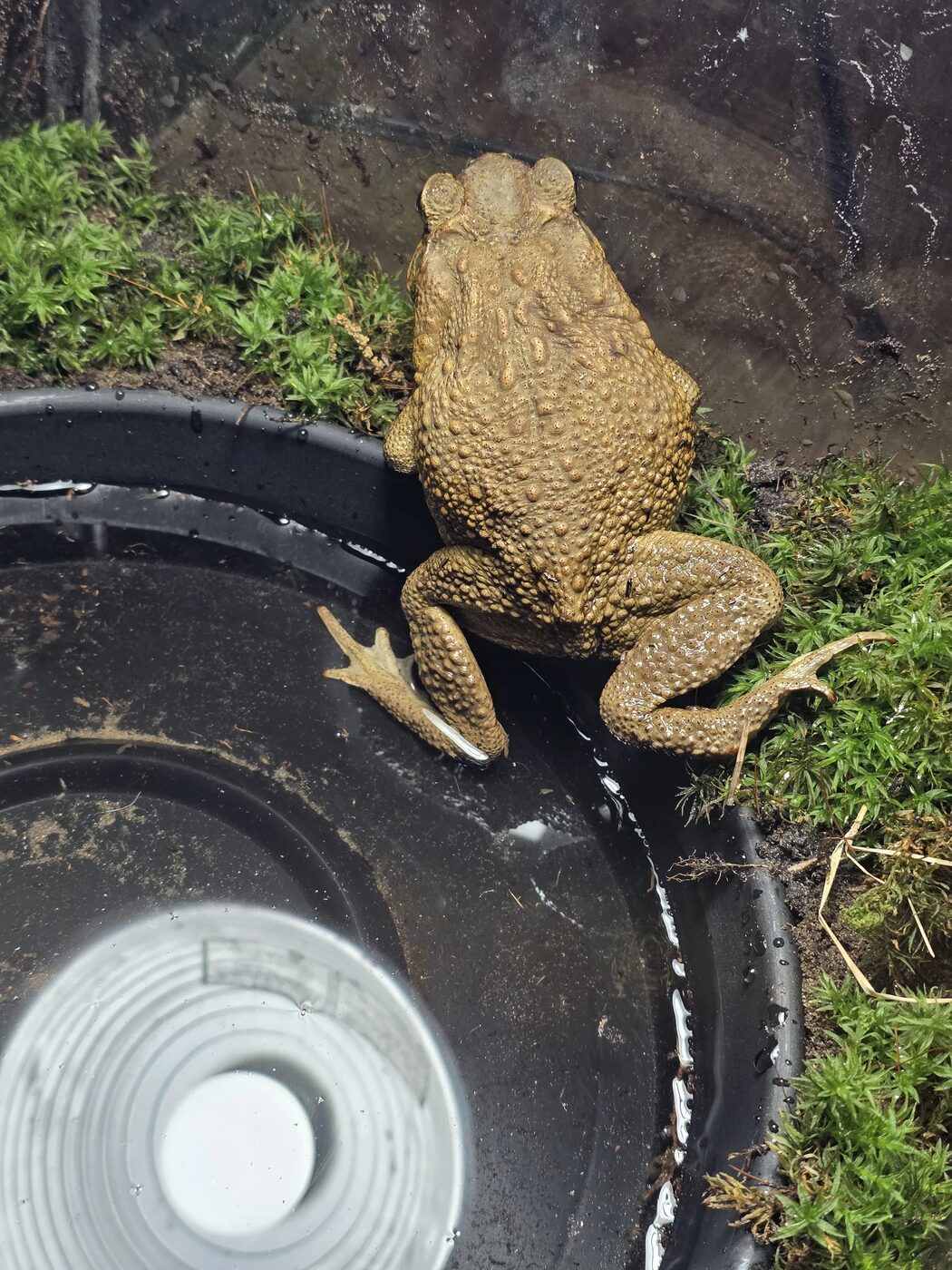
Cane toad
Rhinella marina
Pet trade

Colorado river toad
Incilius alvarius
Pet trade

Common European toad
Bufo bufo
Pet trade

Cuban toad
Peltophryne peltocephala
Zoos & aquariums