
Home / Reptiles / Crocodilians / Spectacled caiman
Some federal rules applySpectacled caiman
Caiman crocodilus
Reptiles › Crocodilians (Crocodylia) › Alligatoridae (Alligators and caimans)
The spectacled caiman (Caiman crocodilus), also known as the white caiman, common caiman, and speckled caiman, is a crocodilian in the family Alligatoridae.

Care at a glance
Species-specific values
Values researched for this exact species. Air, surface and water temperatures are listed separately, and each source is kept as published rather than averaged.
| Minimum enclosure | Enclosure must be at least 8 ft long, 8 ft wide and 4 ft tall. Source: petswithscales.com | |
| Basking surface temperature | 80–90 °F Source: petswithscales.com | |
| Warm side air temperature | 75–80 °F Source: petswithscales.com | |
| Humidity | 60–80 % Source: petswithscales.com | |
| Uvb lighting | Use UVB light so the caiman gets enough vitamin D. Source: petswithscales.com | |
| Diet | Adults eat varied prey including fish, rodents, and poultry. Source: petswithscales.com |
Understanding the animal
About this animal
About this animal
It is brownish-, greenish-, or yellowish-gray colored and has a spectacle-like ridge between its eyes, which is where its common name come from. It grows to a length of 1.4–2.5 m (4 ft 7 in – 8 ft 2 in) and a weight of 7–40 kg (15–88 lb), with males being both longer and heavier than females.
From Wikipedia: Spectacled caiman, CC BY-SA 4.0 (excerpt)
In the wild
In the wild
Researched for this exact species, not its family. Wild conditions are context, not enclosure settings.1
| Where it lives | Native to Central America and northern South America, it inhabits rivers, ponds and wetlands, usually with slow water. Shorelines provide basking sites and vegetation for mound nests. |
| Ground it lives on | Wetland banks and shoreline earth, with leaf litter and vegetation for nesting. |
| Climate | Tropical wet and dry seasons change water levels; drought can concentrate animals in remaining pools. Numerical wild temperature and humidity ranges were not found. |
| Active | Mainly nocturnal and crepuscular hunting, with daytime basking. |
| Social life | Often individually spaced within loose aggregations; size-based dominance and breeding territoriality occur, and females guard young. |
| Wild diet | Insects, snails, shrimp, crabs and fish, with larger animals also taking reptiles, birds and mammals; cannibalism can occur. |
| Behavior to plan for | It waits submerged for prey and reacts rapidly despite long inactive periods. Adults defend nesting areas, and crowded mixed-size groups can suffer cannibalism. |
Native climate (measured)
Native climate (measured)
| Warm-season highs | about 89°F (up to 91°F in the hottest sampled areas) |
| Cool-season lows | about 70°F (down to 67°F in the coldest sampled areas) |
| Average temperature | 77–81°F across sampled records |
| Relative humidity | 81–85% on average (driest month about 79%) |
| Rainfall | about 2812 mm a year |
Measured at 108 wild occurrence records sampled against WorldClim 2.1 climate data (1970–2000 averages). Air conditions in the range are ecological context, not enclosure settings: microhabitats such as burrows, leaf litter or basking rocks can be cooler, warmer or more humid.
Data and studies
The numbers
The numbers
Each bar is what one source reports. Where several sources weigh in, the dashed gold band marks their average.
Maximum recorded lifespan
Longest recorded lifespan reported by each database; typical lifespans are usually shorter. The AnAge record comes from an animal in human care.
Typical adult weight
Average adult body mass in each database (FishBase gives the maximum recorded weight).
Incubation
Female maturity
Veterinary & husbandry research
Veterinary & husbandry research
- Hepatozoon caimani in Caiman crocodilus yacare (Crocodylia, Alligatoridae) from North Pantanal, Brazil Bouer A et al., Revista brasileira de parasitologia veterinaria = Brazilian journal of veterinary parasitology: Orgao Oficial do Colegio Brasileiro de Parasitologia Veterinaria 2017
- Economic aspects of production of Caiman crocodilus yacare Carreira LB et al., Anais da Academia Brasileira de Ciencias 2015
- Kinematic and head morphometric characterisation of spermatozoa from the Brown Caiman (Caiman crocodilus fuscus) Valverde A et al., Animal reproduction science 2019
- Fatty acid profiles in meat from Caiman yacare (Caiman crocodilus yacare) raised in the wild or in captivity Vicente-Neto J et al., Meat science 2010
Peer-reviewed papers that mention this species alongside captivity, zoos, veterinary care or aquaculture. Some cover several species or mention it only in passing, so check the abstract. See all 9 on PubMed → PubMed
Sources for this sheet
- AnAge: The Animal Ageing and Longevity Database (Human Ageing Genomic Resources) (CC BY 3.0) Peer-reviewed researchCurated, referenced longevity and life-history records for thousands of species; maximum lifespans are often from zoo animals.
- Myhrvold et al. (2015). An amniote life-history database. Ecology 96: 3109 Peer-reviewed researchPeer-reviewed compilation of life-history data for over 21,000 birds, mammals and reptiles.
- 50 CFR 17.11: Endangered and threatened wildlife Zoo, university or veterinaryCurrent federal Endangered Species Act list.
- Species+ (UNEP-WCMC and the CITES Secretariat) Zoo, university or veterinaryThe official database of species listed under CITES. UNEP (2026). The Species+ Website. Nairobi, Kenya. Compiled by UNEP-WCMC, Cambridge, UK. Available at: www.speciesplus.net. [Accessed 04/10/2026].
- USFWS International Affairs: CITES Zoo, university or veterinaryFederal agency that issues CITES permits.
- The Reptile Database Peer-reviewed researchScientist-curated catalog of every reptile species, with taxonomy and literature.
- GBIF Backbone Taxonomy (Global Biodiversity Information Facility) (CC BY 4.0) Peer-reviewed researchInternational scientific taxonomy used here for classification. GBIF Secretariat (2023). GBIF Backbone Taxonomy. Checklist dataset https://doi.org/10.15468/39omei, accessed via GBIF.org.
- Wikipedia (species article) (CC BY-SA 4.0) Community referenceFree encyclopedia; useful overviews with their own citations. Short excerpts are quoted under CC BY-SA 4.0, each credited with a link to its article.
- PubMed (U.S. National Library of Medicine) Peer-reviewed researchIndex of peer-reviewed veterinary, zoo and husbandry research.
- iNaturalist (captive observations) Community referenceCommunity observation platform run by the California Academy of Sciences and National Geographic; observations marked captive show animals living in homes, zoos and aquariums.
More alligators and caimans
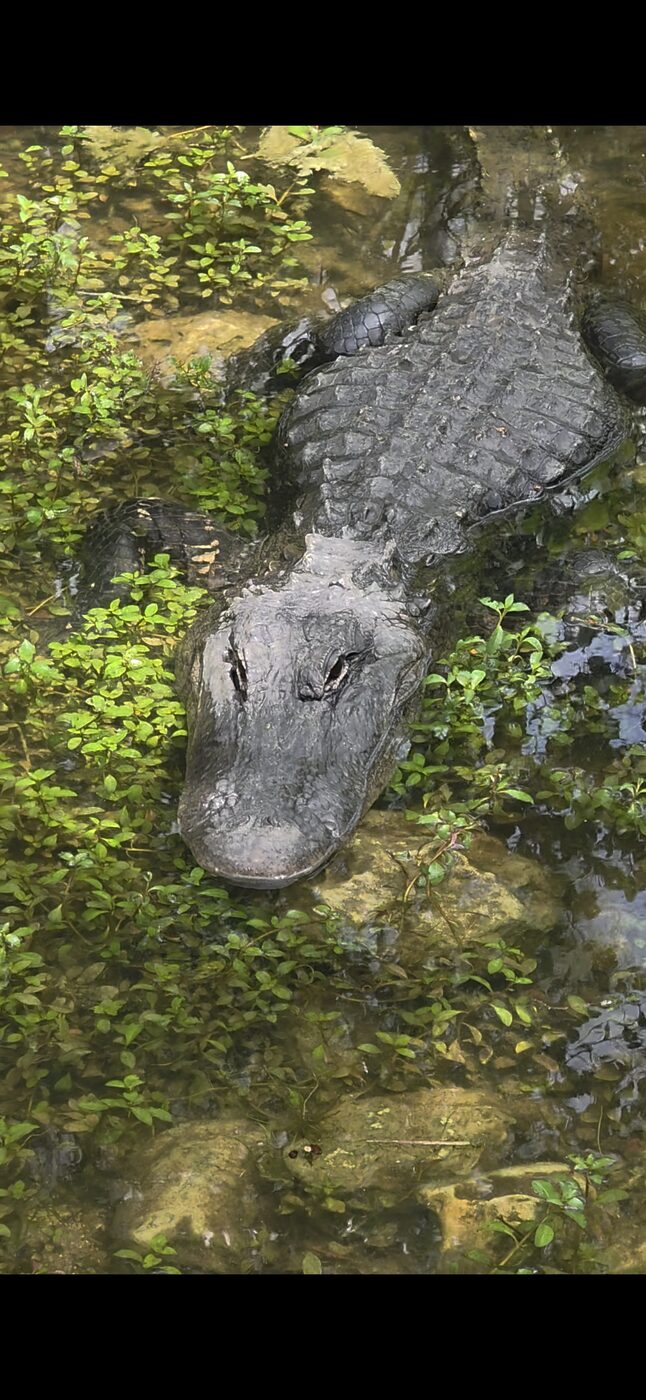
American alligator
Alligator mississippiensis
A 50-year, 10-foot commitment.
Zoos & aquariums

Black caiman
Melanosuchus niger
Zoos & aquariums

Broad-snouted caiman
Caiman latirostris
Zoos & aquariums

Chinese alligator
Alligator sinensis
Zoos & aquariums

Cuvier's dwarf caiman
Paleosuchus palpebrosus
Pet trade

Smooth-fronted caiman
Paleosuchus trigonatus
Zoos & aquariums